Showing posts with label Maryland. Show all posts

Friday, September 20, 2013

Remembering POWs — Civil War prisons, part 3

Today is POW/MIA Recognition Day. The last post mentioned Kathy Reichs and her work with the Joint Prisoners of War, Missing in Action Accounting Command. JPAC continues to look for and identify missing Americans, "Until They Are Home."

DOPL members
During a visit to Point Lookout, Maryland last summer, I realized for the first time that I'm the descendant of a POW. My great-great grandfather Thomas Maness was captured and incarcerated at Camp Hoffman, better known as Point Lookout Prison Camp.

The Descendants of Point Lookout POW Organization (DOPL) held a service at their Confederate Memorial Park. Curious, I drove down again on Saturday to attend.

A lively round of "Dixie"


I enjoyed the people in period costume, the cannon salute, and the small camp set up outside the memorial.

I did not enjoy the guest speaker, who hailed from my own state. His railing and inaccuracies were upsetting; his is that rare voice that has made southern history so unpopular.

With polite applause, the other attendees (many of whom probably work at the nearby military base and realize the Civil War is over) seemed to be sincere history buffs who want to pay respects to their ancestors. I gave Thomas's name to one man, Steve, who promised to look him up.


Pt. Lookout prison camp descendants

I was pleased to get an e-mail from him the next morning, with images of Thomas S. Maness' records.

Thomas deserted to the Union side, which didn't surprise me. He was kept a prisoner for nearly a year, despite his apparent willingness to take the oath of allegiance.

I was surprised to learn that he was only at Point Lookout a short time, about a month.


Camp kitchen


Under severely overcrowded conditions at Point Lookout, Thomas was among a large group of prisoners transferred to another prison camp in July 1864 — Elmira, N.Y.


Next: Journey to Elmira


Saturday, August 31, 2013

Point Lookout cemeteries — Civil War prisons, part 2


Around 4,000 Confederate soldiers (4,500 total including one nurse) died at Point Lookout prison camp during its two years of operation.

The dead were originally buried in five cemeteries: one for Union soldiers on the Potomac River side, two for Confederates in the middle, the "Collored Burying Ground" just above the peninsula, and another one in the middle for  smallpox victims of all races and politics.

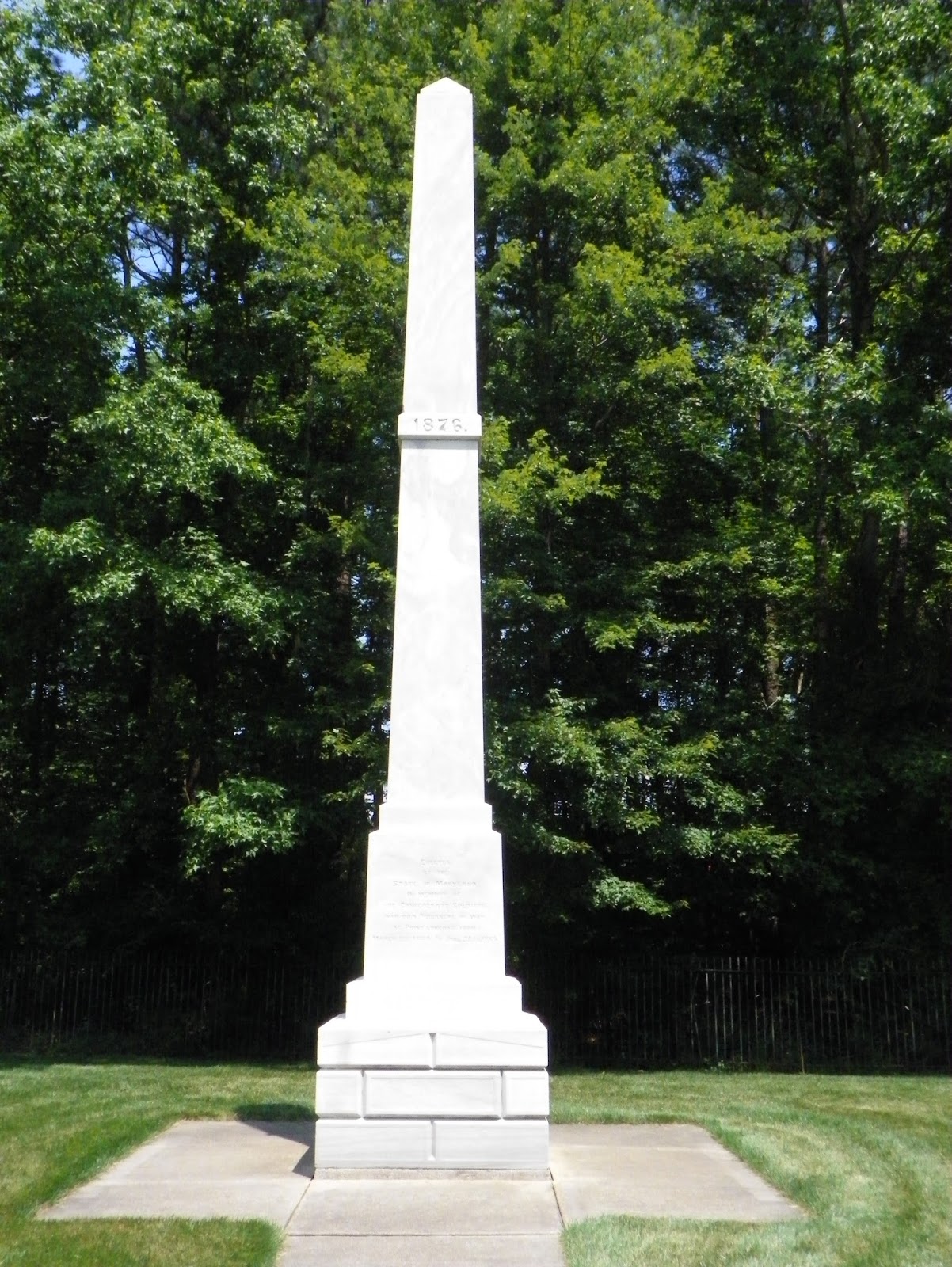
Maryland's Confederate memorial
A year after the Civil War ended, the U.S. Government gave up the lease to the point and tried to straighten up the neglected cemeteries. Some of the Union names had been lost to sand and erosion. The unknown were reburied with the known in their own enclosure, and later moved to a national cemetery (Arlington, I believe, but can't find the source).

The other four graveyards were consolidated on the Chesapeake Bay shore. The government bought that plot of land in 1867. The Confederate dead were moved two more times, along with a marble monument erected by the state of Maryland, eventually winding up in a mass grave in the nearby town of Scotland.

At least the government marked the grave, now on federal property, with an impressive monument and the earliest known names (NPS website).

Beitzell's book adds many names from other records. A simple wooden enclosure at the cemetery houses a binder with an updated list (look near the base of the flag).

Only tiny contraband flags to honor the dead
Because I grew up in our modern United States, I didn't notice at first that Confederate soldiers are buried under the flag of the "enemy." The War was doubly awful because people on both sides were Americans. What more appropriate place for a Confederate flag (or even both flags) than over those who died under it?

But a group of POW descendants noticed, and figured out a way to honor the dead.

The Descendants of Point Lookout POW Organization bought a piece of land right at the entrance to Point Lookout and built a Confederate Memorial. On private property.


Please excuse the plexiglass glare.
Beneath each of the original southern state flags is a plaque with a diary or letter excerpt from one of that state's POWs. Memorial bricks pave the ground, and the base of the statue houses an original "bean pot" from the prison camp.

I walked around and read some of the signs. As I read, fascinated by history about black soldiers and especially photos, I noticed a flyer next to the photos on the announcement board. The DOPL organization had scheduled a memorial service on Saturday. I would still be in town.

Thomas Maness didn't die at Point Lookout, but for the first time in my life, I realized I was the descendant of a POW.

Next (Sept. 20), part 3: A modern memorial

Monday, August 26, 2013

Point Lookout — Civil War prisons, part 1

I've seen Point Lookout many times as a beach, a lighthouse, and the end of the road on the Southern Maryland peninsula. This time, I saw it through Civil War history.* Why? Last year, DNA confirmed that Thomas Swain Maness really was my great-great-grandfather. While visiting friends in Maryland, I remembered that Thomas was a prisoner of war at Point Lookout.

After the Battle of Gettysburg in 1863, thousands of prisoners were marched or shipped to makeshift prisons that quickly overfilled. At Point Lookout — officially Camp Hoffman — the prisoners were crowded into tents on the beach, surrounded by a wooden palisade (upper right in the picture).

Courtesy of Library of Congress


Local history books paint Point Lookout as a concentration camp, with suspected motives of killing off the enemy. The tents were never replaced by buildings in the camp's two years of operation. Prisoners slept in outdoor temperatures with little firewood and inadequate clothing (some with only their underwear, some with no shoes). The beachfront water was bad and the camp's commander was accused of withholding rations. He refuted this, of course, and northern papers reported healthy conditions. Different sources agree that of more than 50,000 prisoners, around 4,000 died.

Hammond General Hospital dominated the tip of the peninsula. When a smallpox epidemic raged through the camp, a second hospital was built just for smallpox victims, doctors, and nurses from the Sisters of Charity. 

Oral history claims that Thomas Maness "was a nice boy before the War," but came back to North Carolina with a mean streak. Could Thomas' prison experience have contributed to that change as much or more so as the horrors of the battlefield? I wanted to know more. I stopped at all the historical markers on the peninsula, including the reconstructed Fort Lincoln. I visited the museum, which sells reprints of Point Lookout Prison Camp for Confederates, a reference book I'd glanced at in the Leonardtown Library. I couldn't find Thomas in the index, but this wonderful reference is an anthology of contemporary sources. Diaries, letters, newspaper articles, prisoner art, maps and a few photos. Daily life in the camp, written by those who lived it. I didn't have Thomas' timeline with me, but the detailed diaries could tell me what the weather was like while he was there. 

One thing I learned from skimming the book is that Maryland, with southern sentiments, wasn't allowed to secede. The federal government couldn't afford to let the state that nearly surrounds Washington, D.C. to join the enemy, so they blocked the polling sites and threw political opponents in jail.

After reporting for several issues in 1861 on large meetings of citizens to "consider the current crisis" and signs of military presence (extracts in the book mentioned above), the St. Mary's Beacon published a letter from General Dix in November stating that anybody who "appear[ed] at the polls to effect their criminal attempt to convert the elective franchise into an engine for the subversion of the Government" would be taken into custody. In other words, you can vote, but only one way.

The Beacon continued to report on the military occupation of St. Mary's County, until about April 1862 when Federal forces arrested one of the editors and the other escaped across the river to Virginia. The following October, the St. Mary's Gazette appeared, ascribing to be "a news and advertising sheet" and to avoid politics, until "the Federal Government shall deem it no longer necessary to pursue so extraordinary a policy as to impose restrictions upon the press...."

Next, Part 2: Burying prisoners of war

* This very un-Civil War has many names among Americans, including the War Between the States, the War of Northern Aggression, and the War of the Rebellion. I've used the term here that's easily recognizable, less partisan, and optimal for search engines.

Monday, March 14, 2011

Book finds in Maryland

Two weeks ago I drove up to Maryland for the weekend to see friends, and this time, to do a little bookhunting.

Friday night, I went with my friend Suzy to listen to live music and indulge in tasty Southern Maryland crab balls.

Saturday morning, I drove down 235 to an antique store in Lexington Park, The Grapevine. I fell in love with this little antique corner chair and bought it for the bookshop. I picked up a few books, too.

After lunch with another friend, I went a used book store in the old part of Leonardtown. As I wandered through aisles and around corners in Fenwick's, I kept thinking there was only one more room, but then there would be a doorway and another room. I like bookstores like that.

Fenwick St. Used Books

They have a whole bookshelf of Star Trek.   :-)

I introduced myself to the owner, Joe, as a new bookseller and he was very kind. He runs the "Old book store" e-mail list for brick-and-mortar booksellers. He answered my questions and mentioned websites and names that have recently become familiar, from the bibliophile list or in my bookselling research.

As we were talking, I noticed the high, ebony, mirrored bar behind the counter. Joe told me that his place had been a bar for many years! He had covered the tile floor with carpet and had shelves built. The small room in the back, the fantasy and sci-fi room, had once been the ladies' room.

After that pleasant visit, I stopped by Staples and picked up a shelf that had been out of stock back home. Then I went to a "new books" store in California, Md. that's going out of business. Bay Books has been an independent shop here for 23 years. 'Hard to believe, since I remember when they first opened!

I wasn't sure I wanted to buy new books, because now I can get a discount from distributors and also because I'm not sure if they're still new books after you buy them from a store. But when I saw that Bay Books was already offering 50% off, I decided to risk buying some.

I had just about decided that I wasn't going to introduce myself, when I saw a sign indicating that the shelves were for sale. I just had to ask about them, and the clerk quickly introduced me to the owner. The shelves were reasonable — not super cheap, but a good value — but I told the owner I just didn't have a way to transport them to N.C. He took my name and number and wished me luck.

The owner of Bay Books had previously offered the store — shelves, inventory, everything — for sale at a very reasonable price, but with no takers they proceeded to liquidation, just like the Borders back home.

I spent the rest of the weekend with friends, food, my former church, more friends and more food. By Monday's departure, the car was filled with books and furniture for the new bookshop.