Showing posts with label Quakers. Show all posts

Wednesday, July 12, 2017

Mendenhall Village Fair 2016

In just a few more days, the annual Village Fair will return to Mendenhall Homeplace in Jamestown, N.C.

Tannery Books will have a pop-up shop on the porch of the Dr. Madison Lindsay house. The century-old home (built by 1817) also served as a medical school.


The Village Fair will be Saturday, July 15, from 10 am to 4 pm. Admission is free, including self-tours of the historical buildings.

A carriage sits outside the Pennsylvania-style barn at the 2016 Village Fair. Inside the barn is one of two false-bottom wagons in the country that were used to smuggle slaves along the Underground Railroad.


A blacksmith from High Point Museum plies his trade in the shady yard.


The doctor is IN.

Costumed interpreters provide a sense of life here in the 19th century.


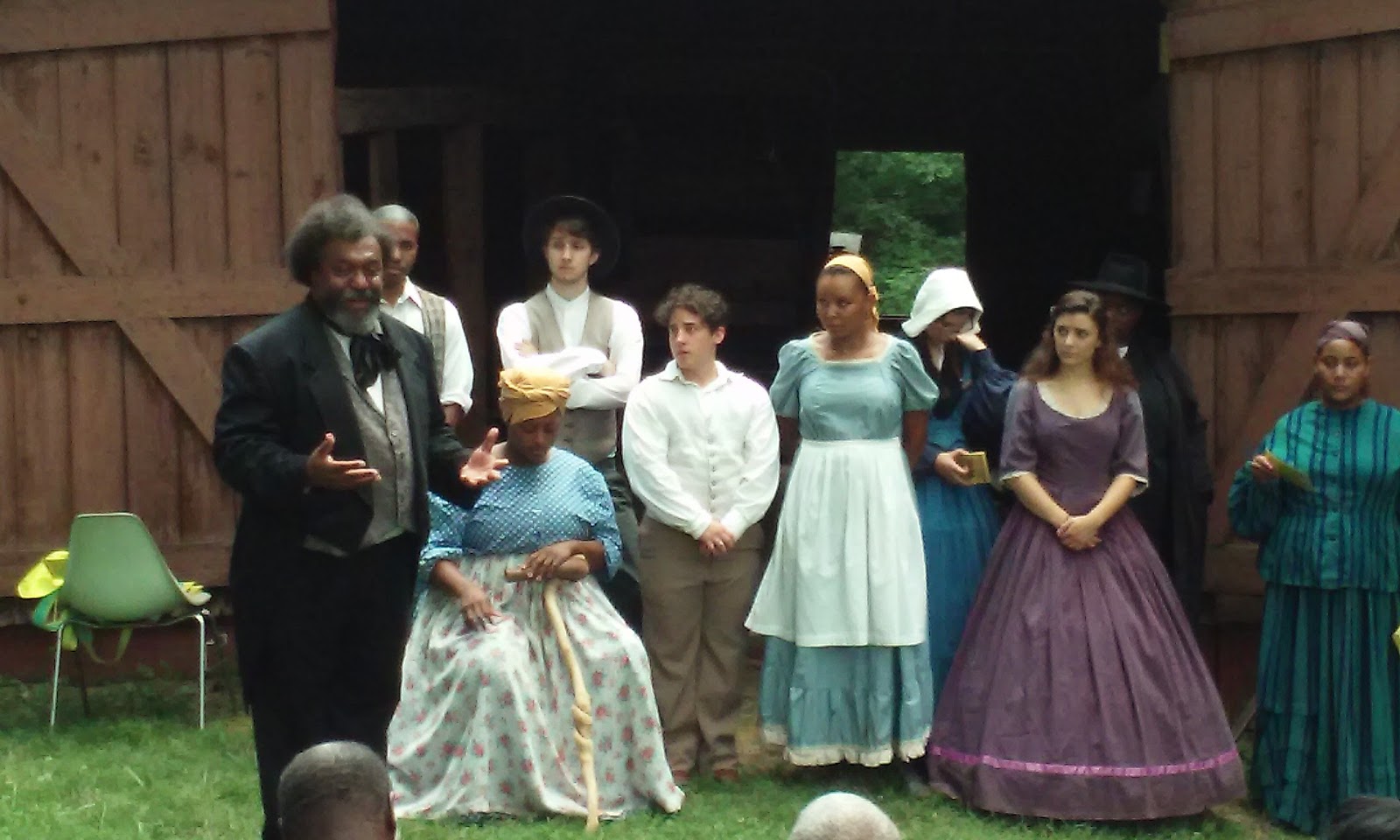
The cast of 'Pathway to Freedom' sings soulful selections from the outdoor drama at 3 pm.


If you're in the central part of the state, Moore County Genealogical Society will have a day of seminars starting at 9 a.m. Saturday, July 15. Topics include researching around burned courthouses and lost records, DNA, and the North Carolina Archives.

Monday, March 27, 2017

QUIP 2017 - a writing retreat in South Carolina


I went to the Quakers Uniting in Publications annual conference this month at Penn Center on St. Helena Island, South Carolina, a place draped in Spanish moss and historical buildings. It's the site of an early school for freed slaves, started early in the American Civil War.


We stayed in Benezet House, a century-old dorm that housed female students and teachers and hosted classes and co-ed chapel services.


It was nice staying together in one building, grabbing coffee or tea in the morning or settling into couches with our laptops in the shared living room.


QUIP planned more down-time, this year, between guest speakers and business sessions, so there was a little time to walk down to the water and around the historical buildings, or to think and write.


Last year's storms had closed the public (ocean) beach. After a tumble that left me bruised and a little wobbly, I kept my explorations to the inside of the old house.


I'd noticed chimneys and cupola vents from the outside and wondered if the attic might be accessible. There were, indeed, easy stairs up, but the access was partially covered by a large, precarious piece of scrap wood. I peeked through the opening and decided not to try to wrestle the covering.


Most of the attic was filled with modern HVAC ductwork and blown-in insulation. One curious thing was a small wooden room, built up to the roof. What was it used for - storage? Was it used to hide something?


Covered circles in the chimneys and the wide hallway upstairs indicated that wood stoves were used for heat. A beautiful, built-in armoire in the hallway must have been shared. We looked into the room behind it and discovered the space inside is now used for closets, but the facade of doors and drawers has been preserved!


The small museum across the street was loaded with information about the school and the Gullah people who lived on the islands (no photography allowed).


You can read more about Penn Center in Penn Center: A History Preserved.


Here are posts about QUIP 2012, 2011 (and here),

Sunday, November 01, 2015

Rough Rock Friends Meeting

I like to visit other Friends (Quaker) meetings when I'm traveling. Rough Rock is off the beaten track in the Navajo Nation in Arizona, not far from Chinle and Many Waters. They meet for worship on Sundays. That is, if somebody goes to get the pastor, because she has the key. Somebody with four-wheel drive, because it rained and the dirt roads are rutted. On October 18, that somebody was me. Hey, it's one way to meet Friends!


Friday, June 27, 2014

History Geekery — Camden Archeaology

For several months, now, I've been working on a book about the Quakers in colonial Camden, S.C. I've found a wealth of primary sources, especially from traveling Quaker ministers who mentioned their visits to Camden in their "journals," that is, published religious memoirs.

An intriguing title came up in an online search. I took a risk and ordered the book. This just arrived in the mail: Camden: Historical Archaeology in the South Carolina Backcountry by Kenneth Lewis.

I wasn't disappointed.

Although not exactly a primary source, the text contains details about colonial Camden: street layout; actual house (and jail and brewery) foundations; typical homes; and dishes and other items found in the ground.


There are even sketches of what the town may have looked like just before and during the American Revolution.

Too bad Joseph Kershaw wasn't a Quaker. I'm about to learn a whole lot about his house!

Friday, October 25, 2013

Murder in Jamestown


A "Brutal Murder" in a quiet Quaker town. Examination of the body, multiple weapons used. Boot imprints taken at the scene. A search of the suspect's clothes for blood. A trial. A verdict — an appeal and another trial.

The year, 1856.

One of our interns at the archives was processing a collection of old letters. She couldn't resist reading a few, and one day she exclaimed out loud how interesting they were. Corresponding sisters mentioned a horrible murder and ongoing news of the trial, then turned abruptly to family matters. Judy threw up her hands. So, then what? Did they catch the murderer?

My coworker Liz asked, "Who was the victim?"

Judy scanned the letter she held in gloved hands. "Martha Pinix."

Liz turned to the internet to see if they could find out what happened. They were delighted to find a book: The Murder of Martha Pinix, A True Tale of Old Jamestown and Deep River. Then Liz laughed. The author was Mary Browning. "I should have known!" If anything had ever happened in Jamestown (North Carolina), historian and author Mary Browning would know about it. And she happened to be our docent that day.

Liz introduced an incredulous Judy to an unassuming little white-haired lady sitting in the next room — the lady who literally wrote the book on murder. This one, at least.

Despite her long list of publications, Mary doesn't currently have a website. Her latest book is here and you can read some of her newspaper articles here.

Each one of us devoured Mary's book. At around 30 pages, it didn't take long. But the well researched story — from 19th-century news articles, court records and early 20th-century recollections — reads like a novel, including a death-row escape and a major plot twist. (That's all I can say, no spoilers!) You can get your own copy here to read the details and decide the verdict.


Wednesday, September 04, 2013

The Underground Railroad and WDYTYA

As I continue revising my novel set in 17th-century Ireland, the (American) Civil War keeps popping up everywhere. I started blogging a series about Civil War prisons (told from a southern perspective) after the 150th anniversary of the Battle of Gettysburg and because of some opportune genealogical research on my ancestor, Thomas Maness. Then singer Kelly Clarkson visited the grisly (and more famous) southern prison Andersonville in a July 24 episode of Who Do You Think You Are (told from a northern perspective).

Singers from Snow Camp Outdoor Theatre's drama about the Underground Railroad, Pathway to Freedom, highlighted the annual Mendenhall Plantation Village Fair. Then the August 13 episode of WDYTYA featured an exciting story about runaway slaves, the Quakers who helped them (including actress Zooey Deschanel's ancestors), and a pre-Civil-War battle in Pennsylvania. Guilford College's own chaplain and professor Max Carter had a hand in the narrative. Behind the scenes, yours truly had a hand in the research.

Yes, I was a freelance genealogist last spring for the popular show! Apparently they contract research for the various family lines of each episode's star, then choose the lineage with the most interesting story to highlight in the show. Although my research stopped at the editing table, I really like the story they chose. Let me put it this way — I learned something new about Quaker history. If you get a chance, watch it. The episode is no longer streaming on TLC's website, but previews are still running here.

Just days after I watched that show, Max gave a talk to the Springfield Friends Memorial Association about a Reconstruction project — the Model Farm — in which Quakers from the North came to Guilford County to help Quakers in North Carolina (a future post). That night, I watched the movie Lincoln. Different perspectives and pieces of Civil War history are quilting together in my brain.

Speaking of local Quaker history, the Bush Hill Heritage Festival takes over our little town next week. Tannery Books will help celebrate our heritage by offering Quaker history books at our booth during the street festival. One of the books is Jennifer Hudson Taylor's latest Quaker novel, Path of Freedom. Jennifer, who visited the bookshop last year, begins this Underground Railroad adventure with loads of local surnames and Guilford County settings.

Wednesday, August 14, 2013

Wordless Wednesday — Antebellum Beauty


A cast member of Snow Camp's Pathway to Freedom poses in front of the Mendenhall Plantation house at the 2013 Village Fair.

Monday, August 12, 2013

Mendenhall Plantation Village Fair 2013


The old Mendenhall store, across the street from the house


I carted Quaker books over to Mendenhall Plantation again this year for their 11th annual Village Fair. The usual summer storm held off until evening, giving us vendors and performers great weather — cloudy with an occasional breeze.


We jumped at occasional musket booms, as a family of Revolutionary re-enactors roamed the plantation this year.


North Carolina's outdoor dramas, featuring performances about our state's history, are wonderful. So far, I've only seen The Lost Colony on Roanoke Island and The Sword of Peace at Snow Camp.

The players from Snow Camp's drama about the Underground Railroad, Pathway to Freedom, once again paid a visit to the Village Fair to share their talents. Let me tell you, these folks can sing!


Jam session on the drums


Here are photos from the Village Fair in 2012 and 2010.

Monday, July 22, 2013

FOURTEEN ARRESTED FOR RELIGIOUS MEETING

(Mullingar, 1662). Fourteen residents of Moate-Granoge and surrounding areas were arrested Sunday as local law enforcement continues to enforce the Act of Assembly, which prohibits any gatherings not sanctioned by appointed officials and the Anglican Church.
       "We don't want to have another uprising like in '41," said Walter Lambert, justice of the peace. "These meetings might look innocent, but they're all about disobeying the law. We've got to nip that in the bud."
       The alleged criminals all hail from the same radical religious group. They call themselves "the people of God," but are more commonly known by their nickname, "Quakers."
       Lambert would not allow any press inside the Mullingar jail. A spokesman for the prisoners answered questions from the Westmeath News on condition of anonymity.
       "Walter Lambert and other officials are breaking the law, not following it," he attested. "This is only the latest event in a long line of harassment."
       According to the spokesman, three members of their society were imprisoned last year for six weeks, then released without ever having been charged with a crime. In a separate incident, John Wilson (a Quaker, but not currently in prison) was badly beaten for refusing to pay for prison food. The spokesman added that Henry Fuller (among the current prisoners) was physically attacked by Lambert himself for speaking to him about religious freedom.
       No one in Lambert's office would comment on the alleged assault.
       A court date has not been set. The Mullingar jailer said the prisoners will be transferred to Dublin prison for further disposition.

What if there had been newspapers in County Westmeath in the 17th century? I doubt they would have had neutral reporting. This was a little writing exercise for the chapter I'm currently editing. The "Act of Assembly" is probably the wrong term, but the rest of the story is based on facts as recorded in the Moate Meeting minutes and Sufferings.

Saturday, May 04, 2013

Bookhunting season 2013

The past few weeks have been a whirlwind of bookhunting, signings and getting ready for spring open house at the bookshop.

I traveled to the Chatham County Library for the first time in a year. This time I hit their bag-sale day and brought back four bags of books — a wide variety, from an unusual vintage photograph of the USS Barker to true crime to English castles. Then I headed south by memory and map, enjoying the beautiful spring day with trees and azaleas blooming. I fumbled around Fayetteville (who knew it was a big city?) looking for the Barnes & Noble, where a friend met me for lunch. After food and catching up we wandered around the bookstore, but I didn't find what I was looking for, especially since I wasn't sure what it was.

The next weekend local author Carolyn Nelson signed books at the shop. Worried about sharing my sore throat, I hid behind the counter most of the day. Fortunately, Carolyn had visitors and friends to keep her company.

I recuperated in time for the annual St. Francis book sale, one of my favourites . Since it was the first day of the sale, I focused on the old and rare book room (one of my earliest posts) and only bought a small box full of books, including H.G. Wells, Sir Arthur Conan Doyle (Sherlock Holmes) and Winslow Homer (black Americana from the Civil War and Reconstruction).

I'd planned to go back Saturday for bag-sale day, to stock the shop with "beach reads" from their wealth of trade paperbacks. Friday night, however, the phone rang. It was the Quaker network — which is a wonderful thing. Jamestown Friends Meeting was having a yard sale early the next morning. Now, I'm not a fan of yard sales, and I'm not a fan of early. But a mutual friend was downsizing, and she might have donated her books to the sale.

So the next morning, bright and early (more early than bright!), I switched destinations from Greensboro to Jamestown (both cities named for Quakers, by the way). I found books and more books, got hugs, bought coffee, and was southern sweet-talked into a freshly baked pecan tart. It turned out to be a most pleasant trip.

This week, after final preparations for the spring sale and open house at the bookshop, I drove down to Asheboro to ask Jeffery Deaver to sign a few books. He spoke about his writing life at the Friends of the Library annual meeting.

He started writing at age 11, but went on to other careers, including law. He began writing during his long daily commute, but threw his first two books away!

Stories like that inspire me to keep writing. Have you heard stories from published authors that keep you going?

I met Jeffery Deaver at Writers' Police Academy 2010, when he'd just started the new James Bond novel, Carte Blanche. Now that it's out, I wanted him to sign my copy. He also signed a couple of his previous works for the bookshop.

Friday, January 11, 2013

South Carolina history and beaver hats

At work the other day (Friends Historical Collection), I pulled older books for possible scanning for Ancestry.com. I was excited to see that Ancestry already has The Annals of Newberry (two volumes) by John Belton O'Neall and John A. Chapman— a nice, clean copy that you can print by single pages. If you don't have access, you can download this messier copy from Google books. The download is easier to print multiple pages, but image only (no word searching). You can search for words by staying online on the Google page. Click on the book cover image to open the reader (NOT the eBook); a search box will be on the left.

Ancestry also has both volumes of Historic Camden, by Thomas Kirkland and Robert Kennedy (note: there are genealogical errors in Kirkland and Kennedy, especially in regard to the English family). Here's the Google version.

I like the Annals for the nitty-gritty details, humour and generous genealogical name-dropping, especially for Bush River Meeting. O'Neall, born in 1793 to an Quaker family of Irish descent, heard first-hand accounts of Revolutionary South Carolina and witnessed the 19th-century events himself.

After a listing settlers in the Bush River area for half a page, O'Neall describes an imagined meeting for worship, probably based on family recollections:

... I can see the aged form of the elder David Jenkins, sitting immediately below the preacher's bench, on the left of the southern entrance to the men's meeting, leaning on the head of his staff, his large protruding lower lip, the most remarkable feature of his face. Alongside of him might be seen the tall form and grey hairs of Tanner Thomson, as he used to be called. Scarcely could the sacred stillness of Friends' meeting keep him from snapping his thumb and finger together, as if feeling a side of leather. Just here I recall the person of Isaac Hollingsworth. His was a stalwart form, more than six feet high. He sits the picture of firmness, and ever and anon, throwing up the ample brim of his flapping beaver, he looks as if he was restless....
A little further to the right or lower down, might be seen the pale features of that excellent man, Joseph Furnas! Near to him was to be seen the tall, erect form, florid complexion, clear, blue eye, ample forehead, and grey hair of John Kelly, Sr.; just alongside of him might be seen Isaac Kirk. Friend Kirk, as he used to be called, was a true Quaker. He was plain and simple as a child, kind and forbearing in every thing. No better heart was covered by a straight-breasted coat. He had his peculiarities: one, that in reading, he read as if he was singing the passages—another, that when talking to any one his foot had always to be in motion. ...
In the women's meeting, on the preacher's bench, under their immense white beavers, I recall the full round faces and forms of the sisters, Charity Cook and Susannah Hollingsworth. Both wives, both mothers of large families, still they felt it their duty to preach "Jesus and him crucified." The first, Charity Cook, was indeed a gifted woman. She traveled through the States extensively. Twice visited England and Ireland. When her husband drove his stage wagon into Rabun's creek, at a time when it was high, drowned two horses, and only escaped drowning himself by riding a chunk to land, she swam to the shore, and thus saved herself. Her sister, Susannah Hollingsworth, was not so highly gifted. Henry O'Neall, and other young Friends, used to affirm, that when Aunt Suzey, as she was called, began to pray, they could always keep ahead of her by repeating the words she was about to say.
Just below the preacher's bench, the once round and graceful form (afterwards bent by 82 winters) of Hannah Kelly, once Hannah Belton, a native of Queen's County, Ireland, might be seen. No more intelligent, kind, or benevolent face ever met the upturned gaze of her juniors. Well might it be said of her, that she was indeed "a mother in Israel." Her eye of blue, her long straight nose, high cheek bones, and clear Irish complexion, can scarcely ever be forgotten by those who saw her.
When I first read "their immense white beavers," I pictured the large, white bonnets of modern stereotypical Quaker illustrations. According to History of American Costume, 1607-1870, bonnet was a loose term from the French used for all kinds of hats, but actual bonnets didn't come about until later in the 18th century, including straw ones. (My Quaker great-grandmother wore a floral blue bonnet.)

Beavers were actually wide-brimmed hats, and women wore them over their caps — caps having been a staple for centuries. Notice in the first paragraph that men wore them, too.

This beaver hat is from the mid-18th century (American Costume, p. 167).

Speaking of Bush River, a group of descendants and people who care about the cemetery will have their annual Bush River Quaker Homecoming May 2-5 in Newberry, S.C. Their nascent website is here. (I noticed mistakes right away in the cemetery list, but they are building this site. The bibliography looks interesting.)

Friday, December 21, 2012

Two Yearly Meetings in partnership

Sometimes you've just got to hang a sign in the shop window, pack your bags, and get out of the country.

Seriously, I went on a short trip to Mexico on church business early last week. North Carolina Yearly Meeting (Quakers) hadn't sent anybody to visit our meeting in Mexico since 2010 (2009 for me) because of the dangers of traveling in that country.
We've missed our brothers and sisters in Christ. With Pastor Jorge leaving after nearly 30 years of service, and our decision to turn over administration of the meeting to Mexico Yearly Meeting, we couldn't stand it any longer. We simply had to go.

After a hearty Mexican breakfast, we visited with a couple of families that I knew from past mission trips, then went to Sunday worship.


The swing in the churchyard now gets lots of use before and after services!


The family sitting in front of me had a Bible for every age.


We gave Jorge a plaque of appreciation and he and his wife joined us for dinner.
Representatives from Mexico and North Carolina yearly meetings
The next day, we met with several pastors and their wives from Mexico Yearly Meeting. We had an awesome time of business and worship together. We returned home excited about the future, determined that our next visit won't be so long in coming.


Thursday, November 29, 2012

Portrait of Allen Jay

Near High Point, N.C., Allen Jay is an elementary school and a neighborhood. Thanks to a donated portrait, people can learn that both were named after a real person, a Quaker minister who started schools and helped save farming communities that had been devastated by the Civil War.

Here's the Archdale-Trinity News article, "Allen Jay is a person, not just an elementary school."

Here's my previous post about Allen Jay, including his autobiography and his house.

Wednesday, October 17, 2012

Wordless Wednesday — Quaker scrapbook

This is the 1947-48 scrapbook I found at a bookstore estate sale last weekend.

(Wordless - well, just a few words) The pages have come loose. A few items may be missing, or they may have been stuck in the back for safe-keeping.


Does anyone know Jane Hockett?


She went to school in Pleasant Garden. She could be a distant cousin, as I and the Hocketts are descended from colonial settler Phillip Hoggatt.


I can tell she was a natural layout person. 

Her activities read like a table of contents for the scrapbook: Girl Scouts, 4-H Club...


And here's what really got me interested...


Jane went to the 1947 Friends World Conference in Richmond, Indiana.

Friday, September 14, 2012

NCYM Biographies — Published!

Billy Britt debuted his latest book, Giants in the Land, at North Carolina Yearly Meeting.

The 17 biographies tell of NCYM leaders — the first one born in 1846 and the last one who passed in 2006. One of them, Isaac Harris, was pastor at my meeting for 30 years, a great influence when I was a little girl.

It's good to preserve these stories of dedicated Quaker servants. But it's the story of this book that excites me.

Billy Britt signs a book for fellow author and Pub Board member Jack Ciancio.

We'd been working on it for several years ("we" being the author and the NCYM Publications Board). I don't know when Billy started his research. I helped edit the manuscript in 2009. About 2010, everything got put on hold when Billy had a heart attack.

Thankfully, he recovered, and we gradually got back to work. All the editors, proofreaders, and even the author are volunteers. (When you see the price of the book, you won't think so. But we're a small independent press and it has photos in it, hence the amount.)

Billy happily signed books and joked around before Saturday night's worship session at yearly meeting.

We all hope somebody writes a sequel with Billy in it. He knew many of the people in his book. And he was superintendent of NCYM for 20 years. Because he's served as interim pastor at several meetings since "retirement," it's a running joke that he's pastored everywhere and knows everybody. He has a mischievous sense of humor and a heart for connecting people with Christ.

Tuesday, September 04, 2012

North Carolina Yearly Meeting

I just got back from the 315th annual session of North Carolina Yearly Meeting, held in Black Mountain.

Lee Hall  "up the hill" where the Young Friends stay

We heard speakers and news about yearly meeting activities. (For non-Quakers, Yearly Meeting is our state-wide organization, as well as the actual meeting. A Monthly Meeting is the official term for each individual church, as well as its monthly business session.)

I was especially impressed by the many things Young Friends (high school) and Young Adults had done, from internships to mission trips.

Epistles were received from yearly meetings around the world, a centuries-old tradition, telling us a little about what's going on among other Quaker organizations. We recorded eight new ministers; I knew several of them and counted it a happy occasion! (Every Friend is considered a minister so we don't "ordain" pastors. But we "record" those who have acknowledged gifts and training in minstry, and some of them become pastors among programmed Friends.)

Sunday afternoon I took a break and hiked up to Lee Hall to sit in one of the rocking chairs on the great porch and soak up the mountain view.

 ('Looks like the same photo I took in 2010.)


Saturday, August 25, 2012

Allen Jay

Josh Brown, who edited the Autobiography of Allen Jay, spoke at Springfield Friends Meeting for their memorial association's annual meeting last weekend.

Josh is a pastor at West Richmond Friends Meeting in Richmond, Indiana, one of the meetings Allen Jay helped found. Before he spoke, Josh played on a dulcimer he made himself. That was followed by a short period of open worship (silence), then Josh read scripture from 1 John 1:1-9.

Allen Jay came to North Carolina to help Friends after the Civil War, help that encouraged them to stay in the area (where many of us are to this day) rather than leave all the schools, meetings, and generations of Quaker influence behind in the northward migration.

I didn't know that Allen was born with a cleft palate, which made talking difficult. Because he felt called as a minister, he worked on his speech and preached despite his discomfort and embarrassment — talk about perserverance!

Josh said, "His autobiography is almost a prayer journal."

Allen Jay was so respected, he helped smooth the way between young Friends who attended a revival at Trinity College and older Quakers who thought such things were unacceptable. Allen attended the revival to see what was going on, and greeted the young Friends there. After one meeting, a young lady who had been "saved" was afraid to go home. Allen went with her and told her father, "Thy child left home unsaved. She now returns a child of Christ, and in his name I ask thee to receive her." The girl wept, the family accepted her, and some of them "accepted the Saviour" as well. 

Allen Jay's house still stands across the street from Springfield Friends. It was a stop along the Underground Railroad, with a secret hiding place for escaping slaves.

The house is currently used by the Friends Emergency Material Assistance Program, where faithful volunteers pack emergency relief kits and sew for children around the world.

Kevin Harris mentions Allen's adventures in this post about the Underground Railroad:

Underground | Arbor Familiae
arborfamiliae.wordpress.com2/18/11
Allen and his parents helped many, many slaves escape in this way. My Jay ancestors who lived in Wayne County, Indiana probably did the same. In a talk about the Underground Railroad that I went to a few weeks ago, ...

Update: If you'd like to learn more about Allen Jay, you can order the book through the affliliate link above or here: Autobiography of Allen Jay.