Showing posts with label South Carolina. Show all posts

Monday, March 27, 2017

QUIP 2017 - a writing retreat in South Carolina


I went to the Quakers Uniting in Publications annual conference this month at Penn Center on St. Helena Island, South Carolina, a place draped in Spanish moss and historical buildings. It's the site of an early school for freed slaves, started early in the American Civil War.


We stayed in Benezet House, a century-old dorm that housed female students and teachers and hosted classes and co-ed chapel services.


It was nice staying together in one building, grabbing coffee or tea in the morning or settling into couches with our laptops in the shared living room.


QUIP planned more down-time, this year, between guest speakers and business sessions, so there was a little time to walk down to the water and around the historical buildings, or to think and write.


Last year's storms had closed the public (ocean) beach. After a tumble that left me bruised and a little wobbly, I kept my explorations to the inside of the old house.


I'd noticed chimneys and cupola vents from the outside and wondered if the attic might be accessible. There were, indeed, easy stairs up, but the access was partially covered by a large, precarious piece of scrap wood. I peeked through the opening and decided not to try to wrestle the covering.


Most of the attic was filled with modern HVAC ductwork and blown-in insulation. One curious thing was a small wooden room, built up to the roof. What was it used for - storage? Was it used to hide something?


Covered circles in the chimneys and the wide hallway upstairs indicated that wood stoves were used for heat. A beautiful, built-in armoire in the hallway must have been shared. We looked into the room behind it and discovered the space inside is now used for closets, but the facade of doors and drawers has been preserved!


The small museum across the street was loaded with information about the school and the Gullah people who lived on the islands (no photography allowed).


You can read more about Penn Center in Penn Center: A History Preserved.


Here are posts about QUIP 2012, 2011 (and here),

Friday, June 27, 2014

History Geekery — Camden Archeaology

For several months, now, I've been working on a book about the Quakers in colonial Camden, S.C. I've found a wealth of primary sources, especially from traveling Quaker ministers who mentioned their visits to Camden in their "journals," that is, published religious memoirs.

An intriguing title came up in an online search. I took a risk and ordered the book. This just arrived in the mail: Camden: Historical Archaeology in the South Carolina Backcountry by Kenneth Lewis.

I wasn't disappointed.

Although not exactly a primary source, the text contains details about colonial Camden: street layout; actual house (and jail and brewery) foundations; typical homes; and dishes and other items found in the ground.


There are even sketches of what the town may have looked like just before and during the American Revolution.

Too bad Joseph Kershaw wasn't a Quaker. I'm about to learn a whole lot about his house!

Friday, January 11, 2013

South Carolina history and beaver hats

At work the other day (Friends Historical Collection), I pulled older books for possible scanning for Ancestry.com. I was excited to see that Ancestry already has The Annals of Newberry (two volumes) by John Belton O'Neall and John A. Chapman— a nice, clean copy that you can print by single pages. If you don't have access, you can download this messier copy from Google books. The download is easier to print multiple pages, but image only (no word searching). You can search for words by staying online on the Google page. Click on the book cover image to open the reader (NOT the eBook); a search box will be on the left.

Ancestry also has both volumes of Historic Camden, by Thomas Kirkland and Robert Kennedy (note: there are genealogical errors in Kirkland and Kennedy, especially in regard to the English family). Here's the Google version.

I like the Annals for the nitty-gritty details, humour and generous genealogical name-dropping, especially for Bush River Meeting. O'Neall, born in 1793 to an Quaker family of Irish descent, heard first-hand accounts of Revolutionary South Carolina and witnessed the 19th-century events himself.

After a listing settlers in the Bush River area for half a page, O'Neall describes an imagined meeting for worship, probably based on family recollections:

... I can see the aged form of the elder David Jenkins, sitting immediately below the preacher's bench, on the left of the southern entrance to the men's meeting, leaning on the head of his staff, his large protruding lower lip, the most remarkable feature of his face. Alongside of him might be seen the tall form and grey hairs of Tanner Thomson, as he used to be called. Scarcely could the sacred stillness of Friends' meeting keep him from snapping his thumb and finger together, as if feeling a side of leather. Just here I recall the person of Isaac Hollingsworth. His was a stalwart form, more than six feet high. He sits the picture of firmness, and ever and anon, throwing up the ample brim of his flapping beaver, he looks as if he was restless....
A little further to the right or lower down, might be seen the pale features of that excellent man, Joseph Furnas! Near to him was to be seen the tall, erect form, florid complexion, clear, blue eye, ample forehead, and grey hair of John Kelly, Sr.; just alongside of him might be seen Isaac Kirk. Friend Kirk, as he used to be called, was a true Quaker. He was plain and simple as a child, kind and forbearing in every thing. No better heart was covered by a straight-breasted coat. He had his peculiarities: one, that in reading, he read as if he was singing the passages—another, that when talking to any one his foot had always to be in motion. ...
In the women's meeting, on the preacher's bench, under their immense white beavers, I recall the full round faces and forms of the sisters, Charity Cook and Susannah Hollingsworth. Both wives, both mothers of large families, still they felt it their duty to preach "Jesus and him crucified." The first, Charity Cook, was indeed a gifted woman. She traveled through the States extensively. Twice visited England and Ireland. When her husband drove his stage wagon into Rabun's creek, at a time when it was high, drowned two horses, and only escaped drowning himself by riding a chunk to land, she swam to the shore, and thus saved herself. Her sister, Susannah Hollingsworth, was not so highly gifted. Henry O'Neall, and other young Friends, used to affirm, that when Aunt Suzey, as she was called, began to pray, they could always keep ahead of her by repeating the words she was about to say.
Just below the preacher's bench, the once round and graceful form (afterwards bent by 82 winters) of Hannah Kelly, once Hannah Belton, a native of Queen's County, Ireland, might be seen. No more intelligent, kind, or benevolent face ever met the upturned gaze of her juniors. Well might it be said of her, that she was indeed "a mother in Israel." Her eye of blue, her long straight nose, high cheek bones, and clear Irish complexion, can scarcely ever be forgotten by those who saw her.
When I first read "their immense white beavers," I pictured the large, white bonnets of modern stereotypical Quaker illustrations. According to History of American Costume, 1607-1870, bonnet was a loose term from the French used for all kinds of hats, but actual bonnets didn't come about until later in the 18th century, including straw ones. (My Quaker great-grandmother wore a floral blue bonnet.)

Beavers were actually wide-brimmed hats, and women wore them over their caps — caps having been a staple for centuries. Notice in the first paragraph that men wore them, too.

This beaver hat is from the mid-18th century (American Costume, p. 167).

Speaking of Bush River, a group of descendants and people who care about the cemetery will have their annual Bush River Quaker Homecoming May 2-5 in Newberry, S.C. Their nascent website is here. (I noticed mistakes right away in the cemetery list, but they are building this site. The bibliography looks interesting.)

Wednesday, June 27, 2012

Wordless Wednesday — Colonial dishwashing


How did the colonists wash their dishes?

Much like we do today — with wash water and rinse water. Here are photos of wash basins at the American encampment in Camden, S.C.


I thought the metal pans looked pretty modern. This kind lady informed me that they were typical of the era. (Notice the wooden buckets for fetching the water.)


This is Part 10 of my "Trip to the Past." Here's Part 9.

Friday, May 04, 2012

What colonial women wore: A Trip to the Past - Part 9

During my "time travel" to the Revolutionary War in Camden, S.C. (previous posts here and here), this helpful young lady in the American camp explained what a lady would wear in colonial times.

The first layer is a shift, which serves as slip during the day and nightgown at night. Her white shift shows at the sleeves. Next she wears stays (a corset) and petticoats of linen or wool.

Her outer layer is a carico jacket, an upper garment which is open at the front, revealing the petticoat. She could also wear a short gown or a bed jacket.

She ties an apron around her waist and tucks in a neckerchief to protect her skin from the sun and for modesty. Colonial women wore caps as a matter of course, but the straw hat she wears on top of it is optional.

Seventeenth century women didn't wear anything under their shifts. (Re-enactors, however, prefer modern underwear to a chilly November draft!)

For lots of details about what colonial Americans wore and how they lived, as well as simple patterns and instructions to make your own period clothing, I recommend Tidings from the 18th Century by Beth Gilgun.


If you're not very handy with needle and thread or don't have the time, vendors at re-enactments — like the lady with the blue straw hat — will be happy to sell you ready-made dresses, caps and other items.

Next week I'll return to the 21st century for bookish events in North Carolina and Pennsylvania. Fill out the "Follow by Email" box in the sidebar of this page to get posts delivered right to your inbox.


Friday, April 27, 2012

Clothing in Colonial America: A Trip to the Past - Part 7


Revolutionary War re-enactors put on a history-of-fashion show — British and American fashion — during my visit to Camden, S.C. (Here are part 1, part 2, part 3, part 4, part 5 and part 6).

I had always heard the British referred to as "Redcoats," but their forces were a colorful lot. Here's an officer in a blue coat with red trim.

The Hessians, Germans hired by the British to come fight in America, wore wigs with a long ponytail down the back. Hessian sharpshooters wore green coats, like this man on the right. Notice his high gaiters (waterproof canvas that looks like boots). The knot on his sword indicates rank.


His German wife, dressed in green riding habit, emceed the fashion show. She said the dangly balls on her hat were designed to keep flies away.

Next to her is an Anglican priest. He has to wear a wide-brimmed hat because the colony has so much more sunshine than back in England.

We forget that Americans fought on both sides during the Revolutionary War. Militia wore whatever clothes they brought from home, which could lead to confusion during battle. So they used symbols to show which army they were with. In 1780, Marion's men wore something white (a feather or paper) in their hats, while the tories wore small pine branches in theirs.

The taller man is showing the waistcoat that he wears under his hunting coat.


This dandy is getting arrested for a wild night out on the town (maybe he should get arrested for those fancy stockings!). He's at the height of fashion with a corduroy coat, silk waistcoat, shoes with buckles and a walking stick.


This British grenadier proudly wears marine and navy emblems. His sword is an investment, bought by his family for 20 shillings.


Next week: Women's clothing in colonial America.

Sign up where it says "Follow by Email" on the right side of this page and you'll get future posts right in your inbox.

Sunday, December 18, 2011

What Soldiers Ate: A Trip to the Past - Part 6

The daily rations for a British soldier were: 
     1 lb. flour or bread
     1 lb. pork or beef
     7 oz. peas
     1 oz. rice
     1 1/2 tbsp. butter
     1 1/2 tbsp. vinegar
     1 gill of rum

Vinegar? Yes, soldiers considered vinegar very important and became disgruntled if they didn't get it. People didn't know about germs in the 18th century, but they considered vinegar a "cleansing" agent — meaning it was good for the digestive system. In modern terms, they used it to purify their drinking water. The vitamin C in vinegar also prevented scurvy.

The British transported meat preserved in brine from Ireland. Sometimes it wasn't very palatable by the time the troops got it.

Soldiers didn't get rations on a daily basis, and it wouldn't be very practical for every soldier to be making bread every day. About six soldiers, who shared a tent, were called a "mess." Each mess assigned one man to do the cooking, and he picked up the rations for all of them once a week.

See the little silver cup at the top of the picture? That's a gill, a common measurement in colonial times. I think of it as a large shot glass.

The American troops had less (except in the vinegar department). Each soldier in Washington's army received the following per day:
     1 lb. bread
     1/2 lb. pork or beef
     1 pint milk or a gill of rice
     1 gill peas or beans
     6 oz. butter
     1/2 pint vinegar

Of course, that was when the army had food.

Sunday, December 11, 2011

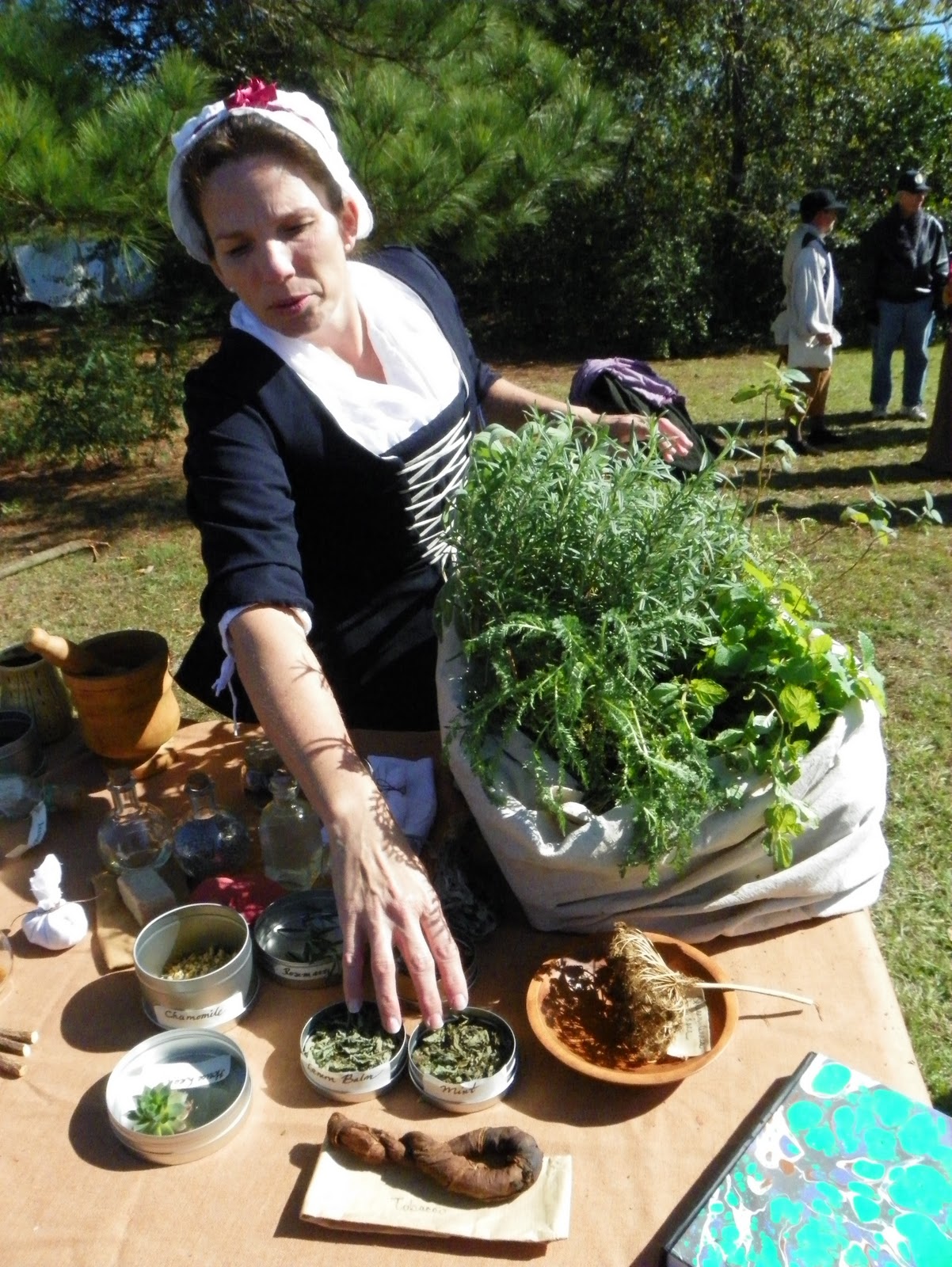
A Lesson in Herbs: A Trip to the Past - Part 5

Colonists knew all about herbs and spices, not only for flavouring food, but also for cures and tonics. Two ladies in the "British camp" gave a lesson on their uses.

For example, yarrow was used to dye clothing. Tobacco was applied to stings, and house leeks (I call these hens and bitties) were good for burns. All kinds of things were made into teas, including mint and chamomile. Some teas were made to cure ills and some were merely cheaper alternatives to imported black tea.

Spices were ground up with a mortar and pestle (I still use a small one) and nutmeg was grated. Sugar came in a "loaf" or cone wrapped in paper.

I didn't realize they had cough lozenges, back then. The apothecary made it with licorice and put his stamp on each lozenge. Pieces of candy, made from anise, peppermint or tamarind, were called comfits.

The colonists used plenty of salt. Before canning came along, people preserved food by drying it, smoking it, or putting it in brine. Meat might be layered in coarse salt — no need to grind it for preserving food.

I learned another thing. We feel like our world has recently gone global because of the information age. But American colonists lived in a new global market because of sea trade. Sugar, spices, rum and salt were all imported.

Sunday, December 04, 2011

Camden: A Trip to the Past - Part 3

Saturday I went to the Revolutionary War re-enactment at Camden. I was particularly interested in details about how people lived in that time period, like food and clothing. Encampment participants had tents and campfires; one man tied fish to a board to smoke it by his campfire. A woman was cleaning pumpkin seeds to toast.  She was going to stuff the pumpkin with chopped apples and roast it on her fire, which sounded yummy.

The Kershaw house was open for self-tours. The present building was built in 1976-77 on the original brick foundation, a replica based on archaeology and photographs. Joseph Kershaw, a patriot, was a successful merchant who built much of original Camden, and his 18th-century mansion overlooked the town. While the Revolutionary War left most of Camden in ashes — including the Fredericksburgh (Quaker) meeting house — the Kershaw house escaped destruction because General Cornwallis used it for his southern headquarters.

After Independence, Camden was rebuilt to the north, on higher ground. The cemetery, the historical centre (around the house) and remains of the magazine and redoubts remain on the site of the early town. Ironically, the Kershaw house was burned in 1865 during the Civil War.


"Soldiers" acted out skirmishes on the Green, in front of the Cornwallis house. (I tried to share a video, but it's too large for blogger so here are a couple of photos.)


Monday, November 21, 2011

A Trip to the Past - Part 2

Friday I drove over to Camden with the vague goal of finding some original documents that Cousar had referenced in his book. One of them mentioned Edward Flin. My ancestor Thomas English married Margaret Flynn (or Flinn), daughter of Edward and Ann, who was "a cousin of Lord Cornwallis." I have not yet found Ann's maiden name or how exactly she was related to the British general, nor have I found anything about her and Edward, including their deaths, except for the land record where they first arrived in South Carolina from Ireland.

I started in the Register of Deeds office. Unlike library archives, they didn't mind if I took pictures, which helped speed up note-taking.

Yes, this is how I spend my vacations!
I found some land records with Englishes in them, and other names in early Camden that are starting to become familiar to me. But I didn't find the book of "Pleadings and Judgments, Book F" that I was looking for. The lady at the counter told me that this building was for Camden records, and I need to go across the street for Kershaw County records.

After going through the metal detector at the courthouse and asking very nicely for photography permission, I walked back through the cold wind to the car and got my camera. The office for intestate (no will) cases is upstairs and the testate records are downstairs. The old books were jumbled around, but I finally found Book F.

And there was the record! A lovely case of two generations who died without a will — the granddaughter's husband wanted to buy the land, so his case included the death dates of Edward and Ann Flin, the names of their children (Margaret and Jean), their grandchildren (Margaret and Thomas English's children), Jean and Thomas' death dates, and more details.

Oh, and Edward was a blacksmith. A primary document with many of my colonial family members and their connections in it — Wonderful stuff!

Sunday, November 20, 2011

A Trip to the Past - Part 1

The first week in November I took a trip back in time.

Actually, I took the camper down to South Carolina to attend a Revolutionary War re-enactment in Camden. My ancestors lived in Camden, during the Revolutionary War — I had to go! This was a perfect opportunity to glimpse what their lives would have been like.

I took a few extra days to research my English family. Thursday I went to the South Caroliniana collection at the University of South Carolina. I wanted to find two sources that books on the English family had referenced: John Cousar's book, Quaker Turned Presbyterian, and Elisabeth Doby English's Descendants of Joshua English. I was excited to finally see them with my own eyes. The former turned out to be a book and the latter was a manuscript.

The South Caroliniana Collection

You can't take pictures of documents in the collection, and I wished I could have taken Cousar's whole book home, there was so much information in it! I wrote notes like crazy and was quickly overwhelmed. The book has paper covers and looks like something that would have had a small print run (i.e. not easy to find a copy).

English's book was more of an extensive family tree, and I took some notes and decided to order copies of the pages with my part of the family, and the branches that lived in the area near the time of the Revolution.

I looked at a few microfilms and then ran out of time. Since parking is difficult at USC and I found the two books that were my goals, I decided to spend tomorrow researching in Camden.

Monday, May 30, 2011

Genealogy fun with South Carolina Quakers

Last week I talked to a couple of people about Quakers in South Carolina. Since I started working at the Friends Historical Collection in January, we've had a few people from out of town come in to research their family history (I'm not the only one who takes genealogy vacations!). This time, a lady had found references to her ancestors in Hinshaw (the popular and handy Encyclopedia of American Quaker Genealogy) and other books and wanted to find primary records from Bush River Meeting.

I've always been fascinated by the Bush River records, and I got the chance to learn more about them. The originals are in our collection, but they were in a fire many years ago, so they're brown and brittle and look like the Dead Sea Scrolls. We have many records from the 1700s that have been preserved and are in decent shape, but the Bush River records haven't been restored, yet, and they're so fragile we don't even touch them. Somehow, at some time past, somebody made a photocopy of them. I pulled those for our visitor, but the years she was looking for were missing.

I racked my brain, trying to remember something from the inventory I've been working on. Finally, on the second day, I found transcripts of the records — and they included all of the years.

I don't know much about Laura Worth, but she is my hero. She helped William Hinshaw write the first volume of the Encyclopedia, the one that included North and South Carolina. As part of that work in the 1930s, she transcribed — by hand — many old Quaker records.

On Friday, I talked to Bill Medlin, author of Quaker Families of South Carolina and Georgia (1982), who now lives in Indiana. His book, out of print for many years, lists many members of Wateree meeting and I wanted to know how he found their names. (My previous posts about the lost Fredericksburgh/Wateree meeting minutes are here and here.) For the book, which he hopes to reprint sometime in the future, Bill used the same techniques I was planning to use: look through the records of other meetings for mentions of Wateree and its members. He encouraged me, but cautioned that not all of his information came from Hinshaw, who only gleaned genealogical extracts. Reading through other meetings' minutes sounds pretty overwhelming, I thought.

Bill confirmed that the Fredericksburgh minutes were received at Bush River in the early 1780s, so they disappeared after that date. He and another genealogist had advertised a reward for those records, with no results, and the other man had searched for them for about 40 years.

The good news is, Bill is currently working on a book about Bush River.

Tuesday, May 03, 2011

Lonely epistles from South Carolina

I went to Friends House in London today. It's a huge building across from Euston train station, with two Meeting houses, cafe, restaurant, library — and that's just the main floor. Signs indicated that offices, publications, etc. were upstairs. I peeked into the large meeting room and it looked like Parliament in the historical movies, with seats down either side and straight-backed wooden seating high on a second level.

Copying 18th-century letters
I went to the library and asked for the 1700s correspondence between colonial South Carolina and London Yearly Meeting. I'm looking for any mentions of Fredericksburgh Monthly Meeting to try to re-create their lost records. Today I found their epistles, mostly annual reports, to London.

Fredericksburgh Meeting members considered themselves remote and independent, so they reported directly to London. I never thought that was strange until I happened to mention to the librarian that most of these pioneers were Irish. His implied question was immediate: wouldn't they report to Ireland? But no, the letters are there. Maybe it was because the Religious Society of Friends started in England; London was considered the mother ship. The letters show great loyalty and attachment, even though the people writing and reading them probably never met.

With London's insistence, Fredericksburgh eventually joined New Garden Quarter, based in North Carolina. They really didn't want to. They wrote that they were "isolate" and "remote." The nearest monthly meeting, Bush River, was about 75 miles away, and New Garden a couple hundred miles. The funny thing is that during those days of walking or traveling by horse, Friends "in this wilderness" felt like New Garden was as out of reach as Mars; they preferred to answer to people on the other side of the ocean.

I found a clue. The helpful librarian brought me an article about Fredericksburgh. They turned over their minutes to Bush River Meeting about 1783. So, at some point, over 200 years ago, the minutes existed. Somebody did write things down.


The library at Quaker House. Old prohibition posters adorn the balcony.

Wednesday, April 13, 2011

Back on the trail of my ancestors

I can't believe I'm going back to England in just two weeks! All my attention has been on the new bookshop, but I need to get back into the genealogy mindset. I'm going to a Quakers Uniting in Publications conference in Birmingham, but I added a precious few days in London at the end of the trip for genealogy research. My primary goal this time is to find out all I can about the Fredericksburgh Monthly Meeting.

Fredericksburgh, now known as Camden, South Carolina, was also known as the Wateree meeting (on the Wateree River) and even Pine Tree Hill. When my ancestor Joshua English moved there from Ireland in 1753, he brought his wife, Mary, and six children: Thomas (22), Elizabeth (18), Robert (16), John (~13), Mary (~11) and Joshua (~8). (Fellow historians think the younger four children came on a separate voyage because they weren't present at court for the land request. My research shows that no other Quaker families arrived in the four months before they did show up in the records, so I believe they traveled with their parents.)

Genealogists with Quaker lines are usually fortunate, because they kept meticulous vital records. However, living archivists and deceased authors alike assure me that no records exist for Fredericksburgh Meeting. Whether they didn't keep records, or the records were destroyed, or they sit lost in someone's attic, nobody seems to know. The meeting fell apart after only a couple of decades and was formally laid down in 1784. Apparently, wealth and slaves and plantation life drew several members away from their faith. Those who stayed true to Quaker ideals moved to Bush River Meeting, which was farther into the South Carolina backcountry, or to other states. Joshua's son Thomas, my ancestor, remained a Quaker and his son John moved to Bush River and then to North Carolina.

Two things inspired me to hunt for these records. 1 - I read in a book that Fredericksburgh reported directly to the London Yearly Meeting. Later on, they were under North Carolina Yearly Meeting, but seemed to have little interaction with other American meetings. 2 - Skimming through a Virginia heritage book, I ran across a letter from Fredericksburgh Meeting, signed by its members. I thought, if a Virginia meeting has a record - a snapshop in time - of this little group of Quakers, more records must exist.

The letter attests to the character of William Terrell and his wife Martha, who apparently moved from Fredericksburgh to Southriver Meeting in Virginia with their children in 1762. It was signed by Samuel Wiley; John, Henry, Robert, James and Rebecca Millhouse; John, Joshua, Robert, Joseph, and Mary English and Mary English Jr.; William Elmore; William Smith; Zeb. Gauntt; Timothy, Samuel, John and Mary Kelly; Mary Tomlinson; Sarah Russell; and Mary Cook.

Those names give me enough clues to hunt for more.

Sunday, November 07, 2010

Back in North Carolina

Just for the record, the space shuttle Discovery launch was scrubbed for this window because of a significant leak that they need to repair. The next opportunity will be Nov. 30 through Dec. 5. You can find updates here. I'll be writing up my experiences as a member of the press at Kennedy Space Center for the newspaper soon, and will post a link here on the Travels with Books blog next week.

I really enjoyed hanging out at KSC all week (much longer than I'd planned!). I also enjoyed camping in my little Scamp, my home away from home. I would have enjoyed it more if I could have unhitched and stayed in one spot. Because of weekend vacationers and other people who came in to see the launch, they were playing musical sites at the campground and I had to reposition almost daily. I brought it with me to KSC several days and got funny looks and comments from some of the guards.

I returned to N.C. to find National Novel Writing Month in full gear. This is the most active we have ever been in the Piedmont area (officially the N.C. Greensboro region on the website), with events scheduled on Monday nights at both the High Point Library and Panera Bread in Greensboro, Thursday mornings at the High Point Barnes & Noble, and Sunday afternoons at various coffee shops around UNC-G. I think there are more write-ins at GTCC, too.

I didn't meet my quota as I was driving up and down the southeast, but I did work on my story a little in the campground in South Carolina on the trip home. I also stayed up last night to take advantage of the time change — way too late — but I was determined to turn that little box green! Hopefully I will catch up with all of these write-ins going on.

Tuesday, July 06, 2010

Tombstone Tuesday - Camden, S.C.

As I finished going through the cemetery files (see previous posts), I did hit paydirt. One of the files contains a spiral-bound notebook where Ted had written down the names in a cemetery (original work), then gone back and annotated where he found full dates or family members' names. Another file had similar work, scribbled onto the backs of re-used paper.

While my goal was to see if we could publish any of Ted's work, I was excited about some of his copied material because it pertains to cemeteries where my Quaker ancestors lived - Bush River and Camden (Fredericksburgh), S.C.

I've never been to Bush River. A descendant in Georgia, with Ted's help, organized a group of people that has done a lot of work to clean up the cemetery. The Haworth family has a couple of photos on their website. I'd like to go there someday, in the next two years.


The Old Quaker Cemetery at Camden, which has grown as it is still in use by the current town, started as a small burying ground used by the Fredericksburgh Monthly Meeting (the old name of Camden, also called Wateree and Pine Tree Hill). Here are some photos I took during a visit in 2007. The brick-covered graves, with no inscription, are purported to be old Quaker graves. Which means that one of them could possibly belong to my ancestor, Joshua English, who immigrated from Ireland in 1753. I don't know. I just know that the 18th-century Quakers didn't believe in marking their names onto headstones.

Sunday, July 04, 2010

Cemetery files

I spent most of Saturday - from lunch to 10pm - going through Ted's cemetery files. And I'm not done, yet. I didn't think it would take so long, but then, I find myself looking at every sheet of paper instead of skimming.

The files were donated to the cemetery committee in keeping with his wishes. Word of mouth has it that he visited every Quaker cemetery in N.C. and some in neighboring states, and wrote down many of the names on the tombstones. My job, for which I enthusiastically volunteered, is to answer the question, can we publish his work?

So far, the answer is not looking good. The information in the files is wonderful, but most of it is copies from already published sources - not original material. Think of your own genealogy files: copies from books, a few printouts of deeds from microfilm, a few scribbled notes on scraps of paper, letters from other genealogy enthusiasts. What's all that going to mean when you're gone? When I'm gone?

Oh, it's all definitely worth keeping! He did a lot of legwork, and some of the books that he copied from may be hard to find. But as far as publishable work... I wonder if he had more, that he kept somewhere else?

Saturday, May 29, 2010

More work, and looking forward to it

I'm excited after this morning's publications board meeting. The author of the collection of Quaker biographies that I edited last summer was there, and we're getting close to publication. Two of our board members went to the QUIP conference (Quakers Uniting in Publications) and had a great time with the international writing community. Next year's meeting is in England and I've already volunteered to go!

We talked about our marketing plan, or lack of one. We're a relatively small nonprofit who sells our books at annual events and through mail order. So I was sitting there thinking, how can we market online when we can't afford online purchasing (eg. ProPay)?

We had a couple of proposals related to publishing cemetery records. A late historian, or his family, donated his research files to another committee who asked us about publishing them. He researched lots of Quaker cemeteries, including some that have been laid down. Although it's sad that he's no longer with us, I'm excited that I'm going to get to look through his files so I can report back to the board. One of the files is about Bush River, the South Carolina meeting my English family ancestors attended.

Sunday, May 16, 2010

GenFest 2010 wrap-up

GenFest 2010 was a fun, informative, long day. The High Point Library staff were, as usual, helpful and organized. I sat between ladies from the High Point Museum gift shop and the Greensboro Library, not far from the Randolph County Genealogical Society and Dr. Bruce Pruitt - a prolific indexer of N.C. and S.C. deeds and records.

I talked to some very interesting folks, from a helpful publisher (as in, the owner of a name I've seen on many books) to a lady who has "original DNA" from East Africa ("hmmm." What else can you say?). I heard about a family reunion in June that I might have to crash. Of course, I couldn't leave without a book, but I restrained myself and bought only one: My Folks Don't Want Me to Talk About Slavery, oral history from former slaves interviewed in the 1930s.

So many genealogical societies, so little... cash. I joined my local county (Randolph) this year, but I can't afford to join all of them. DAR, Sons (and Daughters) of Confederate Veterans, N.C. Genealogical Society, the neighboring county (Guilford) were all represented. And sometimes I think about joining the National Genealogical Society, Quaker historical societies or some of the international ones. It's hard to choose!

The photo is a visitor looking over a "family tree" of 19th-century Springfield Friends Meeting members. Dan Warren drew this a couple of years ago to show how many members are related if you go back a few generations. He's working on another one for Archdale Friends Meeting.

I sold a couple of copies of my book, but mostly enjoyed being around other genealogists and history buffs. I saw Jackie, who heads up the Heritage Centre at the Library, walk by with a big grin on her face - she had an armload of Bruce Pruitt's books.