Showing posts with label Guilford County. Show all posts

Wednesday, July 12, 2017

Mendenhall Village Fair 2016

In just a few more days, the annual Village Fair will return to Mendenhall Homeplace in Jamestown, N.C.

Tannery Books will have a pop-up shop on the porch of the Dr. Madison Lindsay house. The century-old home (built by 1817) also served as a medical school.


The Village Fair will be Saturday, July 15, from 10 am to 4 pm. Admission is free, including self-tours of the historical buildings.

A carriage sits outside the Pennsylvania-style barn at the 2016 Village Fair. Inside the barn is one of two false-bottom wagons in the country that were used to smuggle slaves along the Underground Railroad.


A blacksmith from High Point Museum plies his trade in the shady yard.


The doctor is IN.

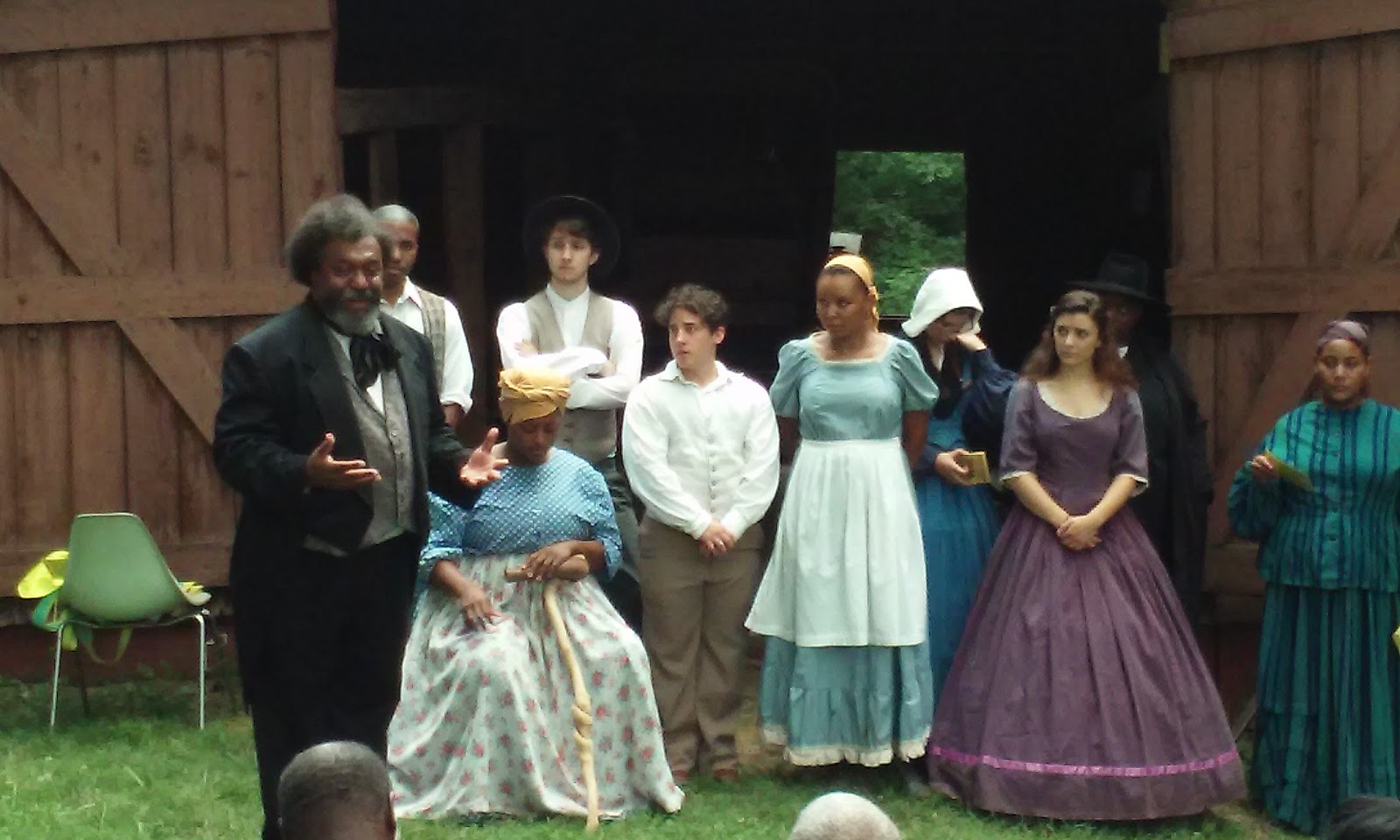
Costumed interpreters provide a sense of life here in the 19th century.


The cast of 'Pathway to Freedom' sings soulful selections from the outdoor drama at 3 pm.


If you're in the central part of the state, Moore County Genealogical Society will have a day of seminars starting at 9 a.m. Saturday, July 15. Topics include researching around burned courthouses and lost records, DNA, and the North Carolina Archives.

Friday, September 19, 2014

Writers' Police Academy 2014 — Day 2

Classes started again early Saturday morning. I enjoyed the session on Policing "Back in the Day." Less than 40 years ago, police still carried revolvers (eg. six-shooters that you have to cock between shots), had only two items on their belts, and had very limited radios. Information — like license registrations — came from books, not computers, or from teletype machines that sent requests for somebody in another state to look in a book. (For a fun fictional account of cops and life in the 1970s, I recommend Life on Mars.)

I grabbed a seat in John Gilstrap's class, which had been overflowing all weekend. His take on "Technical stuff that writers get wrong" had us falling out of those precious seats. We moved from laughter to sobriety as he showed us what kind of damage bullets and explosions can do.

"There are no flesh wounds" or minor bullet wounds, contrary to what we see in movies and TV shows. Even a shoulder is a complex part of anatomy (those of us with past injuries can agree). And a broken leg will not hold a person's weight.

(The very next day I read a passage wherein a villain was standing in the protagonist's path, a piece of bone jutting out of his leg. But maybe the laws of physics don't apply in fantasy...).

Writer and former prosecutor Alifair Burke debunked myths about court cases and police procedure, especially search and/or seizure. More than 90% of searches don't have or need warrants.

The banquet was fun, as usual, though busy for those of us behind the scenes.

Michael Connelly was our featured speaker. He keeps a dedicated writing schedule to pound out all those novels. He worked as a reporter before publishing his first book. As a former journalist myself, his statement resonated with me: "There is no writer's block in the newspaper business."

The silent auction, raffle, and some practical joking topped off the evening. Here's yours truly with the crime scene quilt, one of the silent auction items. It reminds me of a little bookshop decor.

Back to Writer's Police Academy — Day 1

Monday, September 08, 2014

Writers' Police Academy 2014 — Day 1

How do you sum up a high-speed weekend of buzzing writers, detectives, forensics experts, famous authors, a prosecuting attorney, an explosives expert... and much, much more?!

Friday morning I walked into the chaos of our largest class of "recruits" ever. For part of the day I hung out in the hallways, checking people off for the firearms training and emergency driving simulators, and giving directions. I enjoyed the look on one man's face as he walked out of a classroom to hear me direct a lady to "prostitution class" across the hall.

I snuck in a couple of classes, including part of "Romance Behind the Badge." I enjoyed Rick McMahan's class on firearms basics. We learned the differences between rifles and shotguns; single-shot, semi-automatic and automatic (machine guns); revolvers and (semi-automatic) pistols.

Lisa Gardner returned this year and gave an inspiring talk on turning facts into fiction. Most of the experts she calls don't recognize her name. She can almost hear them wondering why she wants to know so much about murder! One of her great tips was to use the coolest detail, or the assumption you made that was wrong — but don't put everything you learned into the story.

Sisters in Crime hosted Friday night's reception. I talked to a couple of the instructors and met a lady from Missouri who, like me, has started a colonial-era historical. I finally drove home. Time for a little sleep before another day of excitement!

Click on the WPA tag below to see past years of Writers' Police Academy or move on to Day 2.

Wednesday, April 23, 2014

Saturday, April 05, 2014

The Battle of Guilford Courthouse

The American and British armies clashed at the Battle of Guilford Courthouse on March 15, 1781. The 233rd anniversary fell on a Saturday this year, allowing reenactors to "fight" on the actual day. 


Pulling artillery back to the Second Line
Shooting started that long-ago morning in New Garden, a Quaker village that is part of modern-day Greensboro. Many history books call it a skirmish. Algie Newlin makes the case for a separate battle in his book, The Battle of New Garden.


A surprise bayonet attack against musket fire
I finally made it this year. The Battleground park is huge. The announcer told the spectators that we were postitioned on the actual hill where the Americans had claimed the high ground in this hilly, wooded area; however, the actual armies were much bigger and the different groups were out of sight of each other.

The calvary attacks!
General Nathanael Greene had organized his army into three main lines. As General Charles Cornwallis' troops advanced, the Americans fought, then moved back to the next line.


An orderly retreat

They finally retreated to Virginia, but after giving the British heavy losses.

Greene lost the battle, but won the campaign, leaving most of his men alive to fight another day.


Wednesday, April 02, 2014

Wordless Wednesday — Carolina Colonial Dancers


The Carolina Colonial Dancers demonstrate country dances before the Battle of Guilford Courthouse anniversary reenactment.


Friday, October 25, 2013

Murder in Jamestown


A "Brutal Murder" in a quiet Quaker town. Examination of the body, multiple weapons used. Boot imprints taken at the scene. A search of the suspect's clothes for blood. A trial. A verdict — an appeal and another trial.

The year, 1856.

One of our interns at the archives was processing a collection of old letters. She couldn't resist reading a few, and one day she exclaimed out loud how interesting they were. Corresponding sisters mentioned a horrible murder and ongoing news of the trial, then turned abruptly to family matters. Judy threw up her hands. So, then what? Did they catch the murderer?

My coworker Liz asked, "Who was the victim?"

Judy scanned the letter she held in gloved hands. "Martha Pinix."

Liz turned to the internet to see if they could find out what happened. They were delighted to find a book: The Murder of Martha Pinix, A True Tale of Old Jamestown and Deep River. Then Liz laughed. The author was Mary Browning. "I should have known!" If anything had ever happened in Jamestown (North Carolina), historian and author Mary Browning would know about it. And she happened to be our docent that day.

Liz introduced an incredulous Judy to an unassuming little white-haired lady sitting in the next room — the lady who literally wrote the book on murder. This one, at least.

Despite her long list of publications, Mary doesn't currently have a website. Her latest book is here and you can read some of her newspaper articles here.

Each one of us devoured Mary's book. At around 30 pages, it didn't take long. But the well researched story — from 19th-century news articles, court records and early 20th-century recollections — reads like a novel, including a death-row escape and a major plot twist. (That's all I can say, no spoilers!) You can get your own copy here to read the details and decide the verdict.


Thursday, September 19, 2013

Writers' Police Academy 2013 — part 3

After my Saturday morning shift and a dose of firearms training, I attended the "From Crime Scene to Court" workshop on crime scene evidence. There's so much going on at Writers' Police Academy one can't catch it all. I didn't even make it to all the sessions Dave Pauly and Katherine Ramsland taught, but showed up enough to qualify as a forensics groupie.

Kathy Reichs, forensic anthropologist and bestselling author, led the afternoon special session. Her books inspired the TV show Bones. Since I don't have TV, I didn't know much about her work, but found her presentation fascinating. She bases all the forensic puzzles in her books on cases she's handled in real life.

Kathy Reichs with new fan Elizabeth Saunders
Kathy explained that a forensic anthropologist is called in when an autopsy is no longer possible because of decay, and an archaeologist when the body is too old to impact a court case, about 30 to 40 years. Her puzzles include more than murder — she's worked on disaster sites, mass graves, POW/MIA cases, and identified the bones of an 18th-century nun.

I came home and found one of her books in my bookshop, Spider Bones (no, I haven't read every book in the shop!).

I devoured it — all day Sunday and part of Monday. 

(No spoilers) One plot line involves identifying the remains of a soldier killed in Vietnam. Kathy used her work with JPAC, the Joint Prisoners of War, Missing in Action Accounting Command, for details in the story.

At my part-time archives job, I've been processing a collection of papers on the Vietnam War all month. I knew little about those times, and the work has been both enlightening and disturbing. I would have enjoyed Spider Bones' forensics, intertwining subplots and family drama anyway, but the collection at work gave me a fresh perspective.

Tomorrow (Sept. 20 this year) is POW/MIA Recognition Day. "Until They Are Home" — that's JPAC's motto.

In tomorrow's post, travel back in time to remember other POWs — from 150 years ago.

This post contains affiliate links. And here's a temporary link to two signed copies of Kathy Reichs books. 

Tuesday, September 17, 2013

Writers' Police Academy 2013 — part 2

5 Things I learned from firearms training


For four years of Writers' Police Academy, I've heard writer-recruits gush about the firearms training simulation, FATS. From their adrenaline-fueled talk about shooting bad guys and trying not to shoot bystanders, I pictured video targets popping up a la Men in Black ("Little Tiffany" scene).

Not quite.

This year, I experienced the simulator first hand. Being a nice little Quaker girl without small arms experience, I wasn't so sure I wanted to shoot a gun. (All you peeps from my first career — stop laughing! Notice I said "small arms.") I'd never shot a pistol before, and hadn't fired a rifle in years.

The instructors briefed us on how to hold our guns, aim, and reload. My Glock 19 was easy to handle; not so easy to aim. (I did have new monovision contacts in and consistently missed to the right. That's my excuse and I'm stickin' to it.)

The scenarios were eye-opening.

I'd always imagined good guys vs. bad guys, a view reinforced by the thrillers we read and watch (and write). Most of the scenes start with a traffic stop or emergency call, and the officer has no idea what he's walking into; ie. whether these folks, these human beings (not black-and-white targets) are good, bad, or somewhere in between. The violence escalates so fast, there's no time to react.

Here are five things I learned:

1. People with empty hands can quickly pick up or pull out a weapon.

2. Weapons can be hard to identify. Did you know there's a cell-phone gun?

3. Upset bystanders can quickly turn into threats.

4. Things happen too fast for really accurate aiming. Even practiced law enforcement shooters lose accuracy because of the adrenaline-filled, split-second timing of an armed encounter.

Anybody who owns a gun needs to practice, practice, practice. Since there's no time to think, only those who've turned their skill into instinct have a chance.

5. I like the Glock 19. I don't want one. I'm so afraid of hurting the wrong person out of fear or bad aim, or that my own gun could be used against me in a surprise attack.

That's the implication in this News 2 story on concealed weapons, cautioning civilians about using their own guns. The video includes a clip from the simulator and features one of WPA's instructors.

I have even more respect for our law enforcement and emergency services folks. If they get a little tense in certain situations, like traffic stops, they have good reason! Thus the intense felony traffic stop in Writers' Police Academy 2013 — part 1.

Training opportunities like FATS not only make us better writers, but also better able to cope with life situations (like in WPA's past self defense classes). Guilford County Sheriff's Office just started a Citizens' Academy, which will include FATS as part of a weeks-long training program.

Wednesday, September 11, 2013

Writers' Police Academy 2013 — part 1

Writers' Police Academy turns murder and mayhem into a three-day thrill ride for writers. 

Lee Lofland, who organizes WPA with Guilford Technical Community College and High Point Library, watched the new recruits come in after planning all year. He wrote his mother hen account of Thursday night as Day One, "All My Children." 

My fourth year working behind the scenes shifted into gear Friday morning. Between directing recruits to firearms training and peddling souvenirs, I caught part of Detective Sluder's session on Human Trafficking. He taught us the difference between trafficking (crime against a person, involuntary) and smuggling (crime against the state, voluntary), and told us about the NHTRC resources and hotline


Katherine Ramsland
Dave Pauly
Friday afternoon brought more free time to hear Katherine Ramsland and Dave Pauly teach about cold cases. There are over 150,000 cold cases (since 1980). 

Katherine got to help verify the body of Jesse James. "It's great fun to dig up old people," she said. 

Dave warned that a lot of murders show no signs of forced entry — the victims let intruders schmooze their way inside. (As I was writing this, I talked to a power company rep through my locked, glass door and told him to leave the paperwork outside.)

In a crowded afternoon session, Katherine (Dr. Ramsland) explained the difference between serial killers, mass murderers and killing sprees. The definitions have changed over the years, but basically, serial killers have a down time between killings, and they plan to go on killing without getting caught. Spree killers are on the move, in sort of a suicidal car-jacking supply-stealing escape, and don't stop until someone stops them (I'm thinking Bonnie and Clyde). Mass murderers have been building up some sort of grudge or anger for years, and retaliate in an explosion of killing — not necessarily the person or people who started the grudge.

Dr. Dan Krane gave an entertaining and technical presentation on DNA forensics. As a novice DNA genealogist (who solved a 137-year-old missing person case last year), I was fascinated. 

He told us what tiny amounts are needed for a DNA sample, and the importance of how the results are presented in court. In one case, a man was convicted on a partial DNA profile, when that same profile could have applied to at least three other people at the scene. 

And you only need about $50-60,000 to start your own crime lab. 

WPA throws in a few surprises every year. Instead of a speaker for the Night Owl session, we left the hotel to watch felony traffic stop procedures. 


Traffic stop with an unknown number of suspects in the car.


"Keep your hands in the air and walk backwards."


Don't mind Lee. He's just taking pictures for The Graveyard Shift.  ;-)

Here are Lee's Friday photos

Wednesday, August 14, 2013

Wordless Wednesday — Antebellum Beauty


A cast member of Snow Camp's Pathway to Freedom poses in front of the Mendenhall Plantation house at the 2013 Village Fair.

Monday, August 12, 2013

Mendenhall Plantation Village Fair 2013


The old Mendenhall store, across the street from the house


I carted Quaker books over to Mendenhall Plantation again this year for their 11th annual Village Fair. The usual summer storm held off until evening, giving us vendors and performers great weather — cloudy with an occasional breeze.


We jumped at occasional musket booms, as a family of Revolutionary re-enactors roamed the plantation this year.


North Carolina's outdoor dramas, featuring performances about our state's history, are wonderful. So far, I've only seen The Lost Colony on Roanoke Island and The Sword of Peace at Snow Camp.

The players from Snow Camp's drama about the Underground Railroad, Pathway to Freedom, once again paid a visit to the Village Fair to share their talents. Let me tell you, these folks can sing!


Jam session on the drums


Here are photos from the Village Fair in 2012 and 2010.

Wednesday, October 17, 2012

Wordless Wednesday — Quaker scrapbook

This is the 1947-48 scrapbook I found at a bookstore estate sale last weekend.

(Wordless - well, just a few words) The pages have come loose. A few items may be missing, or they may have been stuck in the back for safe-keeping.


Does anyone know Jane Hockett?


She went to school in Pleasant Garden. She could be a distant cousin, as I and the Hocketts are descended from colonial settler Phillip Hoggatt.


I can tell she was a natural layout person. 

Her activities read like a table of contents for the scrapbook: Girl Scouts, 4-H Club...


And here's what really got me interested...


Jane went to the 1947 Friends World Conference in Richmond, Indiana.