Showing posts with label 18th-century America. Show all posts

Friday, June 27, 2014

History Geekery — Camden Archeaology

For several months, now, I've been working on a book about the Quakers in colonial Camden, S.C. I've found a wealth of primary sources, especially from traveling Quaker ministers who mentioned their visits to Camden in their "journals," that is, published religious memoirs.

An intriguing title came up in an online search. I took a risk and ordered the book. This just arrived in the mail: Camden: Historical Archaeology in the South Carolina Backcountry by Kenneth Lewis.

I wasn't disappointed.

Although not exactly a primary source, the text contains details about colonial Camden: street layout; actual house (and jail and brewery) foundations; typical homes; and dishes and other items found in the ground.


There are even sketches of what the town may have looked like just before and during the American Revolution.

Too bad Joseph Kershaw wasn't a Quaker. I'm about to learn a whole lot about his house!

Wednesday, April 23, 2014

Saturday, April 05, 2014

The Battle of Guilford Courthouse

The American and British armies clashed at the Battle of Guilford Courthouse on March 15, 1781. The 233rd anniversary fell on a Saturday this year, allowing reenactors to "fight" on the actual day. 


Pulling artillery back to the Second Line
Shooting started that long-ago morning in New Garden, a Quaker village that is part of modern-day Greensboro. Many history books call it a skirmish. Algie Newlin makes the case for a separate battle in his book, The Battle of New Garden.


A surprise bayonet attack against musket fire
I finally made it this year. The Battleground park is huge. The announcer told the spectators that we were postitioned on the actual hill where the Americans had claimed the high ground in this hilly, wooded area; however, the actual armies were much bigger and the different groups were out of sight of each other.

The calvary attacks!
General Nathanael Greene had organized his army into three main lines. As General Charles Cornwallis' troops advanced, the Americans fought, then moved back to the next line.


An orderly retreat

They finally retreated to Virginia, but after giving the British heavy losses.

Greene lost the battle, but won the campaign, leaving most of his men alive to fight another day.


Wednesday, April 02, 2014

Wordless Wednesday — Carolina Colonial Dancers


The Carolina Colonial Dancers demonstrate country dances before the Battle of Guilford Courthouse anniversary reenactment.


Friday, January 11, 2013

South Carolina history and beaver hats

At work the other day (Friends Historical Collection), I pulled older books for possible scanning for Ancestry.com. I was excited to see that Ancestry already has The Annals of Newberry (two volumes) by John Belton O'Neall and John A. Chapman— a nice, clean copy that you can print by single pages. If you don't have access, you can download this messier copy from Google books. The download is easier to print multiple pages, but image only (no word searching). You can search for words by staying online on the Google page. Click on the book cover image to open the reader (NOT the eBook); a search box will be on the left.

Ancestry also has both volumes of Historic Camden, by Thomas Kirkland and Robert Kennedy (note: there are genealogical errors in Kirkland and Kennedy, especially in regard to the English family). Here's the Google version.

I like the Annals for the nitty-gritty details, humour and generous genealogical name-dropping, especially for Bush River Meeting. O'Neall, born in 1793 to an Quaker family of Irish descent, heard first-hand accounts of Revolutionary South Carolina and witnessed the 19th-century events himself.

After a listing settlers in the Bush River area for half a page, O'Neall describes an imagined meeting for worship, probably based on family recollections:

... I can see the aged form of the elder David Jenkins, sitting immediately below the preacher's bench, on the left of the southern entrance to the men's meeting, leaning on the head of his staff, his large protruding lower lip, the most remarkable feature of his face. Alongside of him might be seen the tall form and grey hairs of Tanner Thomson, as he used to be called. Scarcely could the sacred stillness of Friends' meeting keep him from snapping his thumb and finger together, as if feeling a side of leather. Just here I recall the person of Isaac Hollingsworth. His was a stalwart form, more than six feet high. He sits the picture of firmness, and ever and anon, throwing up the ample brim of his flapping beaver, he looks as if he was restless....
A little further to the right or lower down, might be seen the pale features of that excellent man, Joseph Furnas! Near to him was to be seen the tall, erect form, florid complexion, clear, blue eye, ample forehead, and grey hair of John Kelly, Sr.; just alongside of him might be seen Isaac Kirk. Friend Kirk, as he used to be called, was a true Quaker. He was plain and simple as a child, kind and forbearing in every thing. No better heart was covered by a straight-breasted coat. He had his peculiarities: one, that in reading, he read as if he was singing the passages—another, that when talking to any one his foot had always to be in motion. ...
In the women's meeting, on the preacher's bench, under their immense white beavers, I recall the full round faces and forms of the sisters, Charity Cook and Susannah Hollingsworth. Both wives, both mothers of large families, still they felt it their duty to preach "Jesus and him crucified." The first, Charity Cook, was indeed a gifted woman. She traveled through the States extensively. Twice visited England and Ireland. When her husband drove his stage wagon into Rabun's creek, at a time when it was high, drowned two horses, and only escaped drowning himself by riding a chunk to land, she swam to the shore, and thus saved herself. Her sister, Susannah Hollingsworth, was not so highly gifted. Henry O'Neall, and other young Friends, used to affirm, that when Aunt Suzey, as she was called, began to pray, they could always keep ahead of her by repeating the words she was about to say.
Just below the preacher's bench, the once round and graceful form (afterwards bent by 82 winters) of Hannah Kelly, once Hannah Belton, a native of Queen's County, Ireland, might be seen. No more intelligent, kind, or benevolent face ever met the upturned gaze of her juniors. Well might it be said of her, that she was indeed "a mother in Israel." Her eye of blue, her long straight nose, high cheek bones, and clear Irish complexion, can scarcely ever be forgotten by those who saw her.
When I first read "their immense white beavers," I pictured the large, white bonnets of modern stereotypical Quaker illustrations. According to History of American Costume, 1607-1870, bonnet was a loose term from the French used for all kinds of hats, but actual bonnets didn't come about until later in the 18th century, including straw ones. (My Quaker great-grandmother wore a floral blue bonnet.)

Beavers were actually wide-brimmed hats, and women wore them over their caps — caps having been a staple for centuries. Notice in the first paragraph that men wore them, too.

This beaver hat is from the mid-18th century (American Costume, p. 167).

Speaking of Bush River, a group of descendants and people who care about the cemetery will have their annual Bush River Quaker Homecoming May 2-5 in Newberry, S.C. Their nascent website is here. (I noticed mistakes right away in the cemetery list, but they are building this site. The bibliography looks interesting.)

Friday, December 07, 2012

Revolutionary War in South Carolina

I can't believe it's been over a year since I saw the Revolutionary War re-enactment in Camden, S.C.  (more posts here). An amazing number of battles were fought in the Carolina backcountry.

Special thanks to Robert Candler, who was kind enough to share these photos from his trip to the South Carolina Military Museum in Columbia.

Robbie's previous guest post features photos of military rations through the years.


Notice that the Battle of Camden in 1780 is highlighted as one of the major battles of the war. Occupied Camden became General Cornwallis' headquarters.

Look under 1781 and you'll see where the war returned to Camden, or just a little to the north at Hobkirk's Hill, this time with slightly better results for the Patriots.


Pamela Patrick White's wonderful painting of The Battle of Hobkirk's Hill is on exhibit at the museum. 


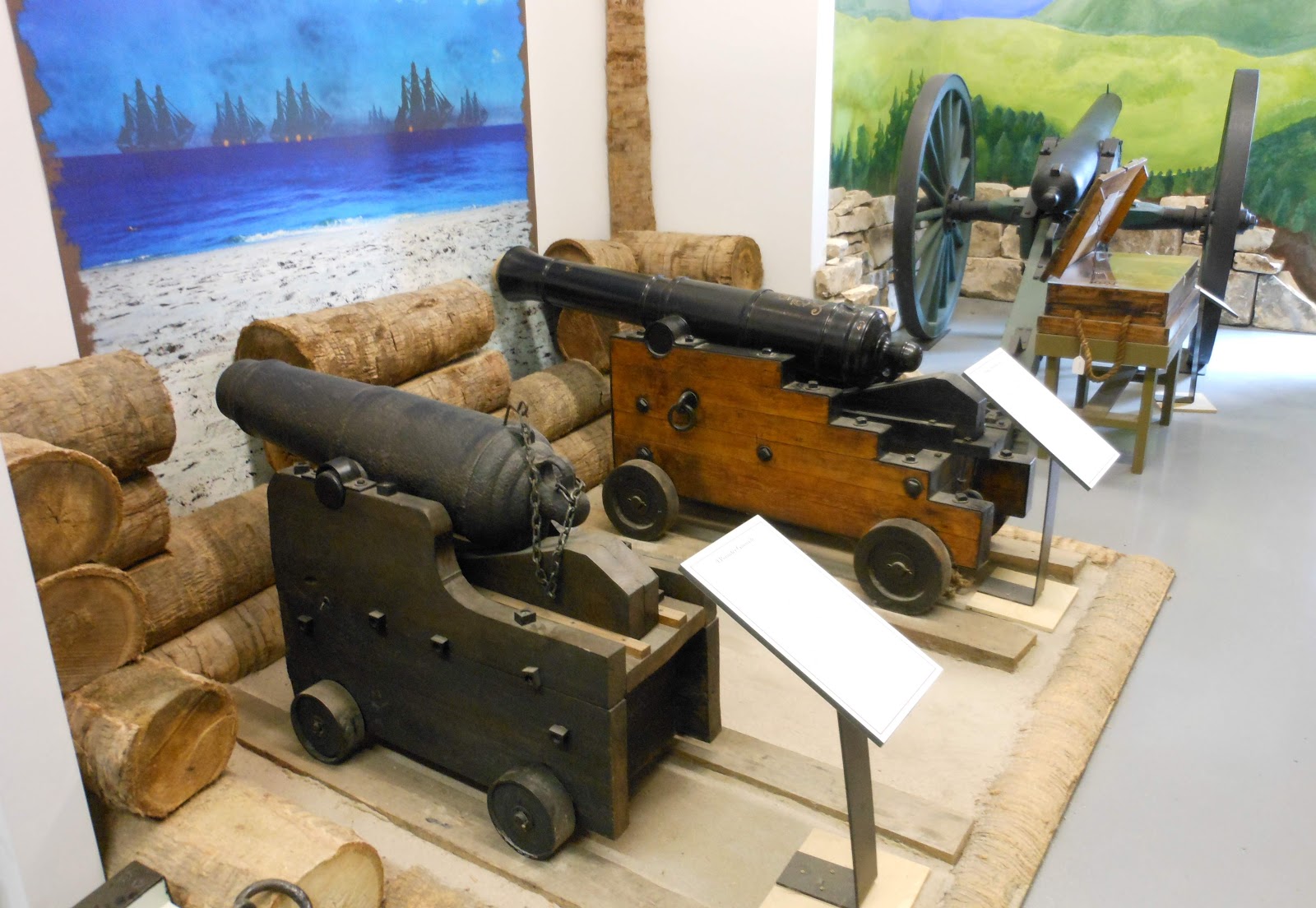
These cannon were used to defend Charleston at a fort still under construction in 1776, which became Fort Moultrie. The palmetto logs absorbed enemy fire instead of cracking.


Wednesday, December 05, 2012

Wordless Wednesday — What soldiers ate, then and now

Guest post by Robert Candler, who took these pictures at the South Carolina Military Museum in Columbia, S.C.


Rations for the American Revolutionary War

(Here's my previous post about What Soldiers Ate, including the British, during the War of Independence.)


Civil War rations


World War I — including corned beef and canned milk


World War II — K-rations were packaged for individual soldiers who were traveling light.


World War II — C-rations were complete meals that could be heated.


Good ol' MREs — Meals, Ready-to-Eat — are the standard issue for today's troops.

Friday, August 17, 2012

American life in 1787

The first thing I do with a genealogical book is check the index for ancestor surnames. Then I sometimes get distracted by bonus snippets about daily life.

Among the genealogy book finds in the shop this month is The 1787 Census of Virginia, Southampton County. It's actually more of a tax list than a census, but according to the authors, the commissioner had to visit each taxpayer at home and note the names of all males over 21.

The information in this county book includes more than just names: white males over 21 and female heads of households, the number of white males 16 to 21, blacks (slaves) 16 and older and 16 and younger. It also list horses, mares, colts and mules; cattle; carriages with number of wheels, ordinary (inn) licenses; billiard tables; number of stud horses; and who was practicing as a physician, apothecary or surgeon.

Only a few professions are listed, probably to differentiate people with similar names. Southampton County had a couple of "taylors," a bell maker, several sheffs (sheriffs?), an overseer, a silver smith, constables, coopers, physicians with licenses, a Dr. with "no physician's license," a merchant, a female plantation owner, and a sea captain.

Slavery is the sad part of our history, but it makes the exceptions stand out. Several free "Negroe" men are listed; some living with other families and some listed alone with their horse. That doesn't mean they didn't have families; only slaves were counted so these men had "0" in each of the people columns.

Most people who owned any transportation had a two-wheeled carriage or "chair." But a couple of men owned phaetons — the impractical little sports car of horse-drawn vehicles.

Here's an interesting post about things that have changed since 1787, including a link to the bar tab for our founding fathers.

How things have changed since 1787 | Constitution Daily
blog.constitutioncenter.org5/24/12
The population of the United States of America was about 3.9 million, according to the 1790 Census. About 700,000 people were being held as slaves. And outside of the census were at least 150,000 Native Americans.

And speaking of drinking and eating and drinking in earlier centuries, the entertaining videos about 21st-century people trying that lifestyle are here.

Travels with Books: Eating 17th-century food
elizabethsaunders.blogspot.com4/15/12
Eating 17th-century food. Have you ever wondered what it would be like to eat the way people did in the 17th century? I've dreamt about an immersion course (small beer for breakfast — why not?) to see what life was like for ...


Wednesday, July 25, 2012

Wordless Wednesday — Village Fair


A costumed interpreter listens to dulcimer music and singing at the Mendenhall Plantation's 10th annual Village Fair.

Wednesday, June 27, 2012

Wordless Wednesday — Colonial dishwashing


How did the colonists wash their dishes?

Much like we do today — with wash water and rinse water. Here are photos of wash basins at the American encampment in Camden, S.C.


I thought the metal pans looked pretty modern. This kind lady informed me that they were typical of the era. (Notice the wooden buckets for fetching the water.)


This is Part 10 of my "Trip to the Past." Here's Part 9.

Friday, May 04, 2012

What colonial women wore: A Trip to the Past - Part 9

During my "time travel" to the Revolutionary War in Camden, S.C. (previous posts here and here), this helpful young lady in the American camp explained what a lady would wear in colonial times.

The first layer is a shift, which serves as slip during the day and nightgown at night. Her white shift shows at the sleeves. Next she wears stays (a corset) and petticoats of linen or wool.

Her outer layer is a carico jacket, an upper garment which is open at the front, revealing the petticoat. She could also wear a short gown or a bed jacket.

She ties an apron around her waist and tucks in a neckerchief to protect her skin from the sun and for modesty. Colonial women wore caps as a matter of course, but the straw hat she wears on top of it is optional.

Seventeenth century women didn't wear anything under their shifts. (Re-enactors, however, prefer modern underwear to a chilly November draft!)

For lots of details about what colonial Americans wore and how they lived, as well as simple patterns and instructions to make your own period clothing, I recommend Tidings from the 18th Century by Beth Gilgun.


If you're not very handy with needle and thread or don't have the time, vendors at re-enactments — like the lady with the blue straw hat — will be happy to sell you ready-made dresses, caps and other items.

Next week I'll return to the 21st century for bookish events in North Carolina and Pennsylvania. Fill out the "Follow by Email" box in the sidebar of this page to get posts delivered right to your inbox.


Wednesday, May 02, 2012

Wordless Wednesday: Fingerless Gloves

Almost wordless: A Trip to the Past - Part 8
(Here's part 7)


I love my fingerless gloves, but I thought they were a modern invention. Re-enactors at Camden assured me that short-fingered gloves were worn in colonial America, especially in camp in the chilly air. Soldiers liked them because they could reload their muskets while wearing them.

Look closely and you'll see the pipes and drums corps wearing them, too.


Friday, April 27, 2012

Clothing in Colonial America: A Trip to the Past - Part 7


Revolutionary War re-enactors put on a history-of-fashion show — British and American fashion — during my visit to Camden, S.C. (Here are part 1, part 2, part 3, part 4, part 5 and part 6).

I had always heard the British referred to as "Redcoats," but their forces were a colorful lot. Here's an officer in a blue coat with red trim.

The Hessians, Germans hired by the British to come fight in America, wore wigs with a long ponytail down the back. Hessian sharpshooters wore green coats, like this man on the right. Notice his high gaiters (waterproof canvas that looks like boots). The knot on his sword indicates rank.


His German wife, dressed in green riding habit, emceed the fashion show. She said the dangly balls on her hat were designed to keep flies away.

Next to her is an Anglican priest. He has to wear a wide-brimmed hat because the colony has so much more sunshine than back in England.

We forget that Americans fought on both sides during the Revolutionary War. Militia wore whatever clothes they brought from home, which could lead to confusion during battle. So they used symbols to show which army they were with. In 1780, Marion's men wore something white (a feather or paper) in their hats, while the tories wore small pine branches in theirs.

The taller man is showing the waistcoat that he wears under his hunting coat.


This dandy is getting arrested for a wild night out on the town (maybe he should get arrested for those fancy stockings!). He's at the height of fashion with a corduroy coat, silk waistcoat, shoes with buckles and a walking stick.


This British grenadier proudly wears marine and navy emblems. His sword is an investment, bought by his family for 20 shillings.


Next week: Women's clothing in colonial America.

Sign up where it says "Follow by Email" on the right side of this page and you'll get future posts right in your inbox.

Wednesday, April 25, 2012

Wordless Wednesday - Genealogy in a family Bible

A little fun at my archives job — I got to copy family tree information that was written in an old Bible. The Bible, published in 1791, belongs to one of our docents and has been in her family for generations. They have taken good care of it! The earliest births and deaths were written on the blank pages in the front and the later, 19th-century information was written on ornate family tree pages in the middle.


Wonderful heirlooms like this always have surprises between the pages. Someone wrote a story and stuck it in this Bible. I also found a strip of cloth and a small evergreen branch.

What treasures have you found in old books?

Sunday, December 18, 2011

What Soldiers Ate: A Trip to the Past - Part 6

The daily rations for a British soldier were: 
     1 lb. flour or bread
     1 lb. pork or beef
     7 oz. peas
     1 oz. rice
     1 1/2 tbsp. butter
     1 1/2 tbsp. vinegar
     1 gill of rum

Vinegar? Yes, soldiers considered vinegar very important and became disgruntled if they didn't get it. People didn't know about germs in the 18th century, but they considered vinegar a "cleansing" agent — meaning it was good for the digestive system. In modern terms, they used it to purify their drinking water. The vitamin C in vinegar also prevented scurvy.

The British transported meat preserved in brine from Ireland. Sometimes it wasn't very palatable by the time the troops got it.

Soldiers didn't get rations on a daily basis, and it wouldn't be very practical for every soldier to be making bread every day. About six soldiers, who shared a tent, were called a "mess." Each mess assigned one man to do the cooking, and he picked up the rations for all of them once a week.

See the little silver cup at the top of the picture? That's a gill, a common measurement in colonial times. I think of it as a large shot glass.

The American troops had less (except in the vinegar department). Each soldier in Washington's army received the following per day:
     1 lb. bread
     1/2 lb. pork or beef
     1 pint milk or a gill of rice
     1 gill peas or beans
     6 oz. butter
     1/2 pint vinegar

Of course, that was when the army had food.