Showing posts with label Colonial America. Show all posts

Friday, June 27, 2014

History Geekery — Camden Archeaology

For several months, now, I've been working on a book about the Quakers in colonial Camden, S.C. I've found a wealth of primary sources, especially from traveling Quaker ministers who mentioned their visits to Camden in their "journals," that is, published religious memoirs.

An intriguing title came up in an online search. I took a risk and ordered the book. This just arrived in the mail: Camden: Historical Archaeology in the South Carolina Backcountry by Kenneth Lewis.

I wasn't disappointed.

Although not exactly a primary source, the text contains details about colonial Camden: street layout; actual house (and jail and brewery) foundations; typical homes; and dishes and other items found in the ground.


There are even sketches of what the town may have looked like just before and during the American Revolution.

Too bad Joseph Kershaw wasn't a Quaker. I'm about to learn a whole lot about his house!

Saturday, April 05, 2014

The Battle of Guilford Courthouse

The American and British armies clashed at the Battle of Guilford Courthouse on March 15, 1781. The 233rd anniversary fell on a Saturday this year, allowing reenactors to "fight" on the actual day. 


Pulling artillery back to the Second Line
Shooting started that long-ago morning in New Garden, a Quaker village that is part of modern-day Greensboro. Many history books call it a skirmish. Algie Newlin makes the case for a separate battle in his book, The Battle of New Garden.


A surprise bayonet attack against musket fire
I finally made it this year. The Battleground park is huge. The announcer told the spectators that we were postitioned on the actual hill where the Americans had claimed the high ground in this hilly, wooded area; however, the actual armies were much bigger and the different groups were out of sight of each other.

The calvary attacks!
General Nathanael Greene had organized his army into three main lines. As General Charles Cornwallis' troops advanced, the Americans fought, then moved back to the next line.


An orderly retreat

They finally retreated to Virginia, but after giving the British heavy losses.

Greene lost the battle, but won the campaign, leaving most of his men alive to fight another day.


Wednesday, April 02, 2014

Wordless Wednesday — Carolina Colonial Dancers


The Carolina Colonial Dancers demonstrate country dances before the Battle of Guilford Courthouse anniversary reenactment.


Wednesday, January 30, 2013

Wordless Wednesday — Plimoth Village

Guest photo post by John Cowgill


Plimoth Village is a "living" 17th-century English village on Plymouth Bay in Massachusetts.


The "pilgrims" portray documented residents who lived in the colony in 1627.


 Houses


 Gardens


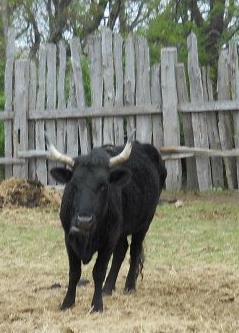
 Farm animals


The fort


Thanks to John Cowgill for photos from his travels. He writes about trains, travel and railroad history for the DC Examiner.

Friday, December 07, 2012

Revolutionary War in South Carolina

I can't believe it's been over a year since I saw the Revolutionary War re-enactment in Camden, S.C.  (more posts here). An amazing number of battles were fought in the Carolina backcountry.

Special thanks to Robert Candler, who was kind enough to share these photos from his trip to the South Carolina Military Museum in Columbia.

Robbie's previous guest post features photos of military rations through the years.


Notice that the Battle of Camden in 1780 is highlighted as one of the major battles of the war. Occupied Camden became General Cornwallis' headquarters.

Look under 1781 and you'll see where the war returned to Camden, or just a little to the north at Hobkirk's Hill, this time with slightly better results for the Patriots.


Pamela Patrick White's wonderful painting of The Battle of Hobkirk's Hill is on exhibit at the museum. 


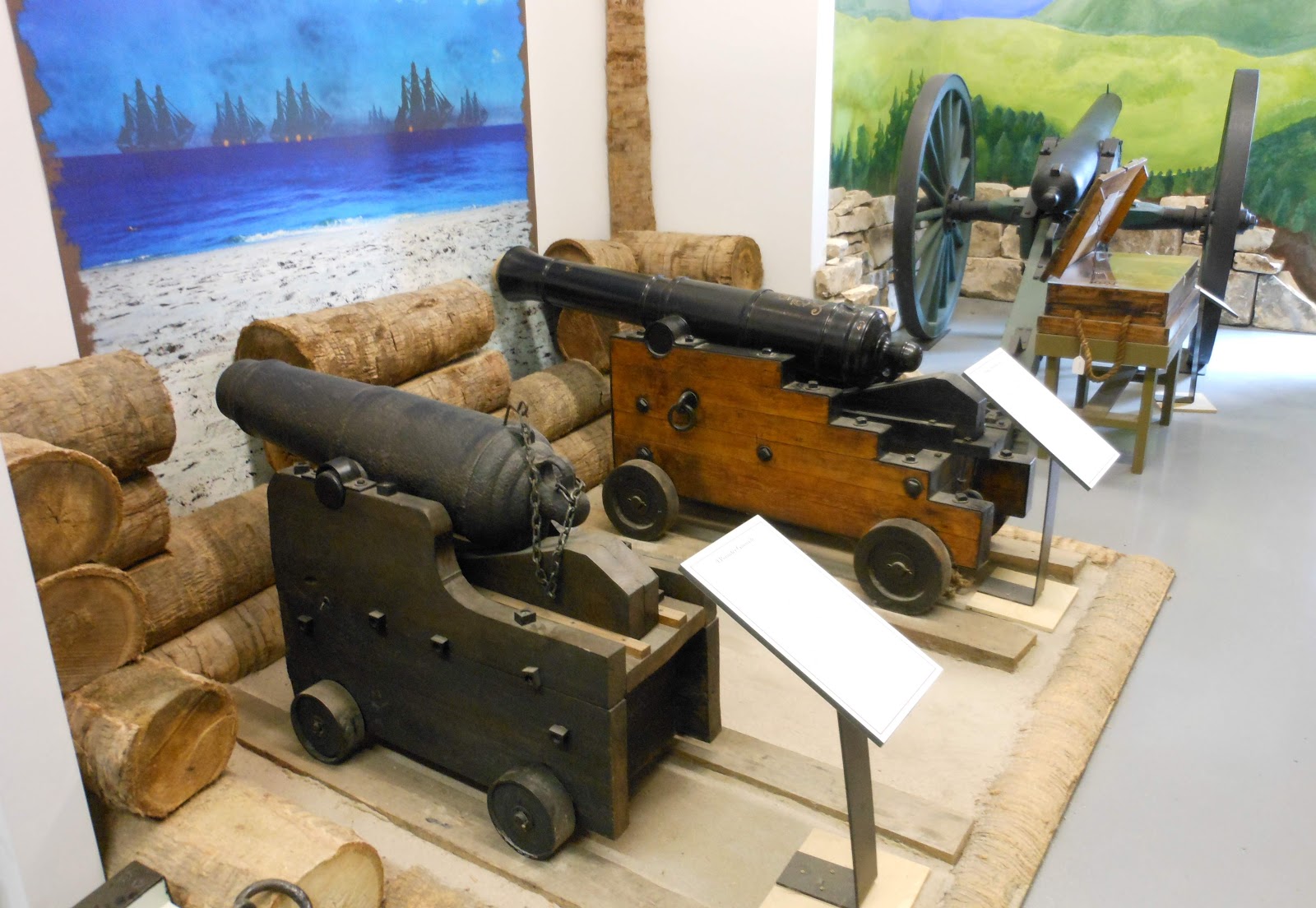
These cannon were used to defend Charleston at a fort still under construction in 1776, which became Fort Moultrie. The palmetto logs absorbed enemy fire instead of cracking.


Wednesday, June 27, 2012

Wordless Wednesday — Colonial dishwashing


How did the colonists wash their dishes?

Much like we do today — with wash water and rinse water. Here are photos of wash basins at the American encampment in Camden, S.C.


I thought the metal pans looked pretty modern. This kind lady informed me that they were typical of the era. (Notice the wooden buckets for fetching the water.)


This is Part 10 of my "Trip to the Past." Here's Part 9.

Friday, May 04, 2012

What colonial women wore: A Trip to the Past - Part 9

During my "time travel" to the Revolutionary War in Camden, S.C. (previous posts here and here), this helpful young lady in the American camp explained what a lady would wear in colonial times.

The first layer is a shift, which serves as slip during the day and nightgown at night. Her white shift shows at the sleeves. Next she wears stays (a corset) and petticoats of linen or wool.

Her outer layer is a carico jacket, an upper garment which is open at the front, revealing the petticoat. She could also wear a short gown or a bed jacket.

She ties an apron around her waist and tucks in a neckerchief to protect her skin from the sun and for modesty. Colonial women wore caps as a matter of course, but the straw hat she wears on top of it is optional.

Seventeenth century women didn't wear anything under their shifts. (Re-enactors, however, prefer modern underwear to a chilly November draft!)

For lots of details about what colonial Americans wore and how they lived, as well as simple patterns and instructions to make your own period clothing, I recommend Tidings from the 18th Century by Beth Gilgun.


If you're not very handy with needle and thread or don't have the time, vendors at re-enactments — like the lady with the blue straw hat — will be happy to sell you ready-made dresses, caps and other items.

Next week I'll return to the 21st century for bookish events in North Carolina and Pennsylvania. Fill out the "Follow by Email" box in the sidebar of this page to get posts delivered right to your inbox.


Wednesday, May 02, 2012

Wordless Wednesday: Fingerless Gloves

Almost wordless: A Trip to the Past - Part 8
(Here's part 7)


I love my fingerless gloves, but I thought they were a modern invention. Re-enactors at Camden assured me that short-fingered gloves were worn in colonial America, especially in camp in the chilly air. Soldiers liked them because they could reload their muskets while wearing them.

Look closely and you'll see the pipes and drums corps wearing them, too.


Friday, April 27, 2012

Clothing in Colonial America: A Trip to the Past - Part 7


Revolutionary War re-enactors put on a history-of-fashion show — British and American fashion — during my visit to Camden, S.C. (Here are part 1, part 2, part 3, part 4, part 5 and part 6).

I had always heard the British referred to as "Redcoats," but their forces were a colorful lot. Here's an officer in a blue coat with red trim.

The Hessians, Germans hired by the British to come fight in America, wore wigs with a long ponytail down the back. Hessian sharpshooters wore green coats, like this man on the right. Notice his high gaiters (waterproof canvas that looks like boots). The knot on his sword indicates rank.


His German wife, dressed in green riding habit, emceed the fashion show. She said the dangly balls on her hat were designed to keep flies away.

Next to her is an Anglican priest. He has to wear a wide-brimmed hat because the colony has so much more sunshine than back in England.

We forget that Americans fought on both sides during the Revolutionary War. Militia wore whatever clothes they brought from home, which could lead to confusion during battle. So they used symbols to show which army they were with. In 1780, Marion's men wore something white (a feather or paper) in their hats, while the tories wore small pine branches in theirs.

The taller man is showing the waistcoat that he wears under his hunting coat.


This dandy is getting arrested for a wild night out on the town (maybe he should get arrested for those fancy stockings!). He's at the height of fashion with a corduroy coat, silk waistcoat, shoes with buckles and a walking stick.


This British grenadier proudly wears marine and navy emblems. His sword is an investment, bought by his family for 20 shillings.


Next week: Women's clothing in colonial America.

Sign up where it says "Follow by Email" on the right side of this page and you'll get future posts right in your inbox.

Sunday, December 18, 2011

What Soldiers Ate: A Trip to the Past - Part 6

The daily rations for a British soldier were: 
     1 lb. flour or bread
     1 lb. pork or beef
     7 oz. peas
     1 oz. rice
     1 1/2 tbsp. butter
     1 1/2 tbsp. vinegar
     1 gill of rum

Vinegar? Yes, soldiers considered vinegar very important and became disgruntled if they didn't get it. People didn't know about germs in the 18th century, but they considered vinegar a "cleansing" agent — meaning it was good for the digestive system. In modern terms, they used it to purify their drinking water. The vitamin C in vinegar also prevented scurvy.

The British transported meat preserved in brine from Ireland. Sometimes it wasn't very palatable by the time the troops got it.

Soldiers didn't get rations on a daily basis, and it wouldn't be very practical for every soldier to be making bread every day. About six soldiers, who shared a tent, were called a "mess." Each mess assigned one man to do the cooking, and he picked up the rations for all of them once a week.

See the little silver cup at the top of the picture? That's a gill, a common measurement in colonial times. I think of it as a large shot glass.

The American troops had less (except in the vinegar department). Each soldier in Washington's army received the following per day:
     1 lb. bread
     1/2 lb. pork or beef
     1 pint milk or a gill of rice
     1 gill peas or beans
     6 oz. butter
     1/2 pint vinegar

Of course, that was when the army had food.

Sunday, December 11, 2011

A Lesson in Herbs: A Trip to the Past - Part 5

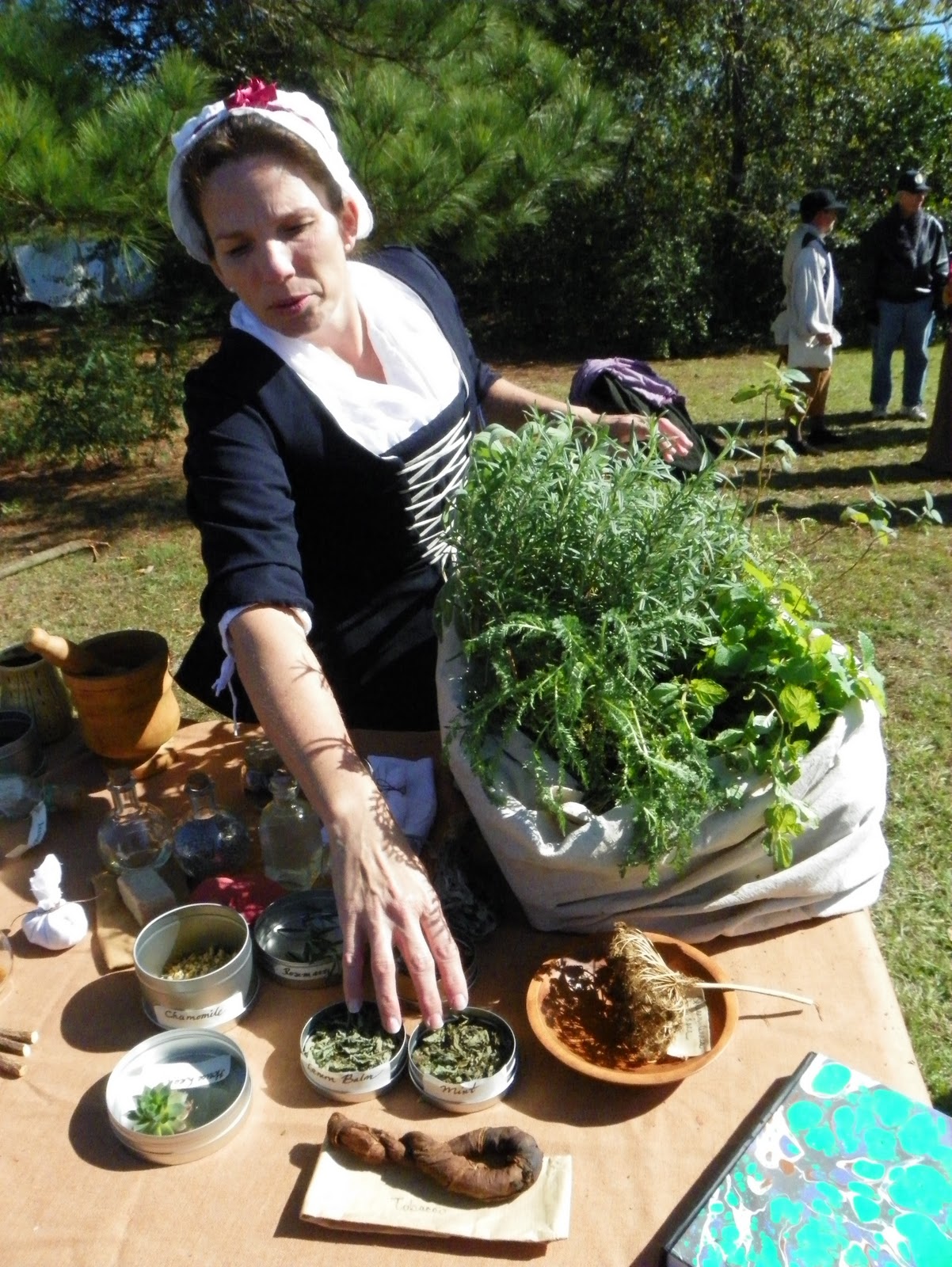
Colonists knew all about herbs and spices, not only for flavouring food, but also for cures and tonics. Two ladies in the "British camp" gave a lesson on their uses.

For example, yarrow was used to dye clothing. Tobacco was applied to stings, and house leeks (I call these hens and bitties) were good for burns. All kinds of things were made into teas, including mint and chamomile. Some teas were made to cure ills and some were merely cheaper alternatives to imported black tea.

Spices were ground up with a mortar and pestle (I still use a small one) and nutmeg was grated. Sugar came in a "loaf" or cone wrapped in paper.

I didn't realize they had cough lozenges, back then. The apothecary made it with licorice and put his stamp on each lozenge. Pieces of candy, made from anise, peppermint or tamarind, were called comfits.

The colonists used plenty of salt. Before canning came along, people preserved food by drying it, smoking it, or putting it in brine. Meat might be layered in coarse salt — no need to grind it for preserving food.

I learned another thing. We feel like our world has recently gone global because of the information age. But American colonists lived in a new global market because of sea trade. Sugar, spices, rum and salt were all imported.