Showing posts with label Food and culture. Show all posts

Wednesday, December 05, 2012

Wordless Wednesday — What soldiers ate, then and now

Guest post by Robert Candler, who took these pictures at the South Carolina Military Museum in Columbia, S.C.


Rations for the American Revolutionary War

(Here's my previous post about What Soldiers Ate, including the British, during the War of Independence.)


Civil War rations


World War I — including corned beef and canned milk


World War II — K-rations were packaged for individual soldiers who were traveling light.


World War II — C-rations were complete meals that could be heated.


Good ol' MREs — Meals, Ready-to-Eat — are the standard issue for today's troops.

Wednesday, May 30, 2012

Learning about Ireland in the 17th century

As I work on my novel about the English family, my ongoing brick wall hasn't been so much about genealogy, but in learning about Ireland. I want to include those little historic details that give the reader a sense of time and place. I've found plenty of references about war and battles and even the persecutions of Quakers, but there seems to be a dearth of information about Irish daily life in the 17th century.

I tried using English social history, especially since my real-life characters were English settlers. I started with Marjorie and C.H.B. Quennell's A History of Everyday Things in England. It's a great resource and I used it to picture what Dinah English and John Clibborn would wear. Other topics, however, are jumbled about rather randomly and I'm never quite sure which would have carried over to the neighboring country.

Quakers journals of the time dealt more with spiritual things than physical. English diaries, like that of the famous Samuel Pepys, reflect an extravagant Restoration England that would have been rejected by Quakers, who strove for lives of simplicity.

I recently had a breakthrough — last month I found Irish Life in the Seventeenth Century, by Edward MacLysaght, through intralibrary loan. Pictures are few, but details abound! For example, the English settlers wore "breeches" (snug at the knee in Quennell's drawings) and the Irish wore "trousers," which were looser garments of similar length. One of the appendices (part of which is in Gaelic, but Dr. MacLysaght condescends to summarize a little for us) tells that poorer Irish men often didn't wear a shirt, just a waistcoat with bare arms under their cloaks. Exactly the little tidbits I've been looking for!

Fascinating as it is, Irish Life is not a quick read, and I had to send the plain blue hardback to its home library. I found a 1979 paperback online, with people in 17th-century costume on the front (remember the lack of pictures?), so I ordered it.

My copy arrived yesterday (yay!), sans appendices, notes and bibliography (boo!). Apparently the author, 91 at the time, (and perhaps his publisher) thought fit to cut 150 pages from "this popular edition." Ouch. Looks like I'll have to save up to buy an older copy.

I've been blessed recently with an outcrop of websites and blog posts to help with 17th- and 18th-century research. I plan to gather some of these resources into a subpage on this website. Meanwhile, here are my top finds for May:

1. A map and clothing from 1610 Ireland, at Irish Historical Textiles (contains the picture on the cover of my newly acquired paperback).

2. The Books of Survey and Distribution list names and show how land changed hands from Catholic to Protestant owners in Cromwellian and Restoration (mid-17th century) Ireland.

3. Popular books in the 18th century — a handy list by Roseanna M. White at Colonial Quills.

4. Did 18th-century women tie their apron strings in the front or the back?

5. What basic skills would an 18th-century outdoorsman or traveling colonist need to know? Keith Burgess tells us at A Woodrunner's Diary.

6. The author of Vintage Visions wears 18th-century finery.

And in a different century:

7. Last month 425 years ago, three ships carrying men, women and children departed English waters to start a new life in Carolina. They would become known as the Lost Colony.

--

Sunday, April 15, 2012

Eating 17th-century food

Have you ever wondered what it would be like to eat the way people did in the 17th century? I've dreamt about an immersion course (small beer for breakfast — why not?) to see what life was like for my ancestors and get details for my novel. But after watching this hilarious episode of the BBC's Supersizers, I'm glad Giles and Sue did the immersion for me. I can live vicariously through their experiences while keeping my internal organs in good working order.

Each of the six videos below is about 10 minutes, for a total 1-hour episode about life — and especially food — in Restoration England. Thanks to A Woodrunners Diary for the idea.

My ancestors in Ireland were Quakers, so they would not have set such an extravagant table. There's a clip about Puritan/Quaker/country food towards the end of the third video.


Wednesday, January 25, 2012

Hardtack

I have the nicest customers at the bookshop.

I told one of them about the food soldiers ate in colonial times. He's more interested in the Civil War, and had ordered some "authentic" hardtack. He promised to bring me a taste.

And he did!

He insisted I wait and eat it with strong coffee. The soldiers would have boiled their coffee and drank it with grounds in their cups.

A box costs quite a bit, so he gave me one of the large crackers.  I took it home and divided it with my family.

We brewed some regular coffee, since that's all we had.

It tasted a lot like a saltine, maybe a little more flour-y. We all agreed that it would taste pretty good if you're a hungry soldier on the march, but we wouldn't want to eat it all the time.

Sunday, December 18, 2011

What Soldiers Ate: A Trip to the Past - Part 6

The daily rations for a British soldier were: 
     1 lb. flour or bread
     1 lb. pork or beef
     7 oz. peas
     1 oz. rice
     1 1/2 tbsp. butter
     1 1/2 tbsp. vinegar
     1 gill of rum

Vinegar? Yes, soldiers considered vinegar very important and became disgruntled if they didn't get it. People didn't know about germs in the 18th century, but they considered vinegar a "cleansing" agent — meaning it was good for the digestive system. In modern terms, they used it to purify their drinking water. The vitamin C in vinegar also prevented scurvy.

The British transported meat preserved in brine from Ireland. Sometimes it wasn't very palatable by the time the troops got it.

Soldiers didn't get rations on a daily basis, and it wouldn't be very practical for every soldier to be making bread every day. About six soldiers, who shared a tent, were called a "mess." Each mess assigned one man to do the cooking, and he picked up the rations for all of them once a week.

See the little silver cup at the top of the picture? That's a gill, a common measurement in colonial times. I think of it as a large shot glass.

The American troops had less (except in the vinegar department). Each soldier in Washington's army received the following per day:
     1 lb. bread
     1/2 lb. pork or beef
     1 pint milk or a gill of rice
     1 gill peas or beans
     6 oz. butter
     1/2 pint vinegar

Of course, that was when the army had food.

Sunday, December 11, 2011

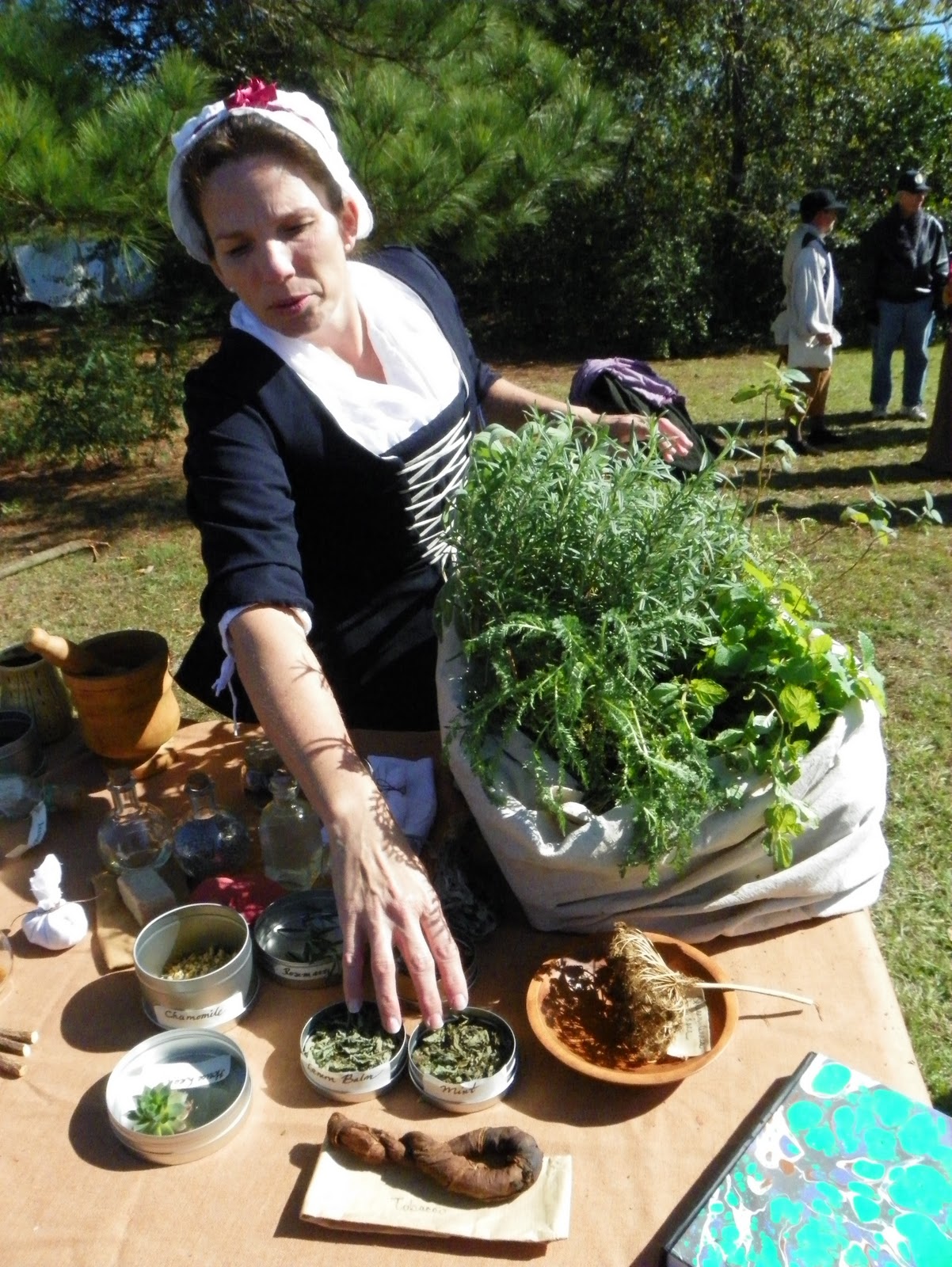
A Lesson in Herbs: A Trip to the Past - Part 5

Colonists knew all about herbs and spices, not only for flavouring food, but also for cures and tonics. Two ladies in the "British camp" gave a lesson on their uses.

For example, yarrow was used to dye clothing. Tobacco was applied to stings, and house leeks (I call these hens and bitties) were good for burns. All kinds of things were made into teas, including mint and chamomile. Some teas were made to cure ills and some were merely cheaper alternatives to imported black tea.

Spices were ground up with a mortar and pestle (I still use a small one) and nutmeg was grated. Sugar came in a "loaf" or cone wrapped in paper.

I didn't realize they had cough lozenges, back then. The apothecary made it with licorice and put his stamp on each lozenge. Pieces of candy, made from anise, peppermint or tamarind, were called comfits.

The colonists used plenty of salt. Before canning came along, people preserved food by drying it, smoking it, or putting it in brine. Meat might be layered in coarse salt — no need to grind it for preserving food.

I learned another thing. We feel like our world has recently gone global because of the information age. But American colonists lived in a new global market because of sea trade. Sugar, spices, rum and salt were all imported.

Sunday, April 04, 2010

Adventures in haggis

I don't remember why, now, but I just had to cook some haggis this past week. For the first time.

I had heard of haggis as a scary mixture of animal innards, used almost as a threat in the movies. Several years ago, they had some at a Celtic festival and we decided to bravely give it a try. Now remember, I grew up in rural North Carolina. I took one taste of the dark mush and exclaimed, "This is liver pudding! I grew up on this!"
(Note the word "pudding" and a meat in the same American phrase; there's got to be some Scottish or English heritage here.)

Haggis is now nostalgic, ever since we went to Scotland in 2006 and had it with "neeps and tatties" (mashed potatoes with turnips, like a shepherd's pie) at Edinburgh Castle.

I've always liked liver pudding, which is available in my local stores. But it's made of pork, and I've become more conscious of pork in everything. Why couldn't I make it out of something a little healthier, like beef or venison?

Ingredients. So I bought some beef liver and threw it in the freezer. And last weekend I thawed it, determined to find enough ingredients to try to make haggis. Anybody who knows me well knows that a recipe is just a starting point. I started with the Frugal Gourmet's Our Immigrant Ancestors, but decided not to try to chase down any icky or high-maintenance ingredients, like sheep's stomach or a heart. I did buy lamb, which required going to the grocery store on the other end of town. I knew I would need to steam it all in something, and having just eaten some beef tamales, I hit on the idea of using corn husks - same cooking method, right?

Cooking. I fried the meat instead of boiling it, since I didn't have to bother with the heart. The first problem was that I only had two cornhusks. I had saved some stiff cabbage leaves (idea borrowed from Korean cooking), but I didn't have enough for all the meat. The second problem was that my steamer was just an insert in a saucepan. I had a huge bowl of mixture (from 2 pounds of meat) and only a few wrappers and a little pot! Continuing to improvise, I wrapped some mixture in aluminum foil and formed a meatloaf shape with the rest and baked it.

Results. By now you're probably thinking that I've lost my mind! But it was all an experiment.
Everything that got baked was dry and crumbly. It might could be rescued with water and a shepherd's pie, but baking is not the best.
The steamed portions, both cabbage and cornhusk-wrapped, turned out fine! Next time I'll get more (a bigger cabbage, too), and I'll buy or borrow a steamer.
The recipe had optional gravy, but no guidelines. Frying the meat gave me the drippings to make gravy. But, note to self: gravy with liver in it is not good! It went in the trash.

By the way, the recipe called for Scotch, so I had to buy some. A drizzle on the haggis goes great. But pour it in a glass, and that's some nasty stuff! 'Guess I'm just a bourbon girl.

Tonight, I made mashed potatoes and served it on some leftover haggis, like an individual shepherd's pie. Mmm.

Sunday, March 28, 2010

Lunch from Africa

After months of juggling our (mostly my) busy American schedules, I finally got to visit my friends from church, an immigrant family from Burundi. They treated me to a wonderful lunch of African foods. As the guest, I was served everything first, including an appetizer of chapali (I don't know how to spell any of these words), which is like fresh pita bread, and chai, which is mostly milk but wonderfully spiced.

For the meal, we had ugali, which is like bread dough made from cassava, small fish mixed with onions (like marinated sardines) and a beef dish. All of the above is eaten with fingers, even the stew-like beef, but you can use the ugali to sop up the yummy beef sauce. We broke out the forks for spaghetti, beans and something like potato salad. They told me I eat little, and heaped a little more on my plate! It was all good.

They have a TV and we watched a movie the rest of the rainy afternoon, their five children cuddled up on the couches. I wonder how TV has affected them. They have all these commercials and probably some violent shows thrown at them. But the cool thing is, the children's mouths drop open and one hides her face when the bad guys with kryptonite start kicking Superman around. And then we all cheer when he gets better. They still feel for the people on TV, whether superheroes or people on the news.

I gave the children a ride back to church for youth and they asked me all kinds of questions. I've known this family for a year, but this is the most we've talked. I'm very proud of how much English they've learned. But my Swahili needs a lot of work!

It was an awesome day.

Sunday, March 14, 2010

Tweets from Louisiana trip

Signing off for mission trip to Louisiana. Will tweet by phone, but can't read nor respond. #travel #katrina #fb 10:06 PM Mar 6th via web

Driving thru New Orleans at night. #fb 8:21 PM Mar 7th via txt

45 people in 2 bunkrooms, have to sleep in dining area. #fb 10:46 PM Mar 7th via txt

Built walls, covered in sawdust and rain. Trusses on house in La. #fb 8:19 PM Mar 8th via txt

Standing under few sheets of roof, pouring rain, lightning. Good time 4 lunch. 12:01 PM Mar 9th via txt

On 2-story ladder today, hammering, arms like noodles. #fb 9:10 PM Mar 9th via txt

Hardware errands, white & blue herons in bayou. #fb 12:56 PM Mar 10th via txt

started vinyl siding. Roof sheets on. Thanks, God, 4 holding off rain! #fb 9:45 PM Mar 10th via txt

Roughing it is not just sleeping on floor, but w so many people, get woke up hourly. #fb 6:45 AM Mar 11th via txt

Cafe au lait, warm beignet, laughing at powdered sugar mess n New Orleans #fb 12:38 AM Mar 12th via txt

Installed insulation, sheetrock today. Leave La. Tomorrow. 8:29 PM Mar 12th via txt

Home, laundry, real bed, my pillow. Long ... hot ... shower.
#fb about 3 hours ago via web Sunday morning

Saturday, October 24, 2009

Saturday in Dublin

I'm glad I got a little time in at the National Library manuscripts collection today (short hours on Saturday), because they will be closed for bank holiday on Monday. Every vacation I've taken to U.K. or Ireland has had a bank holiday. Now I'll have to figure out what to do both Sunday and Monday, when libraries and most attractions are closed.

Had a nice meeting with some Dublin nanowrimo members, including the MLs (local organizers) and a new writer. We met up at the Library Bar, a lovely lounge in the Grand Hotel that has good decor, bookshelves, chandeliers and beat-up wooden floors, plus a good salad and a pint. Who could ask for more?

Wednesday, October 21, 2009

Back in the City

I'm thinking, why did I plan so much of my trip in Dublin? That's just the stress talking, from driving all day in the land of no-right-turns. My new B&B has no parking; I had to crawl up on the sidewalk; it's a tiny car, was still too big for the spot. I'm trying to decide whether to stay at that B&B or check out asap and go back to the first one. But I'll only have the car another day, and I might feel better about this busy part of town when I'm a pedestrian.

Finally found a laundry - almost extinct in Ireland. Life is looking better as I sit in a cafe next to it, with chicken curry soup and wi-fi.

I did find the Quaker cemetery in Rosenallis, today. It's a very nice, peaceful place by the side of the road near a small town. Oh, I miss the beautiful countryside already! But (I remind myself), back to the Quaker library tomorrow, to maybe solve some mysteries, and that's why I came!

Wednesday, October 14, 2009

A rough start, a good ending

The flight from New York was good: a nice Irish man as seatmate, good dinner with chicken and veggies and wine, and even a few hours of sleep. But I got off kilter with my meals and had a headache by the time we arrived. The car hire was excruciatingly slow, and I was quite sick by the time I got the car.
To shorten the story, I drove on the left and survived - praise the Lord! - a kind neighbor took me in and gave me some tea, then I slept until afternoon at the B&B.
Feeling much better, I caught the bus to the National Library and went straight to get the microfilm I had looked at in 2006. I wanted to fill in some more of the Parvin family. It's always hard to know how much to print (at 50 cents a page) and how much to come back later and write notes by hand.
I enjoyed a veggie crepe and coffee for supper, walked around Dublin centre a little and then caught the bus home.

Saturday, October 03, 2009

Wine and Words

I'm not much for poetry readings, but I love books and had always wanted to visit Shakespeare and Co. bookshop in Kernersville, so I drove up to see what was going on at the Press 53 Wine and Words fest. http://www.press53.com/

The questions in my mind - shallow though they seem - were: Is this store as great as it sounds, with rooms and rooms of old books and nooks to get lost in? Is the wine free? Do I have to stay the whole 3 hours or can I graciously slip out?

The answers: Shakespeare was pretty neat, but not what I expected. It's all NEW books - a regular bookstore - and only a couple of rooms of the huge warehouse that is becoming a funky, great courtyard, not-very-accessible kinda mall. The wine was not free, but I still enjoyed it. The disadvantage to drinking wine is that you can't take it with you, so I ended up staying and being tempted by more books! And no, I didn't have to stay the whole time, but I was having fun so I did anyway.

I bought a mystery with a great first sentence, and the Press 53 anthology - less than a week off the press. I had some of the winners sign it. One young man smiled sheepishly and said this was the first book he'd ever signed - how cool is that! I never seem to get around to reading anthologies, but I devoured one of the stories before the show got started. And the poetry readings were very good.

I thought I was done spending money when another book called out to me during the break, "Last Child in the Woods." I've long had a theory, with no hard evidence, that electronic media is a major cause of attention deficit disorders. In other words, have you ever met a child with ADD or ADHD that never had T.V., like in the Amish communities? Well, this author had researched the media, as well as indoors-all-the-time factors. It called to me.

Looking at that book was like communing with the author, while the room full of living, breathing literati faded into smoke. The exception was the lady who sat next to me. She is just as obsessed with history as I am. She's writing about the history of the land on which she lives and I am writing about my ancestors. She was very encouraging - what are the odds of us sitting together!

Tuesday, September 15, 2009

Book browsing in the mountains

After my annual trek to the mountains, I usually detour to Little Switzerland to browse around The Book Exchange. This year, instead of climbing up the mountain to the little switchback town, I ventured into the town of Black Mountain to see what treasures I could find.

The book store was closed until after lunch, so I stumbled into an antique shop, just to see if they had any books at all. I found some in this corner, some on that shelf - they were scattered all around the two-story shop. The ones that finally tempted me were a first-year (not first edition) printing of The Grapes of Wrath, and The Robe - I hadn't really thought about it being a book before the movie. I also fell in love with a 1916 children's book with photographs, some in color, from around the world.

I ate at one of the cafe restaurants and had some kind of herbed tomato mushroom soup - mmm, divine!

Up the hill, the proprietress at Black Mountain Books really knew her business. She helped me identify my newly purchased Grapes of Wrath. Of course, the really good, antique books were priced beyond my range, but I found a couple of interesting titles to take home: another travel memoir of the Australian Outback, an Atlas of Irish History for research for my book, and a Companion Library edition of Robinson Crusoe.

Friday, August 14, 2009

Mexico update

The mission trip was physically and emotionally exhausting, but we got a lot of work done. Here's a list of tweets from the trip.
July 16: safe and sound in Mexico for mission trip. No mucho tiempo en la computadora (oh-not much time on computer).
July 17:
Hot, exhausting day painting new church building in Mexico. Thankful to feel every muscle.
July 17:
had great ideas for writing while up on ladder painting today. Now, totally brain dead.
July 18/19 midnight:
excited, got visa to go farther into Mexico. Have to get up to leave in a few hours.
July 19, night:
Me: I love Mexican food. I'm in Mexico! Tummy (after 1 week): no mas! VETO the spicy food!
Monday, July 20:
Bible school kids showed up, saw new swing set, didn't know what to do with it. Helpers taught them how to use slide.
July 24:
Home safe and sound from Mexico. Thanks for prayers and encouragement.