Showing posts with label writing. Show all posts

Saturday, March 16, 2019

Hemingway's cats

Hemingway's house seen from Key West Lighthouse
I went to Cuba with a group and it was a fantastic trip. During the months leading up to the trip, though, I was a little bummed that I couldn't go to Havana (on the other side of the country from our planned itinerary). I wanted to see Ernest Hemingway's house. So, the day before we met up in Miami, I made a quick side trip to Key West to see his other house.

I'd been to Key West years ago, in the 1990s, including a visit to the house. But a misunderstanding with security during tense international events left me with no pictures. Also, I'd always flown in, and I wanted to drive and see the other islands.


The scenery was beautiful, the weather gorgeous. But it's a really long drive from Miami to Key West, especially when you woke up early to catch the plane to Miami!

I stopped by the Caribbean Club, inspiration for the movie Key Largo. They don't serve lunch, and it was too early for a drink (if I wanted to make it to my destination), so I didn't stay.


I made it to Hemingway's house about a half hour before closing (that's how long the drive is!).

The tour guide was excellent. Ernest Hemingway lived here 1931-1939, writing some of his best known work.


Our guide gave the impression that Hemingway needed a new house with each new wife — his Key West wife stayed here when they divorced, and he moved to Havana, Cuba with his next wife.

The Key West home was actually built in 1851 by Asa Tift. He did something unheard of on islands: he dug a basement. He used the hard coral rock in the construction. As a result, the house has weathered many storms.


During a recent hurricane, museum staff spent the weekend in the house with the more than 50 descendants of Hemingway's six-toed cats.


Some of them like to be petted, but most just want to sleep during the day. Less friendly tom cats have special collars to warn people of their preference for solo strolls.

Hemingway had a catwalk (yes, a second-story walkway) to a smaller building, so he could walk from the beautiful wraparound porch outside his bedroom right over to his upstairs study.

This is where the man wrote, every morning.


Cats everywhere, even in the gift shop!


This post contains an affiliate link, which contains a code that lets any purchases from a big bookseller benefit me, your local bookseller.

Monday, October 08, 2018

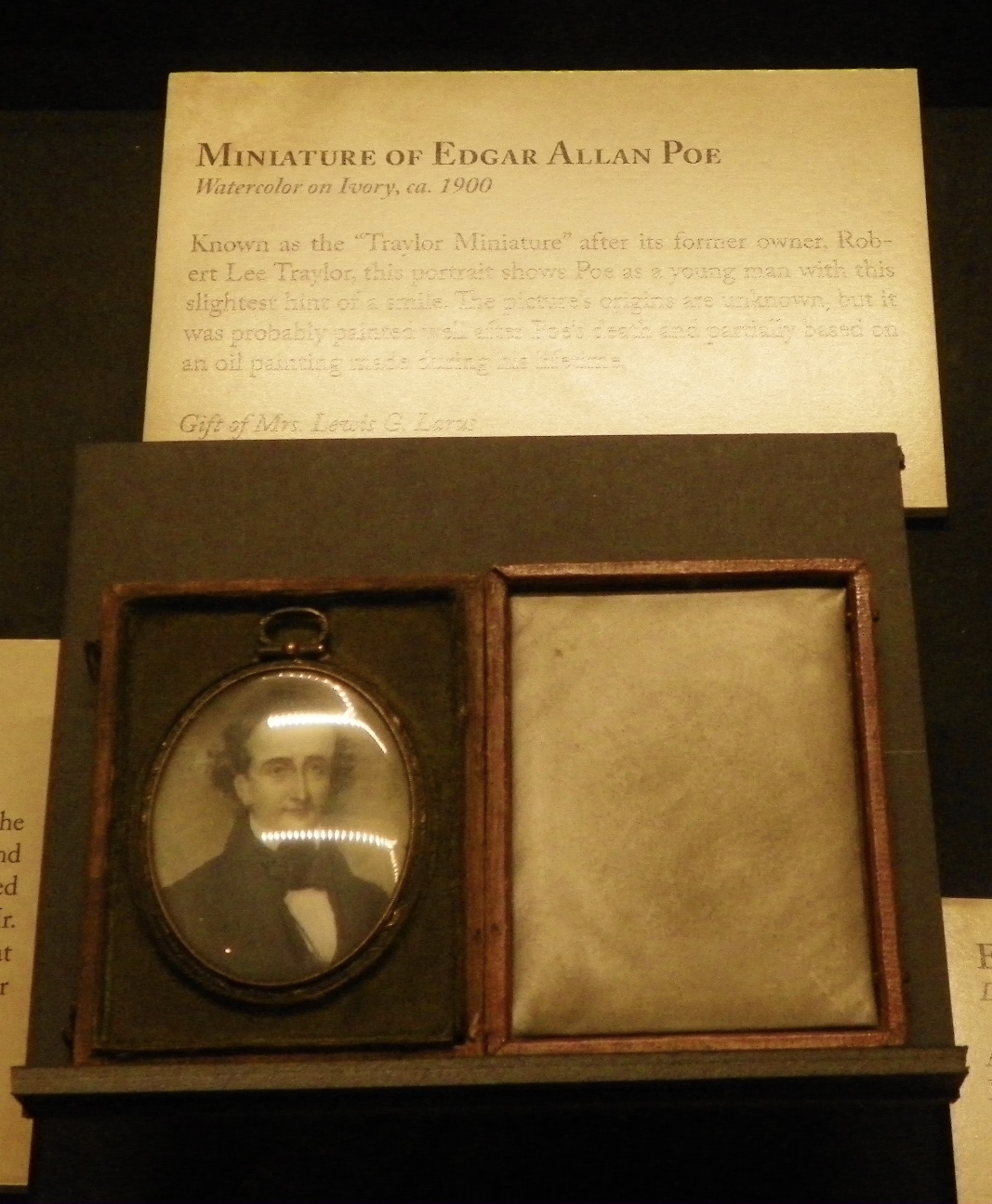
Edgar Allan Poe Museum

Last time I was in Richmond, I finally visited the Edgar Allan Poe Museum. The young tour guide breathed life into the antiques and artifacts with stories of Poe's life, even more intriguing than his writing.

Orphaned by his actor parents as a child, he and his two siblings were taken in by different families. John and Frances Allan of Richmond reared Edgar — Frances was fond of him, but John and Edgar did not get along.

On his own as a young adult, Poe struggled at various professions and found his way into writing. At 27, he married his much younger first cousin, Virginia Clemm. The following years were the happiest time in his life, with some writing success and family life with his wife and aunt in Baltimore and later New York.


Edgar Allan Poe's desk
Virginia died young of tuberculosis, after 11 years of marriage. Poe floundered after that, with less success in his writing career and a failed courtship.

Around 1849 he found work in Richmond and renewed a relationship with a childhood sweetheart. He planned a trip to New York to move his aunt/mother-in-law to Richmond to live with him. Mysteriously, he was found in Baltimore, disoriented and delirious.

After a few incoherent days in the hospital, he died on October 7, 1849. The cause of death remains a mystery. (The 2012 movie The Raven gives a fictional account of Poe's death as murder by poison.)


Poe's childhood home no longer exists, but its original staircase and other artifacts belonging to the Edgar Allan Poe Shrine (now Foundation) found a home with Richmond's oldest house, built ca. 1737.


The buildings are also home to two black cats, Edgar and Pluto. I only snapped photos of Edgar, who was patrolling the courtyard (Pluto was lounging at the bottom of a dark staircase), but I got to pet both of them.

The gift shop added to my wish list, including the book The Poe Shrine: Building the World's Finest Edgar Allan Poe Collection, a book about finding artifacts for the museum, including first editions of Poe's poems and books.


This post contains affiliate links. Clicking on them enables cookies so that I can benefit if you make a purchase.


Monday, March 27, 2017

QUIP 2017 - a writing retreat in South Carolina


I went to the Quakers Uniting in Publications annual conference this month at Penn Center on St. Helena Island, South Carolina, a place draped in Spanish moss and historical buildings. It's the site of an early school for freed slaves, started early in the American Civil War.


We stayed in Benezet House, a century-old dorm that housed female students and teachers and hosted classes and co-ed chapel services.


It was nice staying together in one building, grabbing coffee or tea in the morning or settling into couches with our laptops in the shared living room.


QUIP planned more down-time, this year, between guest speakers and business sessions, so there was a little time to walk down to the water and around the historical buildings, or to think and write.


Last year's storms had closed the public (ocean) beach. After a tumble that left me bruised and a little wobbly, I kept my explorations to the inside of the old house.


I'd noticed chimneys and cupola vents from the outside and wondered if the attic might be accessible. There were, indeed, easy stairs up, but the access was partially covered by a large, precarious piece of scrap wood. I peeked through the opening and decided not to try to wrestle the covering.


Most of the attic was filled with modern HVAC ductwork and blown-in insulation. One curious thing was a small wooden room, built up to the roof. What was it used for - storage? Was it used to hide something?


Covered circles in the chimneys and the wide hallway upstairs indicated that wood stoves were used for heat. A beautiful, built-in armoire in the hallway must have been shared. We looked into the room behind it and discovered the space inside is now used for closets, but the facade of doors and drawers has been preserved!


The small museum across the street was loaded with information about the school and the Gullah people who lived on the islands (no photography allowed).


You can read more about Penn Center in Penn Center: A History Preserved.


Here are posts about QUIP 2012, 2011 (and here),

Monday, January 30, 2017

Books of 2016 - and a Giveaway

Books for Business and Life

Born for This: How to Find the Work You Were Meant To Do - I enjoyed reading an advanced copy of Chris Guillebeau's latest book, and I'm ready to read it again. You don't have to be a full-time entrepreneur to enjoy it; tips and stories include "side hustles" and improving your current job. (Read my review here.)


Would you like to win a free copy of Born For This? Simply leave a comment on this blog post by Friday night, Feb. 3. Be sure to include a way to contact you if you win (e-mail or instagram handle).*


I read part of and skimmed The Courage to Be Rich, but it's terribly outdated. These sound principles for personal finance were written prior to 9-11 (2001), before ideas like skipping that "daily" restaurant coffee became so cliche.

The Shack: Where Tragedy Confronts Eternity – Part thriller and part mind-blowing religious perspective. Aside from a few spots in the middle where the same idea was repeated over and over, this was one of those unique books that leaves you thinking after the final page.

Autopsy of a Deceased Church: 12 Ways to Keep YoursAlive – I highly recommend this book, especially for small church groups.

The Life-Changing Magic of Tidying Up: The Japanese Art of Decluttering and Organizing – I'm still recovering. Or, well... my loveseat is still recovering (where I stacked things). I read the whole book but only attempted the first phase of cleaning out, which resulted in me donating eight bags of clothes – eight bags! For people who want to declutter, I think we need a combination of this KonMari big-event method and FlyLady's 15-minutes-a-day method. The author, Marie Kondo, seems OCD and "born organized." One good idea I took away is that things are a function of time: it's easier to let go when something has already served its purpose. But Marla Cilley, known as the FlyLady, understands those of us who are not constantly cleaning but have 100 things on our minds.

Blog Post Ideas: 21 Proven Ways to Create Compelling Content and Kiss Writer’s Block Goodbye – a quick read with lots of practical ideas.

Books for Genealogy and Writing

Forensic Genealogy – The author is another engineer turned genealogist! I read the entire text and enjoyed it, but would only recommend it to people who like spreadsheets and want to learn more about DNA.
You Can Write Your Family History (2003 version) – I started this book about a decade ago, but thought it dry and too heavy on nonfiction emphasis (I was drafting a novel of my 17th-century ancestors with few facts available). I read the entire book in 2016 and it seems spot on, now that I'm writing nonfiction about my 19th-century family (with enough facts for a story). I recommend it, based on where you are in your family history writing. 

I read most of The 26th Regiment of N.C. Troops, plowing through the battles, as research for the book I'm writing about my great-great-grandfather.

Petersburg: National Military Park, Virginia – more research.


Books for Fun

My recreational reading was all science fiction, from the Victorian era to 5,000 years in the future. Now that I think about it, all the stories occurred no farther than Earth and Mars.

Seven Eves – At 867 pages, this book is huge! But amazing. I had to read it in spurts, because every time I picked it up I stayed up too late. 
Babylon 20/20 – A fast read about what life in the near future could be like if things went horribly wrong. (Disclaimer: my sister wrote it! Proud sister, here!)
John Carter of Mars (A Princess of Mars) – I've wanted to read this classic since the movie came out. It was entertaining, but flowery. 
The 100 – I'd watched the TV show, but the books are very different. I mean, the cover has a picture of Finn, and he's not even in the book!
Day 21 (The 100, book #2)

I'm still Reading:
Homecoming (The 100, book #3) – OK, the show and the books have diverged so much that I kinda got stuck. 
Dirt and the Good Life – Essays by a couple of professionals who took a sabbatical to run a farm. One of those low-stress books with separate stories that you can pick up any time. 

And I started, but put aside: 
Making a Literary Life
I Am Spock

Here are the books of 2015, 2014, and 2012.

Don't forget to leave a comment to enter the giveaway. If you enjoy pictures and stories about books, follow me on Instagram.

*Be sure to leave your contact information (e-mail, instagram, or twitter handle; Facebook won't work for non-"friends") along with your comment to enter the book giveaway. The Friday night deadline includes most time zones, but generally ends around midnight EST. If you win, I'll send you a message to keep your address private. Entrants from outside the continental U.S.A. agree to pay shipping.

This blog contains affiliate links – if you use them, thanks! I received free copies of Born For This (and bought my own extra copy) and Blog Post Ideas. 

Wednesday, November 18, 2015

The Crazy Life of a Work-at-Home Entrepreneur

I never know what the day will bring.

7 am. Drank coffee. Scanned e-mails. Downloaded pictures off the camera from a Saturday event. Wished I'd taken a few more.

9:15 am.  Arrived at a local church for an interview, hair still wet. Got introduced to about 50 preschoolers who were told to impress me with their singing. Sang "Do Lord, Oh do remember me." Good interview.

10:30 am. Drank coffee. Wrote cover letter for a magazine job.

12-1 pm. Distracted as I went online to find the right editor's name. Nothing online. Convinced the printer to print cover letter and resume. Fixed lunch.

1:30 pm. Found the magazine in my bedroom, listing lots of editors' names. Took a nap.

3:00 pm. Called the school to get a quote to add to the church article. Felt self-conscious about uncoifed hair while talking to busy principal. Maybe if I get the magazine job I'll work on my appearance.

3:30 pm. Checked mail and discovered it was warmer outside than inside. Took kitties out on leashes and took papers to edit.

3:45 pm. Amelia leaps into the edge of the creek, plays around on wet leaves. I have to kneel on the muddy bank to reach down and scoop her out. As I try to wrangle both to go inside, Galina backs out of her leash and falls into the middle of the creek. Panic ensues. She splashes upstream until finding an exit. In summary, Galina does not enjoy her first shower, given by me, fully clothed (for my own protection). At one point she opens the sliding glass doors and runs out. I realize just in time that the edited papers are in my back pocket. Papers survive. Cat is grumpy. Amelia gets off with just a paw-washing. We all survive.

4:30ish pm. Put on dry work-out clothes. Wrote a blog post.

5:30 pm. Met my sister at the gym for step class.

6:30 pm. Cooked dinner and watched a show on Netflix.

8:30ish pm. Washed towels from today's adventure. Decided it was too late to start budget work for an upcoming board meeting. Changed into pajamas from chilly sweaty workout clothes.

9ish to 10 pm. Finished revising cover letter and resume in bed (I don't  normally work in the bedroom). Final review and finding links to published clips will have to wait until tomorrow. Sweet kitties are already fast asleep on the bed.


Friday, May 01, 2015

Get Back Into Writing — 8 Tips

So far, 2015 has not been the year of writing for me. I started January gung-ho about a nonfiction book, but sometimes "life gets in the way." To sum it up in a tweet:
2015 so far: visited friends, moved bookshop, family visit, snow, family death, scrapbooked, sold a house, family wedding, mission trip... 
Is it any wonder my writing's been waylaid?!

'Thought I'd share some strategies that help me get back into writing. What gets you motivated? Feel free to add tips in the comments.

1. Free Write. Too paralyzed by perfectionism to start that next query? Daunted by that draft that hasn't been touched for two months? Grease those mental gears by writing about anything else. Set a timer and write about writing, or a memory, or a photo in the nearest magazine.

2. Journal. Capture events, details and feelings from today or the past week.

3. Change the Scene. Take your notebook or laptop to the library, city park, coffee shop or bookstore.

4. Carve Out Space. Create a writing nook or small office in your house. No room? Then pick a different chair from the one where you watch TV or do other routine activities. Keep your writing things — notebook, pen, research books — in that location. The trick is to signal your subconscious; when you sit in that spot, it's time to write.

5. Unplug. Yes, we type faster than we write (Scrivener is my favorite writing software). If you need to get out of a rut, however, or if you spent all day on the computer at your day job, it's time to pull out the paper. Brainstorm ideas for articles. Skim through Writer's Market books or your favorite magazine for submission ideas. When my genealogy-based book projects have been neglected, I draw an extended family tree and tape it to the wall to get a feel for timeline and subplots. Some writers use mindmaps (flow charts of ideas) while others sort characters or scenes on index cards.

6. Protect Your Best Mental Time. I never thought of myself as a morning person. I'd find myself standing in the shower or sitting at the table, staring into space. I finally realized that, while I'm not physically a morning person, my mind and imagination are in hyperdrive. Now I say no to morning meetings and appointments that aren't the best use of my most creative time.

7. Motivate with Deadlines and Rewards. Other people's deadlines work great, especially submission dates from a paying editor. Sticking to your own deadline, however, is hard, especially for a long-term project like a book. First, break big tasks into small pieces, like editing 10 pages or drafting a query letter. Don't use an essential as a reward — like eating a meal or playing with the kids. Pick a small luxury, and stick to it — like watching TV or treating yourself to a latte.

8. Connect with Community. With so many demands on your time, it's easy to put off writing. But having writer buddies to meet you at that coffee shop, or a weekly critique group, is a huge motivator (with a deadline!). I wrote this blog post at the encouragement of Wordsmith Studio — an incredibly supportive online writing community. We're celebrating our third anniversary!


Thursday, November 27, 2014

NaNoWriMo!

I knew this would be a crazy year (2014 Calendar), and it hasn't let up. Fun and craziness are in full gear for November, which is National Novel Writing Month, known by participants as NaNoWriMo.

November 1 write-in at Geeksboro
I did pretty well the first week, fueled by our local group of writers. We met up for write-ins at Geeksboro, a unique coffee shop and movie theatre with a gaming, communal-TV-watching clientele.

Friday, September 19, 2014

Writers' Police Academy 2014 — Day 2

Classes started again early Saturday morning. I enjoyed the session on Policing "Back in the Day." Less than 40 years ago, police still carried revolvers (eg. six-shooters that you have to cock between shots), had only two items on their belts, and had very limited radios. Information — like license registrations — came from books, not computers, or from teletype machines that sent requests for somebody in another state to look in a book. (For a fun fictional account of cops and life in the 1970s, I recommend Life on Mars.)

I grabbed a seat in John Gilstrap's class, which had been overflowing all weekend. His take on "Technical stuff that writers get wrong" had us falling out of those precious seats. We moved from laughter to sobriety as he showed us what kind of damage bullets and explosions can do.

"There are no flesh wounds" or minor bullet wounds, contrary to what we see in movies and TV shows. Even a shoulder is a complex part of anatomy (those of us with past injuries can agree). And a broken leg will not hold a person's weight.

(The very next day I read a passage wherein a villain was standing in the protagonist's path, a piece of bone jutting out of his leg. But maybe the laws of physics don't apply in fantasy...).

Writer and former prosecutor Alifair Burke debunked myths about court cases and police procedure, especially search and/or seizure. More than 90% of searches don't have or need warrants.

The banquet was fun, as usual, though busy for those of us behind the scenes.

Michael Connelly was our featured speaker. He keeps a dedicated writing schedule to pound out all those novels. He worked as a reporter before publishing his first book. As a former journalist myself, his statement resonated with me: "There is no writer's block in the newspaper business."

The silent auction, raffle, and some practical joking topped off the evening. Here's yours truly with the crime scene quilt, one of the silent auction items. It reminds me of a little bookshop decor.

Back to Writer's Police Academy — Day 1

Monday, September 08, 2014

Writers' Police Academy 2014 — Day 1

How do you sum up a high-speed weekend of buzzing writers, detectives, forensics experts, famous authors, a prosecuting attorney, an explosives expert... and much, much more?!

Friday morning I walked into the chaos of our largest class of "recruits" ever. For part of the day I hung out in the hallways, checking people off for the firearms training and emergency driving simulators, and giving directions. I enjoyed the look on one man's face as he walked out of a classroom to hear me direct a lady to "prostitution class" across the hall.

I snuck in a couple of classes, including part of "Romance Behind the Badge." I enjoyed Rick McMahan's class on firearms basics. We learned the differences between rifles and shotguns; single-shot, semi-automatic and automatic (machine guns); revolvers and (semi-automatic) pistols.

Lisa Gardner returned this year and gave an inspiring talk on turning facts into fiction. Most of the experts she calls don't recognize her name. She can almost hear them wondering why she wants to know so much about murder! One of her great tips was to use the coolest detail, or the assumption you made that was wrong — but don't put everything you learned into the story.

Sisters in Crime hosted Friday night's reception. I talked to a couple of the instructors and met a lady from Missouri who, like me, has started a colonial-era historical. I finally drove home. Time for a little sleep before another day of excitement!

Click on the WPA tag below to see past years of Writers' Police Academy or move on to Day 2.

Tuesday, December 31, 2013

2014: A Writer's Calendar

New Year's brings out all the goals and resolutions for the coming year (especially for bloggers).

I don't know how people do it.

I like goals to keep me on track, but the holidays (preceded by NaNoWriMo) are so crazy. I need time to ponder important decisions, like how I might spend a precious year of life.

I don't want to wait too late, though. In 2010 I didn't make goals until June! Last year, I wrote a retrospective of my writing year in April, my blogiversary and Wordsmith Studio's anniversary.

As I work on goals over the next few days, I'm considering all the writing events and opportunities coming up in 2014. This list might be useful for other writers, too. If you know of similar events (especially free ones and month-long challenges), please add a link and short description in the comments.

January

Robert Lee Brewer of Writer's Digest will help us kick off the year with daily ideas or prompts starting Jan. 1 at the Get Started Write Challenge. Look for the latest challenge here or follow @robertleebrewer or Twitter hashtag #gswc.

Joy Weese Moll encourages people to read books that will help them with their goals — writing or otherwise — in her New Year's Resolution Reading Challenge.

National Blog Posting Month (NaBloPoMo) starts every month at BlogHer. Sign up by Jan. 5 to join this month's challenge. (See November for more.)

Cartoonist and encourager Debbie Ridpath Ohi hosts the 250-500-1000 Words A Day Challenge.  You choose your goal and start anytime during the year. Debbie has links to fun word-count widgets you can add to your blog.

February

I've always wanted to do The Month of Letters Challenge, hosted by author Mary Robinette Kowal. People love to get real letters in the mail. The challenge is simply to mail something — a letter, card, postcard — each of the 23 days that the mail runs.

Lynn Palermo hosts the Family History Writing Challenge throughout the month of February, a great nudge for those who've always wanted to put those stories or that research in writing.

April

Two Camp NaNoWriMos are planned this year, one in April and one in July. The camps, similar to NaNoWriMo (see November), match you up with a small group of fellow writers in your genre.

If you're more interested in poetry than noveling, Robert Lee Brewer also hosts the April PAD (Poem-A-Day) Challenge at Poetic Asides.

May

I'm a member (and social media admin @quakerquip) for Quakers Uniting in Publications, an organization for writers and publishers. Their annual meeting is in New England this year, May 1-4, at Woolman Hill Quaker Retreat Center in Massachusetts.

July

Camp NaNoWriMo — see April.

September

Writers' Police Academy is not a free event, but I always participate and have an awesome time. Registration will open soon for the Sept. 4-7 event in North Carolina (fills up fast!).

October

For nonfiction inspiration, Jane Ann McLaughlin () hosts the October Memoir and Back Story Blog Challenge. 

November

November means National Novel Writing Month! It's not just about writing 50,000 words in 30 days, it's the huge motivation from doing it with other writers cheering you on. We have an active group of local wrimos and love to meet up in person for that extra writer mojo.

For poets, Robert will encourage you to write a chapbook at the November PAD Chapbook Challenge.

November is peak time for NaBloPoMo — the challenge is to write a blog post every day. BlogHer provides optional prompts from the month's theme. One participant has a list of FAQs on an unofficial guide site.

December

Did you write a poem a day in November? Poets follow up by editing in December, then submitting their manuscripts!


Welcome to Wordsmith Studio's New Year's Bash Bloghop! Did you just arrive from Janice's Inspiring Quotes for 2014? Hop on over to MobyJoe Cafe for the... well... Jeannine's different perspective on New Year's Eve.

Thursday, September 19, 2013

Writers' Police Academy 2013 — part 3

After my Saturday morning shift and a dose of firearms training, I attended the "From Crime Scene to Court" workshop on crime scene evidence. There's so much going on at Writers' Police Academy one can't catch it all. I didn't even make it to all the sessions Dave Pauly and Katherine Ramsland taught, but showed up enough to qualify as a forensics groupie.

Kathy Reichs, forensic anthropologist and bestselling author, led the afternoon special session. Her books inspired the TV show Bones. Since I don't have TV, I didn't know much about her work, but found her presentation fascinating. She bases all the forensic puzzles in her books on cases she's handled in real life.

Kathy Reichs with new fan Elizabeth Saunders
Kathy explained that a forensic anthropologist is called in when an autopsy is no longer possible because of decay, and an archaeologist when the body is too old to impact a court case, about 30 to 40 years. Her puzzles include more than murder — she's worked on disaster sites, mass graves, POW/MIA cases, and identified the bones of an 18th-century nun.

I came home and found one of her books in my bookshop, Spider Bones (no, I haven't read every book in the shop!).

I devoured it — all day Sunday and part of Monday. 

(No spoilers) One plot line involves identifying the remains of a soldier killed in Vietnam. Kathy used her work with JPAC, the Joint Prisoners of War, Missing in Action Accounting Command, for details in the story.

At my part-time archives job, I've been processing a collection of papers on the Vietnam War all month. I knew little about those times, and the work has been both enlightening and disturbing. I would have enjoyed Spider Bones' forensics, intertwining subplots and family drama anyway, but the collection at work gave me a fresh perspective.

Tomorrow (Sept. 20 this year) is POW/MIA Recognition Day. "Until They Are Home" — that's JPAC's motto.

In tomorrow's post, travel back in time to remember other POWs — from 150 years ago.

This post contains affiliate links. And here's a temporary link to two signed copies of Kathy Reichs books. 

Tuesday, September 17, 2013

Writers' Police Academy 2013 — part 2

5 Things I learned from firearms training


For four years of Writers' Police Academy, I've heard writer-recruits gush about the firearms training simulation, FATS. From their adrenaline-fueled talk about shooting bad guys and trying not to shoot bystanders, I pictured video targets popping up a la Men in Black ("Little Tiffany" scene).

Not quite.

This year, I experienced the simulator first hand. Being a nice little Quaker girl without small arms experience, I wasn't so sure I wanted to shoot a gun. (All you peeps from my first career — stop laughing! Notice I said "small arms.") I'd never shot a pistol before, and hadn't fired a rifle in years.

The instructors briefed us on how to hold our guns, aim, and reload. My Glock 19 was easy to handle; not so easy to aim. (I did have new monovision contacts in and consistently missed to the right. That's my excuse and I'm stickin' to it.)

The scenarios were eye-opening.

I'd always imagined good guys vs. bad guys, a view reinforced by the thrillers we read and watch (and write). Most of the scenes start with a traffic stop or emergency call, and the officer has no idea what he's walking into; ie. whether these folks, these human beings (not black-and-white targets) are good, bad, or somewhere in between. The violence escalates so fast, there's no time to react.

Here are five things I learned:

1. People with empty hands can quickly pick up or pull out a weapon.

2. Weapons can be hard to identify. Did you know there's a cell-phone gun?

3. Upset bystanders can quickly turn into threats.

4. Things happen too fast for really accurate aiming. Even practiced law enforcement shooters lose accuracy because of the adrenaline-filled, split-second timing of an armed encounter.

Anybody who owns a gun needs to practice, practice, practice. Since there's no time to think, only those who've turned their skill into instinct have a chance.

5. I like the Glock 19. I don't want one. I'm so afraid of hurting the wrong person out of fear or bad aim, or that my own gun could be used against me in a surprise attack.

That's the implication in this News 2 story on concealed weapons, cautioning civilians about using their own guns. The video includes a clip from the simulator and features one of WPA's instructors.

I have even more respect for our law enforcement and emergency services folks. If they get a little tense in certain situations, like traffic stops, they have good reason! Thus the intense felony traffic stop in Writers' Police Academy 2013 — part 1.

Training opportunities like FATS not only make us better writers, but also better able to cope with life situations (like in WPA's past self defense classes). Guilford County Sheriff's Office just started a Citizens' Academy, which will include FATS as part of a weeks-long training program.

Wednesday, September 11, 2013

Writers' Police Academy 2013 — part 1

Writers' Police Academy turns murder and mayhem into a three-day thrill ride for writers. 

Lee Lofland, who organizes WPA with Guilford Technical Community College and High Point Library, watched the new recruits come in after planning all year. He wrote his mother hen account of Thursday night as Day One, "All My Children." 

My fourth year working behind the scenes shifted into gear Friday morning. Between directing recruits to firearms training and peddling souvenirs, I caught part of Detective Sluder's session on Human Trafficking. He taught us the difference between trafficking (crime against a person, involuntary) and smuggling (crime against the state, voluntary), and told us about the NHTRC resources and hotline. 


Katherine Ramsland
Dave Pauly
Friday afternoon brought more free time to hear Katherine Ramsland and Dave Pauly teach about cold cases. There are over 150,000 cold cases (since 1980). 

Katherine got to help verify the body of Jesse James. "It's great fun to dig up old people," she said. 

Dave warned that a lot of murders show no signs of forced entry — the victims let intruders schmooze their way inside. (As I was writing this, I talked to a power company rep through my locked, glass door and told him to leave the paperwork outside.)

In a crowded afternoon session, Katherine (Dr. Ramsland) explained the difference between serial killers, mass murderers and killing sprees. The definitions have changed over the years, but basically, serial killers have a down time between killings, and they plan to go on killing without getting caught. Spree killers are on the move, in sort of a suicidal car-jacking supply-stealing escape, and don't stop until someone stops them (I'm thinking Bonnie and Clyde). Mass murderers have been building up some sort of grudge or anger for years, and retaliate in an explosion of killing — not necessarily the person or people who started the grudge.

Dr. Dan Krane gave an entertaining and technical presentation on DNA forensics. As a novice DNA genealogist (who solved a 137-year-old missing person case last year), I was fascinated. 

He told us what tiny amounts are needed for a DNA sample, and the importance of how the results are presented in court. In one case, a man was convicted on a partial DNA profile, when that same profile could have applied to at least three other people at the scene. 

And you only need about $50-60,000 to start your own crime lab. 

WPA throws in a few surprises every year. Instead of a speaker for the Night Owl session, we left the hotel to watch felony traffic stop procedures. 


Traffic stop with an unknown number of suspects in the car.


"Keep your hands in the air and walk backwards."


Don't mind Lee. He's just taking pictures for The Graveyard Shift.  ;-)

Here are Lee's Friday photos. 

Saturday, August 03, 2013

'Double Vision' by F. T. Bradley

Look what just arrived in the mail!


F. T. Bradley (Fleur), a fellow founding member of Wordsmith Studio, incorporates her penchant for history into middle-grades thrillers. I was intrigued by the idea of stories along the line of National Treasure for kids, and wanted to read it myself before recommending it to my young nephews. Fleur was kind enough to sign my copy of Double Vision and sent an extra one for my local library.

The second book in the series, Double Vision: Code Name 711, launches October 15.

With hints like Leonardo da Vinci, Paris, George Washington's coat, and America's first cadre of spies — I'm looking forward to a little reading!

Disclaimer: I received a review copy for myself, with no obligation other than to share the second copy. Affiliate links are included in this post.

Monday, May 06, 2013

Irish names

As I fill in servants and supporting characters in my history-based fiction, I want to avoid stereotypical Irish names like Patrick or Moira. What were the given names of people who really lived in early modern Ireland?

I started with a primary source, the "Sufferings" of the Quakers in Moate Monthly Meeting — and immediately ran into the great dilemma of this type of research: who was Irish and who was English? Centuries of English colonization or "plantations" (preceded by Viking and Norman settlements), along with intermarriage, left a mixed populace. The question of whether a man was Irish or English might be restated as: "Which generation of English was he?"

The prefixes O' and Mac served as a guide as I scanned the indices of my reference books. MacLysaght also claims Crowe, Maloney, Brady, Cock and Spencer as Irish surnames. The best source for other surnames turned out to be The Grand Juries of County Westmeath, containing an appendix of family genealogies that takes up most of the book.


Given names for men


The most common are Daniel, Hugh, George, Edmond or Edmund, Sean, Thomas or Tom, and James. There were also several mentions of Torlogh or Turlough, Robert, Con or Conn, John, Eoin, Owen, Kevin, Brian or Bryan, Keadagh or Kedagh, Terence, and Donall, Donel, Donal.

More names: Denis, Fergal, Art, Redmond, Egan, Beare, Rory, Peadar, William, Michael, Ernie, Eamon or Eamonn, Dermot, Edward, Eddie, Antony, Anthony, Lucius, Jimmy, Cormac, Stephen, Henry, Raymond, Ramsey, Joe or Joseph, Martin, Frank, Art, Arthur, Seamus, Conor, Feagh, Charles, Cahir, High, Jeremiah, Patrick, Paddy, Colm, Allen, Neil, Neill, Shane, Abraham, Nial, Aghery, Christopher, Theobald, Nangle, Phelim, Mallachy, Maurice, Richard, George, Morgan, Conla, David, Hubert, Hume, Francis, Breasal, Thadeus, Garrett, Nathaniel, Peyton, Whitney, Francis, Logan, Theobald, Walter, Peter, and Cuthbert.

I primarily wanted early modern Ireland names, but Grand Juries also provides interesting ancient names with their Roman equivalents; you can see how they morphed into more modern names.

Duachus Galach, Duach, Errnin, Eogan (Owen), Fergusius, Feargna (Fergnaus), Achaius (Eochy Tiorm), Aodh Finn, Brenain, Cathalan, Arten, Orgaille (Orgallius), Brefny, Cu-Conachi (Constantine), Mac-nahighe or Macnahighe (Nicholaus), Tiernan, Godfrey (Godfridus), Maolsachlin (Mallachy), Giolla-Joso (Gelasius), Giola-Josa-Ruadh (Gelasius), Cathal (Cathaldus or Carolus), Donogh, Murketagh, Awly, Fergall, Andach, Morough, Matha (Mathew), Matthias, Rufus, Manus, Maolmordha, Philip, Cuconacht, Cormac, Mahon, Carbrey, and Fedlim (Phelim).

The names in Modern Ireland are more recent and possibly anglicized. They continue many of the names already listed, plus Justin, Connor, Frank, Oliver, Malcolm, Michael, Heber, Louis, Nevil, Samuel, Flann, Murrough, Mairtin, Feargus, Tomas, Cahir, Jeremiah, Sylvester, Ernest, and Philip.


Given names for women


By far, the most common name I found was Katharine, Catherine, Kate. Mary and Mary Anne also showed up several times.

Other names were Maud, Bernadette, Patricia, Rossa, Patsy, Nuala, Grace, Kitty, Dorcas, Genet, Margaret, Jane, Elizabeth, Susannah, Diana, Louisa, Ruth, Jane, Eleanor, Bridget, Sarah, Margaret, and Anne.

More ancient: Fedelonia, Indearva, Ranalt, Winifred, and Finguola (Penelope).

More modern (in addition to the names above, still in use): Deidre.

You'll notice I included nicknames and spelling variants. Here's a great resource on nicknames and how some names changed.

Saturday, May 04, 2013

Bookhunting season 2013

The past few weeks have been a whirlwind of bookhunting, signings and getting ready for spring open house at the bookshop.

I traveled to the Chatham County Library for the first time in a year. This time I hit their bag-sale day and brought back four bags of books — a wide variety, from an unusual vintage photograph of the USS Barker to true crime to English castles. Then I headed south by memory and map, enjoying the beautiful spring day with trees and azaleas blooming. I fumbled around Fayetteville (who knew it was a big city?) looking for the Barnes & Noble, where a friend met me for lunch. After food and catching up we wandered around the bookstore, but I didn't find what I was looking for, especially since I wasn't sure what it was.

The next weekend local author Carolyn Nelson signed books at the shop. Worried about sharing my sore throat, I hid behind the counter most of the day. Fortunately, Carolyn had visitors and friends to keep her company.

I recuperated in time for the annual St. Francis book sale, one of my favourites . Since it was the first day of the sale, I focused on the old and rare book room (one of my earliest posts) and only bought a small box full of books, including H.G. Wells, Sir Arthur Conan Doyle (Sherlock Holmes) and Winslow Homer (black Americana from the Civil War and Reconstruction).

I'd planned to go back Saturday for bag-sale day, to stock the shop with "beach reads" from their wealth of trade paperbacks. Friday night, however, the phone rang. It was the Quaker network — which is a wonderful thing. Jamestown Friends Meeting was having a yard sale early the next morning. Now, I'm not a fan of yard sales, and I'm not a fan of early. But a mutual friend was downsizing, and she might have donated her books to the sale.

So the next morning, bright and early (more early than bright!), I switched destinations from Greensboro to Jamestown (both cities named for Quakers, by the way). I found books and more books, got hugs, bought coffee, and was southern sweet-talked into a freshly baked pecan tart. It turned out to be a most pleasant trip.

This week, after final preparations for the spring sale and open house at the bookshop, I drove down to Asheboro to ask Jeffery Deaver to sign a few books. He spoke about his writing life at the Friends of the Library annual meeting.

He started writing at age 11, but went on to other careers, including law. He began writing during his long daily commute, but threw his first two books away!

Stories like that inspire me to keep writing. Have you heard stories from published authors that keep you going?

I met Jeffery Deaver at Writers' Police Academy 2010, when he'd just started the new James Bond novel, Carte Blanche. Now that it's out, I wanted him to sign my copy. He also signed a couple of his previous works for the bookshop.