Showing posts with label Virginia. Show all posts

Monday, October 08, 2018

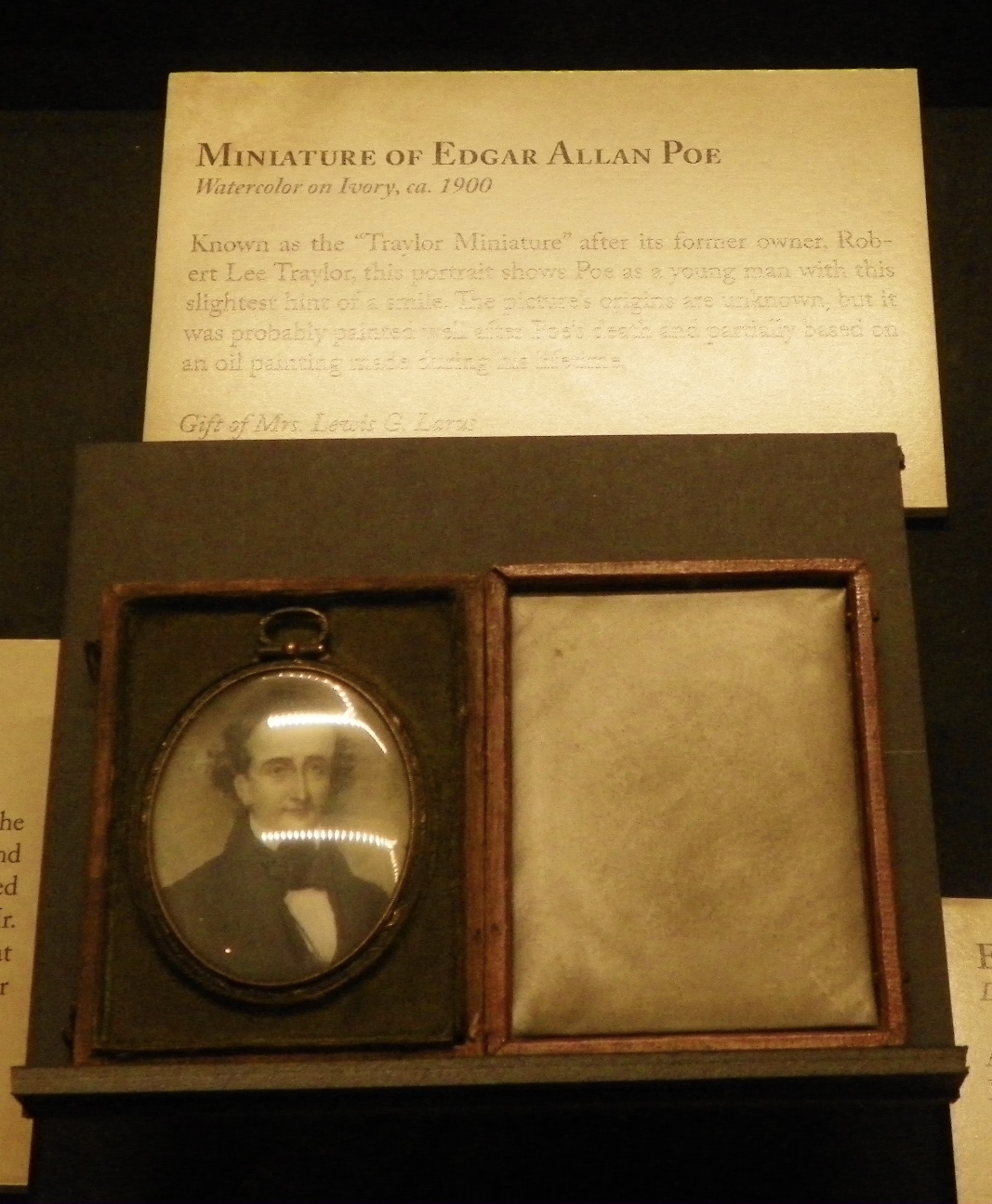
Edgar Allan Poe Museum

Last time I was in Richmond, I finally visited the Edgar Allan Poe Museum. The young tour guide breathed life into the antiques and artifacts with stories of Poe's life, even more intriguing than his writing.

Orphaned by his actor parents as a child, he and his two siblings were taken in by different families. John and Frances Allan of Richmond reared Edgar — Frances was fond of him, but John and Edgar did not get along.

On his own as a young adult, Poe struggled at various professions and found his way into writing. At 27, he married his much younger first cousin, Virginia Clemm. The following years were the happiest time in his life, with some writing success and family life with his wife and aunt in Baltimore and later New York.


Edgar Allan Poe's desk
Virginia died young of tuberculosis, after 11 years of marriage. Poe floundered after that, with less success in his writing career and a failed courtship.

Around 1849 he found work in Richmond and renewed a relationship with a childhood sweetheart. He planned a trip to New York to move his aunt/mother-in-law to Richmond to live with him. Mysteriously, he was found in Baltimore, disoriented and delirious.

After a few incoherent days in the hospital, he died on October 7, 1849. The cause of death remains a mystery. (The 2012 movie The Raven gives a fictional account of Poe's death as murder by poison.)


Poe's childhood home no longer exists, but its original staircase and other artifacts belonging to the Edgar Allan Poe Shrine (now Foundation) found a home with Richmond's oldest house, built ca. 1737.


The buildings are also home to two black cats, Edgar and Pluto. I only snapped photos of Edgar, who was patrolling the courtyard (Pluto was lounging at the bottom of a dark staircase), but I got to pet both of them.

The gift shop added to my wish list, including the book The Poe Shrine: Building the World's Finest Edgar Allan Poe Collection, a book about finding artifacts for the museum, including first editions of Poe's poems and books.


This post contains affiliate links. Clicking on them enables cookies so that I can benefit if you make a purchase.


Friday, April 20, 2018

Virginia Antiquarian Book Fair

I attended Colorado Antiquarian Book Seminar (CABS) in 2014, thanks to a scholarship from the Independent Online Booksellers Association. It was a stepping-stone dream come true for a bookseller with just three years in the business. I'd just closed my open shop and planned to make it as an online business.  But our instructors, successful booksellers with a wide variety of experience and specialties, touted multiple options including book fairs and catalogs.

Although I haven't yet made it to Book Week in New York City, I attended the Rocky Mountain Book & Paper Fair in Denver. When I came home from CABS, I didn't feel like I had the inventory to support a real antiquarian book fair. And there aren't any in North Carolina.


As my antique books inventory grew over the past couple of years, I started looking around for a venue in nearby states and found the Virginia Antiquarian Book Fair in Richmond. Alas, they were already booked up months in advance. Bummer.


Then, on March 5, I received a message saying a booth had opened up and was I still interested? Wow! I decided to take the opportunity and mailed in a check. Scary and exciting — my first antiquarian book fair, and only a month to get ready!


I bought another portable shelf and worked really hard getting a "new" collection of American Revolution, Civil War and other books ready to go. I even brought a couple to finish up in the hotel room the night before the fair, handwriting the last few descriptions.


The Virginia fair was very organized and easy to set up. Here's my booth after I sold quite a few books — before the doors opened!


Nick Cooke of Black Swan Books was one of the VABA organizers. Very welcoming and friendly, he invited all of us to his shop in the historic district Friday night. What a fun bookshop! I'd describe it as one and a half stories, with little nooks where you can sit and visit or browse.


It was a nice opportunity to relax a little and meet other booksellers, including people with familiar names that I'd never met in person.

I was happy to see Lorne Bair at the fair, the instructor from CABS who told me I should attend a book fair in the first place!

Overall, it was a great, exciting, exhausting experience. I hope to do it again next year!

Tuesday, April 03, 2018

Tombstone Tuesday – Blandford Church Cemetery in Petersburg, Virginia

I won't have time for research when I visit Richmond for the Virginia Antiquarian Book Fair in a few days. However, I had lovely weather for a visit last fall to Richmond and Petersburg. My goal was to find the general area where my ancestor's brother, Shadrach Maness, was buried.

Shadrach fell early in the siege of Petersburg, killed 23 June 1864. His Civil War record gives no details, but histories of the long battle of Petersburg provide two likely causes of death that correspond to that date. Snipers were picking off soldiers from a distance during that time. There was also a skirmish that day in gullies or trenches outside the Confederate line, a successful attempt to prevent Federal forces from taking the Weldon Railroad.

Oral history says that Shadrach was buried in an unmarked grave near Blandford Church, even though he has a marker in Moore County, N.C. I thought, even if it's unmarked, perhaps there would be a mass grave or some commemorative marker that I could visit.

I had no idea — Blandford Church cemetery is enormous! Stones near the church date back to colonial days and the American Revolution. I caught a caretaker as he was closing for the day and asked him where burials might be for early in the battle. He handed me a rough map, complete with street names, and waved off toward the roads behind the church. "You might try Cemetery Hill," he said. "There's 32,000 of them buried there."

As I walked down the nearest lane, I was surprised by the variety of markers. I've visited large memorial sites, like Gettysburg and Arlington with their small, uniform tombstones. And smaller, old cemeteries with elaborate stones, sometimes with lengthy epitaphs on full-size grave coverings like in Europe. Blandford has both the numbers and uniqueness.

Some of the markers were draped: urns with a draping, or these tall monuments with drapings, but all carved in stone.


These floral headstones had matching footstones.


One grave had its own hobbit-like hill.


There were statues and monuments and mini-parks, including this large arch memorial to "Our Confederate Heroes."


This monument has "Unknown" and the names of states, including North Carolina, carved on its base. Would this be as close as I could get to Shadrach's final resting place?

When I visited last fall, our country was in an uproar about Confederate monuments. This one was built in 1890. I sat in a peaceful gazebo nearby and looked off towards graves that covered the hills in front of me. Why wouldn't people want to pay tribute to thousands and thousands of young men who never got to return home? Shadrach, who volunteered as a substitute for his dear friend Quimby Wallace when the draft was in full force, was only 17 when he died.


Overwhelmed.


I was glad to see a place where various Confederate flags (most with the white background) were still allowed. A cemetery as well as a battlefield, what more appropriate place?

I was equally glad to see the American flag, like these at a marker for World War II and Vietnam veterans. At the end of the War Between the States, "rebels" were given full pardon and the nation was united again. Not always on the same page, as we well know in the 21st century, but our young men and women continue to fight as one under the American flag.


Over near the church, here are some of the early graves with full stones. Some were decorated with Masons marks, some with swords, some with angels.

Different art. Different eras. At Blandford it's as if every individual has freedom to express themselves, yet all end up together in this quiet, peaceful place.
Tuesday, November 08, 2016

Tombstone Tuesday – Nancy Maness

My great-great-grandfather's third wife, Nancy Pool Maness, had a bit of mystery about her. Her son-in-law, the informant on her death certificate, didn't know her date of birth and she's missing in the 1900 and 1910 censuses. Despite her dramatic death — having been killed by a train — I couldn't find any mention of the accident or an obituary in the regional papers. Perhaps her tombstone would at least fill in a date.

Nancy's death certificate clearly states that she was buried in Brown Cemetery. I found modern transcriptions online through Find A Grave and RootsWeb, but no Nancy. Although there are several hundred graves listed, I couldn't find a management office for the cemetery. So I added the cemetery to my Virginia itinerary, hoping it wouldn't be so large that I couldn't find anything.

Directions and GPS led me north of Radford, along a winding road in the low mountains with glimpses of a parallel railroad track.

As I turned into a steep drive, I laughed at myself, realizing why I hadn't been able to find an "office." Brown was a family cemetery that grew into a community cemetery. On top of a hill in the countryside, the stones stand out in dramatic outline against the evening sky. The cemetery looks down on the railroad track to the east and a large pasture with cows to the west.

The sun cast a burst of rays through the clouds as I walked, row after row, reading the names. I never found Nancy, or Fannie (who was also buried there), or Nancy's parents. A few stones were completely obscured by a black mold. Patterns in the grass told me there are many unmarked graves. Sadly, I saw a few from this century that still have temporary markers – future unmarked graves for those either too poor or too alone to afford a permanent gravestone.

At least I saw the cemetery, in some way paying my respects. Perhaps there's a book or a file somewhere that has an older list, including stones that aren't there anymore.

After a good dinner and a night's rest in Radford, I returned to the courthouse in Pulaski to finish looking through the chancery file. Before heading back to North Carolina, I stopped in the old courthouse and then the Ratcliffe Transportation Museum. The latter has a scaled model of the town of Pulaski in the 1950s, as well as a museum of local history.


Friday, November 04, 2016

Nancy Pool Maness – part 2

Since finding my great-great-grandfather's third wife, Nancy Pool Maness, who had a daughter (Fannie B. Maness Sifford) and later died in a tragic accident, I wanted to know more about her life. I don't find Nancy until the 1920 census, which leaves a huge gap since 1880. I've never found Thomas in any census, except 1870 with his first wife and children. Did he stick around a few years, or did his wanderlust take him away before Fannie ever knew him (like in his second marriage)?

The 1920 census gave me a clue: Nancy owned her own home in the Dublin Magisterial District, Pulaski County, Va. Perhaps a deed or a will would mention Thomas. So I traveled to Virginia a few weeks ago for a short research vacation.

I started looking in the Pulaski County Courthouse in the town of Pulaski. The only index reference I found listed Nancy Poole Manes [sic] estate as grantor.

Nancy actually lived in Belspring, not the city of Dublin. The deed book mentioned property sold in a case of Mrs. Agnes Maness, plaintiff, against Charles P. Sifford. I recognized Charles as Nancy's son-in-law, Fannie's husband. There were no details.

More information was in the Chancery Court records, those large tomes similar to deed books. Entries spanned several years in the 1920s. The court ordered Nancy's house to be sold at auction. "Infant defendants" — minors — were mentioned without names. Were they Charles' and Fannie's children, or others? Who was this Agnes Maness?

The answers were in the Chancery Court files. All of the papers related to the case, from the initial complaint around 1924, were tied together and filed under the case closing date of 1932. And what treasure they contained!

Agnes Manes had been married to Thomas Cleveland Manes (this branch of the family dropped an "s"). As the complaint states: "the said Cleveland Manes and Mrs. Nannie Sifford were the only two children of Mrs. Nancy Manes who died at Belspring, in said county, several years ago, intestate, and leaving the said Cleveland Manes and Nannie Sifford as her [sole] heirs at law." Both children died soon after their mother, and this case was between in-laws.

After the house was sold in 1926 and the assigned commissioner and guardians agreed on distribution, each grandchild received $16 to $25 dollars, with a larger amounts of $105 going to Charles and $36 to Agnes.

I can imagine the situation from my own experience: Charles, who still lived in the vicinity and had grown children with one boy at home, was in no hurry to clean out and sell his mother-in-law's house. Perhaps he thought one of the grandchildren would live in it, someday. Agnes, who lived in Pennsylvania and had no sentimental ties to the home, and whose coal-miner husband's death left her with six small children and no income, needed whatever she could get to survive. The case doesn't seem too contentious, as Agnes did not require anyone to be bonded and Charles signed a paper agreeing to sell the house. But I imagine these two families, living in different states, did not remain close. Both spouses eventually remarried.

The more I find, the more questions arise. Cleveland was born in 1886, nine years after his sister. Does that mean that my Thomas Maness stayed in one place for a decade, fathering that second child? Did he wander off, but come back to Nancy later? Or did Nancy meet some other man after Thomas left? With her husband missing, she would not have been able to remarry.

Cleveland's obituary doesn't mention his parents, and I haven't yet found a death certificate or any other record that does.

Thomas' next known whereabouts was in 1895, when he married wife number four in Moore County, N.C.

Next time: Searching for Nancy's grave

Tuesday, November 01, 2016

Searching for wife number three – part 1

In trying to fill in the life of my colorful ancestor, Thomas Swain Maness, I found out his third marriage was in Virginia, to Nancy Pool in 1876. They married in Giles County, which is right next to Pulaski County, which seemed to confirm our family's oral history that he left home to find a job at the Bertha Zinc Mine.

The 1880 census lists Nancy by her maiden name, living with her parents. Thinking that she might have found out about Thomas' other marriages and considered herself single, and not finding her in a later census (1890 missing), I'd stopped looking.

Then last year I ran across Nancy's death record. Her name had been horribly mistranscribed in Ancestry as Nannie Mares, but it popped up while researching her father, Moses Pool. Like Thomas' other wives who never knew what happened to him, she considered herself a widow. It's a sad record, as the informant didn't know her birthdate or much about her, and she was "Accidentally killed by train."


Not only did Nancy keep her married name, but the informant's name led me to a child. Fannie B. Maness, daughter of Nancy and Thomas Maness, married railroad engineer Charles P. Sifford. I have more cousins in Virginia!

Next time: Finding a surprise in the Virginia court records!

Friday, August 17, 2012

American life in 1787

The first thing I do with a genealogical book is check the index for ancestor surnames. Then I sometimes get distracted by bonus snippets about daily life.

Among the genealogy book finds in the shop this month is The 1787 Census of Virginia, Southampton County. It's actually more of a tax list than a census, but according to the authors, the commissioner had to visit each taxpayer at home and note the names of all males over 21.

The information in this county book includes more than just names: white males over 21 and female heads of households, the number of white males 16 to 21, blacks (slaves) 16 and older and 16 and younger. It also list horses, mares, colts and mules; cattle; carriages with number of wheels, ordinary (inn) licenses; billiard tables; number of stud horses; and who was practicing as a physician, apothecary or surgeon.

Only a few professions are listed, probably to differentiate people with similar names. Southampton County had a couple of "taylors," a bell maker, several sheffs (sheriffs?), an overseer, a silver smith, constables, coopers, physicians with licenses, a Dr. with "no physician's license," a merchant, a female plantation owner, and a sea captain.

Slavery is the sad part of our history, but it makes the exceptions stand out. Several free "Negroe" men are listed; some living with other families and some listed alone with their horse. That doesn't mean they didn't have families; only slaves were counted so these men had "0" in each of the people columns.

Most people who owned any transportation had a two-wheeled carriage or "chair." But a couple of men owned phaetons — the impractical little sports car of horse-drawn vehicles.

Here's an interesting post about things that have changed since 1787, including a link to the bar tab for our founding fathers.

How things have changed since 1787 | Constitution Daily
blog.constitutioncenter.org5/24/12
The population of the United States of America was about 3.9 million, according to the 1790 Census. About 700,000 people were being held as slaves. And outside of the census were at least 150,000 Native Americans.

And speaking of drinking and eating and drinking in earlier centuries, the entertaining videos about 21st-century people trying that lifestyle are here.

Travels with Books: Eating 17th-century food
elizabethsaunders.blogspot.com4/15/12
Eating 17th-century food. Have you ever wondered what it would be like to eat the way people did in the 17th century? I've dreamt about an immersion course (small beer for breakfast — why not?) to see what life was like for ...


Sunday, July 04, 2010

Cemetery files

I spent most of Saturday - from lunch to 10pm - going through Ted's cemetery files. And I'm not done, yet. I didn't think it would take so long, but then, I find myself looking at every sheet of paper instead of skimming.

The files were donated to the cemetery committee in keeping with his wishes. Word of mouth has it that he visited every Quaker cemetery in N.C. and some in neighboring states, and wrote down many of the names on the tombstones. My job, for which I enthusiastically volunteered, is to answer the question, can we publish his work?

So far, the answer is not looking good. The information in the files is wonderful, but most of it is copies from already published sources - not original material. Think of your own genealogy files: copies from books, a few printouts of deeds from microfilm, a few scribbled notes on scraps of paper, letters from other genealogy enthusiasts. What's all that going to mean when you're gone? When I'm gone?

Oh, it's all definitely worth keeping! He did a lot of legwork, and some of the books that he copied from may be hard to find. But as far as publishable work... I wonder if he had more, that he kept somewhere else?