Showing posts with label MANESS. Show all posts

Tuesday, April 03, 2018

Tombstone Tuesday – Blandford Church Cemetery in Petersburg, Virginia

I won't have time for research when I visit Richmond for the Virginia Antiquarian Book Fair in a few days. However, I had lovely weather for a visit last fall to Richmond and Petersburg. My goal was to find the general area where my ancestor's brother, Shadrach Maness, was buried.

Shadrach fell early in the siege of Petersburg, killed 23 June 1864. His Civil War record gives no details, but histories of the long battle of Petersburg provide two likely causes of death that correspond to that date. Snipers were picking off soldiers from a distance during that time. There was also a skirmish that day in gullies or trenches outside the Confederate line, a successful attempt to prevent Federal forces from taking the Weldon Railroad.

Oral history says that Shadrach was buried in an unmarked grave near Blandford Church, even though he has a marker in Moore County, N.C. I thought, even if it's unmarked, perhaps there would be a mass grave or some commemorative marker that I could visit.

I had no idea — Blandford Church cemetery is enormous! Stones near the church date back to colonial days and the American Revolution. I caught a caretaker as he was closing for the day and asked him where burials might be for early in the battle. He handed me a rough map, complete with street names, and waved off toward the roads behind the church. "You might try Cemetery Hill," he said. "There's 32,000 of them buried there."

As I walked down the nearest lane, I was surprised by the variety of markers. I've visited large memorial sites, like Gettysburg and Arlington with their small, uniform tombstones. And smaller, old cemeteries with elaborate stones, sometimes with lengthy epitaphs on full-size grave coverings like in Europe. Blandford has both the numbers and uniqueness.

Some of the markers were draped: urns with a draping, or these tall monuments with drapings, but all carved in stone.


These floral headstones had matching footstones.


One grave had its own hobbit-like hill.


There were statues and monuments and mini-parks, including this large arch memorial to "Our Confederate Heroes."


This monument has "Unknown" and the names of states, including North Carolina, carved on its base. Would this be as close as I could get to Shadrach's final resting place?

When I visited last fall, our country was in an uproar about Confederate monuments. This one was built in 1890. I sat in a peaceful gazebo nearby and looked off towards graves that covered the hills in front of me. Why wouldn't people want to pay tribute to thousands and thousands of young men who never got to return home? Shadrach, who volunteered as a substitute for his dear friend Quimby Wallace when the draft was in full force, was only 17 when he died.


Overwhelmed.


I was glad to see a place where various Confederate flags (most with the white background) were still allowed. A cemetery as well as a battlefield, what more appropriate place?

I was equally glad to see the American flag, like these at a marker for World War II and Vietnam veterans. At the end of the War Between the States, "rebels" were given full pardon and the nation was united again. Not always on the same page, as we well know in the 21st century, but our young men and women continue to fight as one under the American flag.


Over near the church, here are some of the early graves with full stones. Some were decorated with Masons marks, some with swords, some with angels.

Different art. Different eras. At Blandford it's as if every individual has freedom to express themselves, yet all end up together in this quiet, peaceful place.

Wednesday, November 15, 2017

Meeting a Maness cousin

If you've read this blog you know I've been working off-and-on on a book about my great-great-grandfather, Thomas Maness. (Click on the keyword Maness below if you'd like to catch up.) I never did meet Ms. Lessie, a descendant of Thomas' fifth wife who helped solve his identity through DNA. I suspected I might never meet her since she had severe health problems and complicated family, but I'd still like to meet her son and maybe other members of the family. We put these things off, and then it's too late. I read Ms. Lessie's obituary online last spring.

But soon after that, I received an e-mail from Gail, a descendant of Thomas' first wife! I'd seen a photograph she shared on Ancestry of Thomas' second son, Robert "Bob" Maynor (he changed his last name sometime in adulthood). He was a tall man, standing next to his diminutive little wife, Lula. I'd commented that my grandfather, Frank V. Maness, was also tall, and married a 5-foot tall woman.

Gail and I e-mailed a few times and then talked on the phone. We arranged to meet at a public library in the middle of the state (a little bit of caution, there, when meeting strangers).

"Maness" cousins, Gail and Beth
We had a wonderful visit, sharing documents and talking about our relatives. Gail didn't know about Thomas, but she told stories about Bob and Lula's children. Lula lived to be 102. Her obituary lists 38 grandchildren, 85 great-grandchildren and 88 great-great-grandchildren — all descendants of Thomas Maness!

I've been busy all summer with multiple jobs, including some genealogy freelance work, but we hope to get together again, soon. Gail has offered to show me around the cemeteries where her side of the family is buried. We are both the lone genealogy buffs in our families, so it's extra nice to make that connection.

By the way, I look like a crazy person in the photo because I'm so used to being behind the camera, encouraging other people to smile. Maybe I'll figure out this selfie thing someday.

Saturday, February 11, 2017

I found my ancestor – Not There!

For the past year or so, I've been poring through texts about the American Civil War, especially the Battle of Gettysburg, as research for a book about my ancestor Thomas Maness. Modern books about the Twenty-Sixth North Carolina Regiment, antique books from the library published by old veterans at the dawn of the 20th century, archived maps and narratives.

I hate it.

Technology and terrain brought "enfilading fire" from cannon down upon the troops, while tactics that hadn't changed much since the Revolutionary War kept men marching toward the enemy in all-important line. My great-great-grandfather's regiment, the 26th North Carolina Infantry, lost the highest number (and percentage) of men of any regiment in any battle in the War (Underwood, p. 58). His company, Company H, reported only six men on the duty roster who hadn't been killed, wounded, or captured.

Since Thomas Maness didn't die in the war, and wasn't captured until the following year, I set out to prove that he was one of those six men.

I'd been using Civil War service cards for Thomas: individual records that were transcribed years ago from old rosters (found in Fold3, from microfilm at the National Archives). Besides dates of service and POW time, the cards contain rich details like height and eye color, and the fact that Thomas couldn't read or write (he made his mark). I created a timeline, putting the information in order, and realized there was a huge gap in Thomas' records through much of 1863. That was frustrating, since the Battle of Gettysburg occurred 1-3 July 1863.

I almost went to D.C. last year, but fortunately found out that the information on Fold3 was all the National Archives had as far as service records. I finally found out the original muster rolls were closer to home, in the North Carolina State Archives, and planned a trip to Raleigh.

The archives where I work contains many old ledger books of church records, and that's what I expected for the muster rolls. To my surprise, the librarians brought out huge sheets the size of unfolded road maps. Each sheet detailed one payday and muster (attendance) for Company H, with names and details listed down both sides.

Company H muster roll for 30 June 1863

I went straight to the critical date of 30 June 1863. Ignorant of the large Union force in the nearby town of Gettysburg, but wonderfully timed for future historians, the Confederate army mustered and paid their soldiers the night before the battle. That muster has been used to cite who was in the Battle, although usually by numbers rather than individuals.

The ink or pencil on this particular sheet had faded so much I strained to read it. Finally I found T. S. Maness at the very bottom on the front. I leaned over and followed the line across the page to faint writing in the "Remarks" column: "C[ont] in hospital at Petersburg, V. A." Thomas wasn't paid that day, although his cousin on the line below, Jonas Sedberry Maness, was paid $22.00 for 2 months.

Thomas wasn't there.

I was shocked and pleased and probably laughed. All that research for nothing – my ancestor wasn't even in the Battle of Gettysburg! Why was it funny? Because it matched up with oral history, passed on by Thurman Maness and Lacy Garner. The stories said that when Thomas felt a particularly awful battle coming up, he took "salts" (laxatives) and made himself sick enough to miss it.

Thomas Maness might not have been the most honorable man in the world, but he was certainly a character. His scrappy wit kept him alive — and without that, I wouldn't be here.

Tuesday, November 08, 2016

Tombstone Tuesday – Nancy Maness

My great-great-grandfather's third wife, Nancy Pool Maness, had a bit of mystery about her. Her son-in-law, the informant on her death certificate, didn't know her date of birth and she's missing in the 1900 and 1910 censuses. Despite her dramatic death — having been killed by a train — I couldn't find any mention of the accident or an obituary in the regional papers. Perhaps her tombstone would at least fill in a date.

Nancy's death certificate clearly states that she was buried in Brown Cemetery. I found modern transcriptions online through Find A Grave and RootsWeb, but no Nancy. Although there are several hundred graves listed, I couldn't find a management office for the cemetery. So I added the cemetery to my Virginia itinerary, hoping it wouldn't be so large that I couldn't find anything.

Directions and GPS led me north of Radford, along a winding road in the low mountains with glimpses of a parallel railroad track.

As I turned into a steep drive, I laughed at myself, realizing why I hadn't been able to find an "office." Brown was a family cemetery that grew into a community cemetery. On top of a hill in the countryside, the stones stand out in dramatic outline against the evening sky. The cemetery looks down on the railroad track to the east and a large pasture with cows to the west.

The sun cast a burst of rays through the clouds as I walked, row after row, reading the names. I never found Nancy, or Fannie (who was also buried there), or Nancy's parents. A few stones were completely obscured by a black mold. Patterns in the grass told me there are many unmarked graves. Sadly, I saw a few from this century that still have temporary markers – future unmarked graves for those either too poor or too alone to afford a permanent gravestone.

At least I saw the cemetery, in some way paying my respects. Perhaps there's a book or a file somewhere that has an older list, including stones that aren't there anymore.

After a good dinner and a night's rest in Radford, I returned to the courthouse in Pulaski to finish looking through the chancery file. Before heading back to North Carolina, I stopped in the old courthouse and then the Ratcliffe Transportation Museum. The latter has a scaled model of the town of Pulaski in the 1950s, as well as a museum of local history.


Friday, November 04, 2016

Nancy Pool Maness – part 2

Since finding my great-great-grandfather's third wife, Nancy Pool Maness, who had a daughter (Fannie B. Maness Sifford) and later died in a tragic accident, I wanted to know more about her life. I don't find Nancy until the 1920 census, which leaves a huge gap since 1880. I've never found Thomas in any census, except 1870 with his first wife and children. Did he stick around a few years, or did his wanderlust take him away before Fannie ever knew him (like in his second marriage)?

The 1920 census gave me a clue: Nancy owned her own home in the Dublin Magisterial District, Pulaski County, Va. Perhaps a deed or a will would mention Thomas. So I traveled to Virginia a few weeks ago for a short research vacation.

I started looking in the Pulaski County Courthouse in the town of Pulaski. The only index reference I found listed Nancy Poole Manes [sic] estate as grantor.

Nancy actually lived in Belspring, not the city of Dublin. The deed book mentioned property sold in a case of Mrs. Agnes Maness, plaintiff, against Charles P. Sifford. I recognized Charles as Nancy's son-in-law, Fannie's husband. There were no details.

More information was in the Chancery Court records, those large tomes similar to deed books. Entries spanned several years in the 1920s. The court ordered Nancy's house to be sold at auction. "Infant defendants" — minors — were mentioned without names. Were they Charles' and Fannie's children, or others? Who was this Agnes Maness?

The answers were in the Chancery Court files. All of the papers related to the case, from the initial complaint around 1924, were tied together and filed under the case closing date of 1932. And what treasure they contained!

Agnes Manes had been married to Thomas Cleveland Manes (this branch of the family dropped an "s"). As the complaint states: "the said Cleveland Manes and Mrs. Nannie Sifford were the only two children of Mrs. Nancy Manes who died at Belspring, in said county, several years ago, intestate, and leaving the said Cleveland Manes and Nannie Sifford as her [sole] heirs at law." Both children died soon after their mother, and this case was between in-laws.

After the house was sold in 1926 and the assigned commissioner and guardians agreed on distribution, each grandchild received $16 to $25 dollars, with a larger amounts of $105 going to Charles and $36 to Agnes.

I can imagine the situation from my own experience: Charles, who still lived in the vicinity and had grown children with one boy at home, was in no hurry to clean out and sell his mother-in-law's house. Perhaps he thought one of the grandchildren would live in it, someday. Agnes, who lived in Pennsylvania and had no sentimental ties to the home, and whose coal-miner husband's death left her with six small children and no income, needed whatever she could get to survive. The case doesn't seem too contentious, as Agnes did not require anyone to be bonded and Charles signed a paper agreeing to sell the house. But I imagine these two families, living in different states, did not remain close. Both spouses eventually remarried.

The more I find, the more questions arise. Cleveland was born in 1886, nine years after his sister. Does that mean that my Thomas Maness stayed in one place for a decade, fathering that second child? Did he wander off, but come back to Nancy later? Or did Nancy meet some other man after Thomas left? With her husband missing, she would not have been able to remarry.

Cleveland's obituary doesn't mention his parents, and I haven't yet found a death certificate or any other record that does.

Thomas' next known whereabouts was in 1895, when he married wife number four in Moore County, N.C.

Next time: Searching for Nancy's grave

Tuesday, November 01, 2016

Searching for wife number three – part 1

In trying to fill in the life of my colorful ancestor, Thomas Swain Maness, I found out his third marriage was in Virginia, to Nancy Pool in 1876. They married in Giles County, which is right next to Pulaski County, which seemed to confirm our family's oral history that he left home to find a job at the Bertha Zinc Mine.

The 1880 census lists Nancy by her maiden name, living with her parents. Thinking that she might have found out about Thomas' other marriages and considered herself single, and not finding her in a later census (1890 missing), I'd stopped looking.

Then last year I ran across Nancy's death record. Her name had been horribly mistranscribed in Ancestry as Nannie Mares, but it popped up while researching her father, Moses Pool. Like Thomas' other wives who never knew what happened to him, she considered herself a widow. It's a sad record, as the informant didn't know her birthdate or much about her, and she was "Accidentally killed by train."


Not only did Nancy keep her married name, but the informant's name led me to a child. Fannie B. Maness, daughter of Nancy and Thomas Maness, married railroad engineer Charles P. Sifford. I have more cousins in Virginia!

Next time: Finding a surprise in the Virginia court records!

Saturday, April 02, 2016

Born for This!

Only three more days 'til Chris Guillebeau's new book Born for This hits the stands!

I signed up to be part of Chris' "street team" because I was so excited I didn't want to wait until the April 5 launch date. An advance copy arrived on my doorstep – literally – in late January.

Similar to his previous work, like The Happiness of Pursuit (which inspired me to go on my cross-country trip last year), this new book is full of inspiration for the entrepreneurial lifestyle with successful examples. It's not just for online entrepreneurs; Chris offers advice and examples of "hacking one's job" or improving your current career.

I liked that, instead of giving the popular advice of finding a niche, this book acknowledges people who have multiple interests. Sometimes the interests have a common thread, like me with genealogy, archives work, and antiquarian bookselling. One takeaway for me was the "side-hack," or creative side job that could either become a future career or just provide near-term financial support.

Born for This is great for a secular book about finding meaningful work. I'd love it if Chris could combine his energy and world-traveling insight with somebody spiritually grounded like Rick Warren into writing that provides practical steps with heavenly priorities.

By the way, I spent half a day yesterday revisiting my draft book about Thomas Maness and researching two of his five wives. I was on such a roll I had to make myself stop to shower and eat lunch – that's how much fun I was having. As I finally tore myself away from the laptop and stretched, I thought, "Yeah, I was born for this!"


As mentioned, I received an advanced copy of the book, the only obligation being to buy my own copy when it's available (which I did). There are also affiliate links in this blog.

Tuesday, May 26, 2015

Tombstone Tuesday — Memorial Day 2015

I've seen photos of the tombstone, but I always wanted to visit my great-great-grandfather's grave in person.

Something about my research this past weekend, combined with everybody talking about the meaning of Memorial Day, gave me a wild hair to drive out to Moore County and pay my respects.

By myself, 50 miles each way. Not even a library or courthouse open to make the trip "worthwhile." Oh, and I had family plans in the afternoon. Just find the cemetery and come right back.

All their lives, my grandfather and uncle got excited whenever they heard the name Maness. In Moore County, though, you can't throw a rock without hitting a Maness. Pleasant Hill United Methodist Church cemetery looked like a field of Manesses.


I finally found Thomas Swain Maness' grave (thanks to the person who posted a photo on Find-A-Grave with a view of the larger stones near it).

I'd brought a special flag: the Confederate version of the POW/MIA flag. During the long drive I thought about Thomas, who lied about his age to get into the army at 12 or 13 years old. After three years of hellish battles, he lied, deserted, did everything he could to get out.

Instead of letting him take the Oath of Allegiance, the Union kept him in prison camps at Point Lookout, Md. and Elmira, N.Y. for the next year. He eventually returned, married at about 17, and led a very full — and somewhat disturbed — life.

I wanted to bring an American flag, too, but this was a last-minute jaunt and I didn't have one. Thankfully, some kind-hearted soul had placed flags at all of the veteran graves in the cemetery. Thomas was both.


Sadly, they missed his brother Shadrach, even though his stone reads "KIA." He really did sacrifice everything and, in his case, for a friend. Shadrach went into the army as a substitute for Quimby Wallace (who had a wife and children), and never came home.


At least Shadrach's grave is next to a kinsman, Reuben Maness. Reuben was a chaplain in the army. He was also killed.

Maybe I'll bring an extra flag or two next year.


_ _ _


After all these years ... Thomas, meet your great-great-granddaughter. 

As the little flag says: "You shall not be forgotten."


_ _ _


Wednesday, December 25, 2013

Christmas at Elmira, 1864

What was Christmas like in a Civil War prison camp? Perhaps a white one in 1864 Elmira, N.Y.

My great-great-grandfather, Thomas Swain Maness, didn't read or write, but some of his fellow prisoners left journals and accounts of life in Elmira prison camp. The winter of 1864 brought bitter cold and smallpox raged through the camp. Amidst constant cold and hunger and the fear of that disease, prisoners tried to find a little fun when they could.


Fellow North Carolinian Lewis Leon wrote:
November and December - Nothing, only bitter cold. We dance every night at some of our quarters. Some of the men put a white handkerchief around one of their arms, and these act as the ladies. We have a jolly good time. (1)
Wilbur W. Gramling, a South Carolina soldier who arrived at Elmira about the same time as Thomas, wrote in his journal (the last part missing or unreadable, as quoted):
Saturday, Dec. 24, 1864. Weather fair & has moderated a great deal. Jeff Davis has poisoned himself. Bob had whipped Grant. There is 40 cases of smallpox. 4 have died. Prospects are bad for Christmas.
Sunday, Dec. 25, 1864. Fair and very pleasant. Christmas but it seems no more than any other day. ground is melting which makes it very slippery. Today is The snow on
A heavy snow arrived that Thursday. (2)


1. Leon, L., Diary of a Tar Heel Confederate Soldier, Charlotte, Stone Publishing, 1913; p. 68.

2. Triebe, Richard H., Fort Fisher to Elmira: The Fatal Journey of 518 Confederate Soldiers, Coastal Books, 2013; p. 148.

3. Photo — Holmes, Clay W., Elmira Prison Camp: A History of the Military Prison at Elmira, N.Y., July 6, 1864, to July 10, 1865, G.P. Putnam's Sons, New York and London, 1912.

Friday, December 20, 2013

Journey to Elmira — Civil War prisons, part 4

As President Lincoln and General Grant banned prisoner exchanges by August 1863, and the Battle of Gettysburg added to the influx of prisoners, military "prisons became less of a temporary detention center and more like long-term concentration camps." (Triebe, 105) After over a month at the overcrowded Point Lookout Prison Camp, my great-great-grandfather Thomas Swain Maness was transferred to the new prison at Elmira, New York.

I promised at the end of a previous post to write about Elmira. I didn't know how daunting that would be. First of all, I haven't found anything that directly relates to Thomas, other than his transfer and release. He didn't read or write, so his name doesn't come up in the many extant letters and journals. Secondly, expanding the search to the writings of others has turned up volumes of conflicting information. If you think our country is divided and partisan today, imagine how it was when the two different "parties" literally tried to kill each other!

Author Clay Homes painted the camp in a positive light in his thick 1912 tome. He blamed many of the deaths and starvation on the state of the prisoners' stomachs after their previous ordeals, even claiming that hookworm disease came from an excess of cornmeal in the Southern diet. (Holmes, 317-318). Author Richard Triebe quoted a former prisoner as saying, "If ever there was a hell on Earth, Elmira Prison was that hell...." Even primary documents are suspect, because the prisoners' letters were censored.

Here are my current conclusions from skimming different sources, without the intensive research of all materials available (which would take years).

- Although Elmira had one of the highest death rates at 24% (Holmes, 255), prisoners saw it as an improvement over Point Lookout. They had fresh water to drink, and left the vindictive guards and random shootings behind. Within the year, many had barracks to replace their tents.

- Despite the good drinking water and buildings, the men bathed (or not) in the backwash pond that served as a mass latrine. Fatal diseases, as well as scurvy and lice, were rampant.

- Secretary of War Edward Stanton and other high officials carried out an unofficial retaliation policy of persecuting the prisoners through bureaucracy  and delays. For example, a large shipment of beef was sent to the prison. It was rejected as low quality, but then sold to the townspeople. Books of both northern and southern perspectives depict an underground trade in rats and punishment for eating dogs. A drainage project for the latrine pond was delayed by "paperwork," keeping conditions unsanitary. Firewood rations were scarce, despite an unusually cold winter with temperatures below zero.

- Many northerners and local officers showed kindness to the prisoners — or tried to. A New York textile company tried to provide clothing for the freezing men; the shipment was turned away because of the policies mentioned above. Any provisions had to meet strict rules, such as only coming from close family members. Some guards sold handcrafts in town for the prisoners. Inmates weren't allowed to have money, but it was kept on file for them at the commissary, including money in letters from home. Within the prison walls, inmates used tobacco for currency.

- A couple of entrepreneurs built stands by the prison walls for spectators. The stands were taken down later for fear of spying or communicating with prisoners.

- Neglect and cemetery moves resulted in lost records and mass burial at Pt. Lookout. In contrast, John W. Jones, a former slave, kept meticulous records and marked the graves of every soldier who died at Elmira. 

Main sources:

Holmes, Clay W., Elmira Prison Camp: A History of the Military Prison at Elmira, N.Y., July 6, 1864, to July 10, 1865, G.P. Putnam's Sons, New York and London, 1912. (Photos are from Holmes' book.)

Triebe, Richard H., Fort Fisher to Elmira: The Fatal Journey of 518 Confederate Soldiers, Coastal Books, 2013 (revision of 2010 book).

Beitzell, Edwin W., Point Lookout Prison Camp for Confederates, St. Mary's County Genealogical Society, 2007 (reprint of 1972 book).


Friday, September 20, 2013

Remembering POWs — Civil War prisons, part 3

Today is POW/MIA Recognition Day. The last post mentioned Kathy Reichs and her work with the Joint Prisoners of War, Missing in Action Accounting Command. JPAC continues to look for and identify missing Americans, "Until They Are Home."

DOPL members
During a visit to Point Lookout, Maryland last summer, I realized for the first time that I'm the descendant of a POW. My great-great grandfather Thomas Maness was captured and incarcerated at Camp Hoffman, better known as Point Lookout Prison Camp.

The Descendants of Point Lookout POW Organization (DOPL) held a service at their Confederate Memorial Park. Curious, I drove down again on Saturday to attend.

A lively round of "Dixie"


I enjoyed the people in period costume, the cannon salute, and the small camp set up outside the memorial.

I did not enjoy the guest speaker, who hailed from my own state. His railing and inaccuracies were upsetting; his is that rare voice that has made southern history so unpopular.

With polite applause, the other attendees (many of whom probably work at the nearby military base and realize the Civil War is over) seemed to be sincere history buffs who want to pay respects to their ancestors. I gave Thomas's name to one man, Steve, who promised to look him up.


Pt. Lookout prison camp descendants

I was pleased to get an e-mail from him the next morning, with images of Thomas S. Maness' records.

Thomas deserted to the Union side, which didn't surprise me. He was kept a prisoner for nearly a year, despite his apparent willingness to take the oath of allegiance.

I was surprised to learn that he was only at Point Lookout a short time, about a month.


Camp kitchen


Under severely overcrowded conditions at Point Lookout, Thomas was among a large group of prisoners transferred to another prison camp in July 1864 — Elmira, N.Y.


Next: Journey to Elmira


Saturday, August 31, 2013

Point Lookout cemeteries — Civil War prisons, part 2


Around 4,000 Confederate soldiers (4,500 total including one nurse) died at Point Lookout prison camp during its two years of operation.

The dead were originally buried in five cemeteries: one for Union soldiers on the Potomac River side, two for Confederates in the middle, the "Collored Burying Ground" just above the peninsula, and another one in the middle for  smallpox victims of all races and politics.

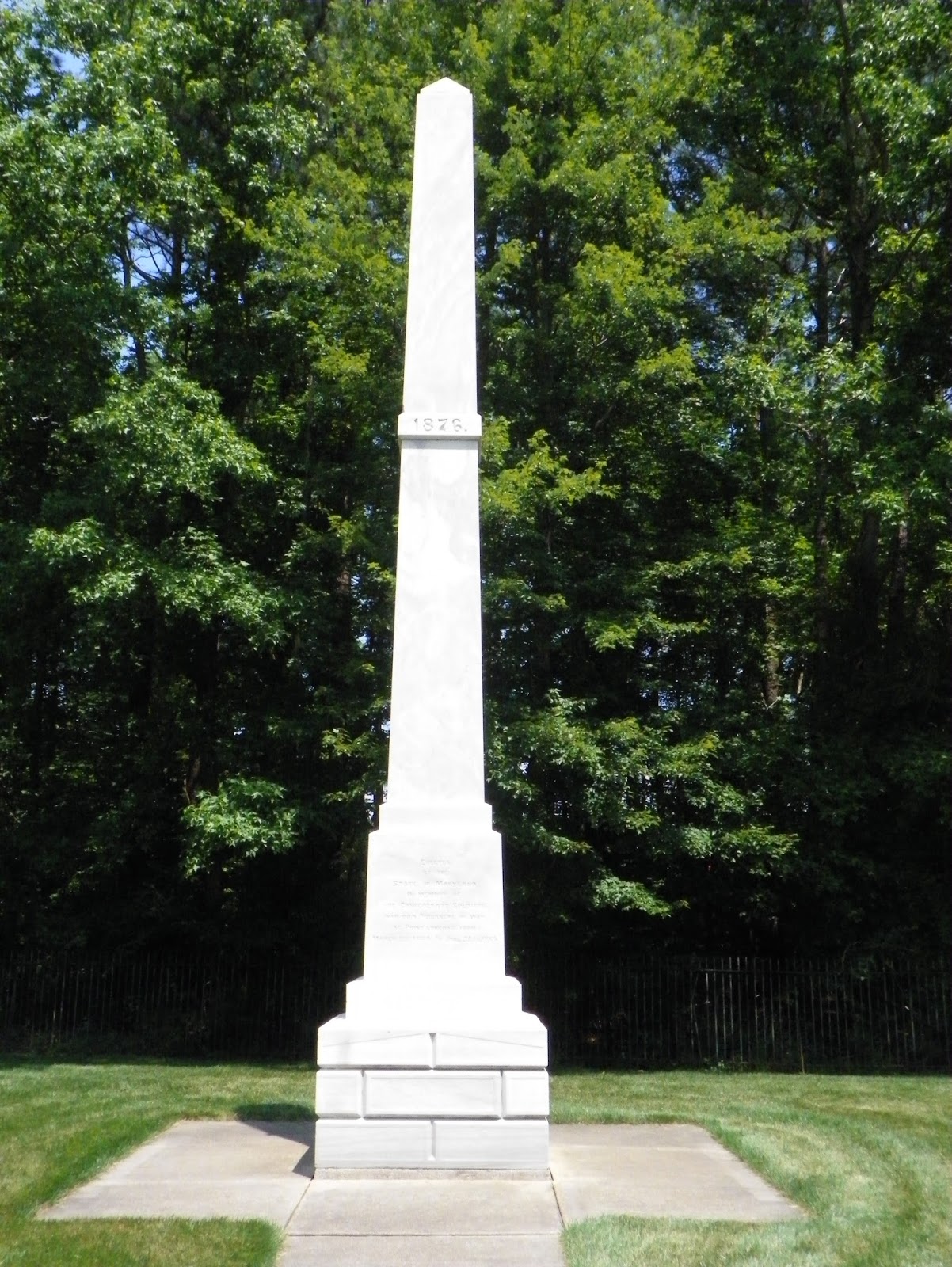
Maryland's Confederate memorial
A year after the Civil War ended, the U.S. Government gave up the lease to the point and tried to straighten up the neglected cemeteries. Some of the Union names had been lost to sand and erosion. The unknown were reburied with the known in their own enclosure, and later moved to a national cemetery (Arlington, I believe, but can't find the source).

The other four graveyards were consolidated on the Chesapeake Bay shore. The government bought that plot of land in 1867. The Confederate dead were moved two more times, along with a marble monument erected by the state of Maryland, eventually winding up in a mass grave in the nearby town of Scotland.

At least the government marked the grave, now on federal property, with an impressive monument and the earliest known names (NPS website).

Beitzell's book adds many names from other records. A simple wooden enclosure at the cemetery houses a binder with an updated list (look near the base of the flag).

Only tiny contraband flags to honor the dead
Because I grew up in our modern United States, I didn't notice at first that Confederate soldiers are buried under the flag of the "enemy." The War was doubly awful because people on both sides were Americans. What more appropriate place for a Confederate flag (or even both flags) than over those who died under it?

But a group of POW descendants noticed, and figured out a way to honor the dead.

The Descendants of Point Lookout POW Organization bought a piece of land right at the entrance to Point Lookout and built a Confederate Memorial. On private property.


Please excuse the plexiglass glare.
Beneath each of the original southern state flags is a plaque with a diary or letter excerpt from one of that state's POWs. Memorial bricks pave the ground, and the base of the statue houses an original "bean pot" from the prison camp.

I walked around and read some of the signs. As I read, fascinated by history about black soldiers and especially photos, I noticed a flyer next to the photos on the announcement board. The DOPL organization had scheduled a memorial service on Saturday. I would still be in town.

Thomas Maness didn't die at Point Lookout, but for the first time in my life, I realized I was the descendant of a POW.

Next (Sept. 20), part 3: A modern memorial

Monday, August 26, 2013

Point Lookout — Civil War prisons, part 1

I've seen Point Lookout many times as a beach, a lighthouse, and the end of the road on the Southern Maryland peninsula. This time, I saw it through Civil War history.* Why? Last year, DNA confirmed that Thomas Swain Maness really was my great-great-grandfather. While visiting friends in Maryland, I remembered that Thomas was a prisoner of war at Point Lookout.

After the Battle of Gettysburg in 1863, thousands of prisoners were marched or shipped to makeshift prisons that quickly overfilled. At Point Lookout — officially Camp Hoffman — the prisoners were crowded into tents on the beach, surrounded by a wooden palisade (upper right in the picture).

Courtesy of Library of Congress


Local history books paint Point Lookout as a concentration camp, with suspected motives of killing off the enemy. The tents were never replaced by buildings in the camp's two years of operation. Prisoners slept in outdoor temperatures with little firewood and inadequate clothing (some with only their underwear, some with no shoes). The beachfront water was bad and the camp's commander was accused of withholding rations. He refuted this, of course, and northern papers reported healthy conditions. Different sources agree that of more than 50,000 prisoners, around 4,000 died.

Hammond General Hospital dominated the tip of the peninsula. When a smallpox epidemic raged through the camp, a second hospital was built just for smallpox victims, doctors, and nurses from the Sisters of Charity. 

Oral history claims that Thomas Maness "was a nice boy before the War," but came back to North Carolina with a mean streak. Could Thomas' prison experience have contributed to that change as much or more so as the horrors of the battlefield? I wanted to know more. I stopped at all the historical markers on the peninsula, including the reconstructed Fort Lincoln. I visited the museum, which sells reprints of Point Lookout Prison Camp for Confederates, a reference book I'd glanced at in the Leonardtown Library. I couldn't find Thomas in the index, but this wonderful reference is an anthology of contemporary sources. Diaries, letters, newspaper articles, prisoner art, maps and a few photos. Daily life in the camp, written by those who lived it. I didn't have Thomas' timeline with me, but the detailed diaries could tell me what the weather was like while he was there. 

One thing I learned from skimming the book is that Maryland, with southern sentiments, wasn't allowed to secede. The federal government couldn't afford to let the state that nearly surrounds Washington, D.C. to join the enemy, so they blocked the polling sites and threw political opponents in jail.

After reporting for several issues in 1861 on large meetings of citizens to "consider the current crisis" and signs of military presence (extracts in the book mentioned above), the St. Mary's Beacon published a letter from General Dix in November stating that anybody who "appear[ed] at the polls to effect their criminal attempt to convert the elective franchise into an engine for the subversion of the Government" would be taken into custody. In other words, you can vote, but only one way.

The Beacon continued to report on the military occupation of St. Mary's County, until about April 1862 when Federal forces arrested one of the editors and the other escaped across the river to Virginia. The following October, the St. Mary's Gazette appeared, ascribing to be "a news and advertising sheet" and to avoid politics, until "the Federal Government shall deem it no longer necessary to pursue so extraordinary a policy as to impose restrictions upon the press...."

Next, Part 2: Burying prisoners of war

* This very un-Civil War has many names among Americans, including the War Between the States, the War of Northern Aggression, and the War of the Rebellion. I've used the term here that's easily recognizable, less partisan, and optimal for search engines.

Saturday, August 11, 2012

It's Him!! — DNA Genealogy Success

I got the e-mail today. Ms. Lessie's DNA results are in.

Image: FreeDigitalPhotos.net
I logged in to the Family Tree DNA site and clicked on "Matches" in the Family Finder box.

Two names were listed under close relatives. My uncle's name was number one.

Thomas Swain Maness is my great-great-grandfather.

I'm still trying to wrap my head around this — a lifetime goal, and here it is. My family has been looking for Thomas S. (Swain) since he disappeared in 1875. I was really discouraged when y-DNA testing showed no link between my uncle and one of Swain's cousins. But our Thomas and Ms. Lessie's grandfather Swain had too many things in common. So we never gave up.

While finding out was the goal, it's not the end. I'm on vacation right now without phone numbers and genealogy notes, so next week I'll tell Ms. Lessie and her son — our new cousins! — and hopefully plan a trip to meet them. The stories about Swain Maness will become part of our family lore.

I have a couple of other leads to follow. The two DNA tests tell me that:
- Swain was not biologically related to Abednego (and Shadrach, Meshach, and the other brothers).
- Swain told the truth about his name (Thomas S.), county, and age on his marriage license. Could he also have been telling the truth about his parents, the mysterious George and Mary (not found on censuses) instead of the oral-history Henry?

The best part was getting to call my uncle and tell him the news! He's been the third generation in this four-generation search, and he's encouraged me and helped in every way possible. Thanks, Uncle Oscar. Our great big genealogy gamble paid off!

-----
Note: Family Tree DNA is an affiliate site, which means if you're interested in DNA testing, I'd appreciate it if you'd click on the link above or the ad at right to go to their website.

Friday, August 03, 2012

So...Why a second DNA test when the first one failed?

I'm still waiting for the results of my great big genealogy gamble (follow-up posts here and here). No one has asked why I gambled on this second (autosomal DNA) test when the first (yDNA) test failed, but I'll explain, anyway.

For yDNA, you have to compare direct male descendants. If you can't read the scribbled chart that I used to help me think, here are the highlights:
  • Henry and Isaac Maness were brothers, sons of Abednego (possibly a triplet).
  • Henry's son Thomas Swain Maness (blue arrow - my suspected great-great grandfather) and Isaac's son Tommy were first cousins.
  • We compared yDNA between Tommy's grandson (Mr. Thurman) and my uncle. If Swain is our ancestor, they would be third cousins, once removed, and both direct male descendants.
They didn't match. In fact, we didn't seem to be even remotely related!


Here's why I didn't give up: 
  • The similarities are uncanny. Same name, same age, from the same county. Swain was rumoured to have several wives, including one in Randolph County. Both men were woodcutters by trade. Both were dark-haired or "black-headed" men.
  •  Most of this genealogical information is from oral history — it seems reliable because it's only second hand. Mr. Thurman lived to be 101, and his father told him this information! However, we have no primary sources for Swain's birth or family.
Swain was orphaned as a boy and reared by relatives. Was he really part of the Maness family? I looked at other DNA results in the Maness family project (a great resource, found through Family Tree DNA - aff link). I drew a blue line on my chart to show that Mr. Thurman matched a descendant of Seth, Abednego's brother. That confirms that Mr. Thurman was indeed part of the Maness family. No one in Henry's line, however, has been tested. There are several places in the family tree where a "biological incident" could have occurred (aka an illegitimate child). The best way to check would be to test one of Swain's descendants. But the only ones I've found, so far, are female.

In the past year, autosomal testing (Family Finder test) has taken off and I learned that we could now test one of Swain's granddaughters. The comparison is supposed to be reliable up to third cousins. If Swain is our ancestor, my uncle and Ms. Lessie would be first cousins, once removed.

New technology is opening up doors to genealogy that didn't exist when I started this blog, much less two decades ago when I started searching for Thomas S. Maness!

Saturday, July 21, 2012

DNA Genealogy: Drama and Suspense (part 2)

In my last post, I was waiting to hear back from Mitchell, a potential cousin through the MANESS family, about whether he or his mother would take the autosomal DNA test. The test I had already paid for.

Meanwhile, my uncle had been watching the mailbox for his test. A week passed. Then another. I tried to remember how long it had taken for our kit to arrive when we did the y-DNA test a couple of years ago. When he asked me about it for the third or fifth time, and over two weeks had gone by, I e-mailed Family Tree DNA to see if we needed to report a lost kit.

Mitchell returned my call. After talking with his mother, he thought her anxieties would be cured if I sent a notarized letter saying that I had paid for the test and they wouldn't get a bill or anything. I said: no problem, but I couldn't get to a notary until the end of the week.

He called me back in a few days, laughing. He had started reading "the Brady book," a family history that mentioned Sarah Brady and Swain Maness. "You know," he said, "I've heard these names all my life, but didn't know anything about them. This is interesting!"

He was hooked. (Could it be, the birth of another genealogy addict?) I mailed the letter June 29.

Family Tree DNA got right back to me. We didn't get a kit because they still had my uncle's cell sample from a couple of years ago. His test was already in progress!

I waited another week to hear back from Mrs. Lessie's family. Every few days I logged onto Family Tree DNA's site to see if their kit had arrived at the lab. Every time, I saw a warning that it had not been returned, so analysis could not begin. What now?

Finally, on July 14, I called Mitchell to check. Guess what? Mrs. Lessie's sister had talked her into it — "It's like that Brady book," she said — and that convinced her. They had just taken the kit to the post office that morning. Yay!!

I received an e-mail this week that the sample arrived at the lab, nearly a month after I'd placed my order. Now I can breathe again. I expect results in mid- to late-August.

My uncle says, "I think it's gonna be him."

Friday, July 20, 2012

DNA Genealogy: Drama and Suspense

My great big genealogy gamble had me holding my breath, and not just for the results.

Monday, June 18, I called Mrs. Lessie to confirm her willingness to take a DNA test, then I pulled out my credit card and paid for TWO autosomal DNA tests (Family Finder - affiliate link) — one for her and one for my uncle. I was so excited! (I plan to write a future post about why this test should tell us, once and for all, if Swain Maness is my missing great-great-grandfather.) I was a little nervous because Mrs. Lessie keeps forgetting who I am; I have to explain every time I call.

I should have been more than a little nervous.

Saturday, June 23, her son Mitchell called me. He explained that his mother has Alzheimer's. Fortunately I had asked her to write down my phone number, but she couldn't remember anything about that slip of paper with my name or number on it. Worse yet, the test kit had arrived and she was upset about it. She didn't want to take the test. Mitchell said, "Sorry, we can't help you."

My heart sank. When I could get a word in, I tried to explain what a big investment this was, and how my family had been searching for this man, perhaps his great-grandfather, for generations. He agreed to wait a few days and ask his mother again.

About two hours later, when my hands had stopped shaking, I had a brainstorm. Autosomal DNA has a good percentage for comparison up to third cousins — if Ms. Lessie wouldn't take the test, her son could do it!

I called Mitchell back and left a message. And waited...

Friday, June 22, 2012

My great big genealogy gamble

I found it! 

A quick recap for new readers: Shortly before my great-grandfather was born (in North Carolina), his father left to find a job in Virginia — and was never seen again. Paw carried a tin-type picture of his father, Thomas S. Maness, and searched for him all his life. I am the fourth generation trying to solve this mystery.

We think Thomas S. is Thomas "Swain" of Moore County, N.C.  I was so disappointed when a Y-DNA (male) comparison between my uncle and a man who reputedly shared ancestors with Swain turned up negative. Descriptions of both men are so close, we weren't ready to give up. Now that autosomal DNA can compare women and men, I wanted to compare the DNA of my uncle with Swain's granddaughter, Mrs. Lessie — one last try!

Mrs. Lessie agreed, but then I lost the key to my safe deposit box containing money for the expensive test. My uncle offered to pay to get a new key. Before we went to the bank, I decided to search one more time. I found it! Yay! Where? In one of the places I had already looked. Go figure.

I cashed my savings bond and called Ms. Lessie. I had to remind her again who I was. I verified her address, logged in to my FamilyTree DNA account, and ordered the tests!

At nearly $600, this is a big gamble. But if it solves our 137-year-old family mystery, it'll be worth every penny.
Or what woman having ten silver coins, if she loses one of them, does not light a lamp, sweep the house, and search carefully until she finds it? When she has found it, she calls together her friends and neighbors, saying, "Rejoice with me, for I have found the coin that I had lost." Mark 15:8-9

Sunday, March 25, 2012

DNA Genealogy Excitement!

As I've said in previous posts, I'm the fourth generation searching for our ancestor Thomas S. Maness, who disappeared from his family in Randolph County, N.C. in 1875. We suspect he may be Thomas "Swain" Maness of Moore County, who was married to several women (at the same time), including one in Randolph County. We tried testing Y-DNA (male family lines) to compare with his first cousin-once removed, and came up with no match. But the stories about Swain are so similar, and he was adopted by relatives — we can't help but question his undocumented parentage. I began to look for living direct descendants (instead of cousins), but found only females, including a granddaughter, Mrs. Myrtle (correction: I talked to Mrs. Lessie; Mrs. Myrtle is her sister).

A few weeks ago, I read more about DNA testing on the Family Tree DNA website. I hadn't realized that autosomal testing works with either gender. However, that portion of DNA gets more mixed up with every generation, so it's only useful for close relatives. Autosomal testing has a high reliability for comparing up to third cousins. I drew a little chart to see how close Ms. Lessie would be to us if Swain were our ancestor. I was stunned to realize she would be my grandfather's first cousin, and my living uncle's first cousin-once removed.

Thomas S. married my great-grandmother in 1874 when he was 25. Swain married Ms. Myrtle's grandmother in 1901 when he was about 50 and she was much younger. I hadn't realized that his children by different women, half-siblings, could be an entire generation apart.

Could DNA give us the answer we've been searching for for more than a century?

I have two obstacles.
1. The test costs $289. To compare, we would need a test for my uncle and a test for Ms. Myrtle — nearly $600! This is not a good time in my life to come up with that kind of money.
2. DNA testing can sound big-brotherish to some people. Would Ms. Lessie, who is 89 years old, consent to be tested?


Image by jscreationzs / FreeDigitalPhotos.net